Showing posts with label Georg Solti. Show all posts

Sunday, March 22, 2026

In "one of the mightiest shouts of human aspiration ever made in music," is this the most beautiful music ever? Or this? Or this?

Or, "FOUND" FREE MUSIC (SAMPLES), Part 2

In Part 1, we enjoyed Seattle Chamber Music Society's gift of the 1st movement of Schubert's String Quintet (plus bonus music). The unconscionably delayed Part 2 is inspired by a free video preview offered by the Berlin Philharmonic's Digital Concert Hall of the orchestra's January 2026 performances, under Chief Conductor Kirill Petrenko, of a work described by Deryck Cooke as "one of the mightiest shouts of human aspiration ever made in music," which the Philharmoniker hadn't played since opening night of the 2011-12 season, Sept. 18, 2011. -- Ed.
UPDATE: A new block of performances added from a special source
2nd UPDATE (Monday): Coming up next (at the end)
3rd UPDATE (later Monday): Semyon Bychkov on Mahler 8

There's a snatch on YouTube from that 2011 Berlin Phil performance under then-Chief Conductor Simon Rattle
[2:34] "Accende lumen sensibus" ("Kindle our senses with light")
[Eventually we're going to hear a little more of this performance.]

IN ALL LIKELIHOOD YOU ALREADY RECOGNIZE THE PIECE.
(IF NOT, WILL THIS LONGER EXCERPT GIVE IT AWAY?)


I've chosen an unusual start point. It just happens that this strategic moment is one of the most beautiful musical moments I know. Yes, yes, I say that, or words to that effect, a lot here. Why, it came up in Part 1 of this post, in the cases of both the first and the second movements of the Schubert C major String Quintet. In my defense, I would point out that since I'm in charge of the Sunday Classics program, and I get to choose all the music, an awful lot of it is music that's especially close to my heart.

Let's start by just listening through this little chunk I've carved out.
-- Ed.

"Imple superna gratia, gratia, quae tu creasti pectora"
("Fill with heavenly grace, grace, the breasts that thou created")


[4:10] Joyce Barker & Agnes Giebel (s), Kerstin Meyer (ms), Helen Watts (c), Kenneth Neate (t), Alfred Orda (b), Arnold van Mill (bs); Charles Spinks, organ; BBC Chorus, BBC Choral Society, Goldsmith's Choral Union, Hamp­stead Choral Society, Emanuel School Boys' Choir, Orpington Junior Sing­ers, "much-augmented" London Symphony Orchestra, Jascha Hor­en­stein, cond. Live performance from the Royal Albert Hall, Mar. 20, 1959

by Ken

In this case, the sheer beauty of the musical moment seems to me to have a crucial structural purpose, which is why I've made this seriously varied assortment of performance clips. And they really are very different -- in pacing, obviously (I've arranged them in "length" order, but performances that are closest in length may be the most different in everything else -- flow, tone(s), color(s), emphasis. Some of them may be barely recognizable as the same music. In each case, though, I encourage you to take note of how your experience is affected by the first voice we hear -- and to a lesser extent the second, and then the third, fourth, and fifth, who enter together. But especially the first, who not only introduces this melody but throughout the movement we're sampling will be sailing and soaring over the musical staff and over the ensemble.

If there's one thing our composer knew, it was voices. He spent the major part of his career in the pit of opera houses. But that didn't incline him to make life easy for singers when he wrote for them. It's more that he had ideas about how he could stretch those voices. In this case, for his top voice, the first soprano, he understood that coming in un-warmed-up she couldn't be asked to leap straight to high B-flats and Cs, and at first asked her only to show great fluidity and tonal sheen and be able to sustain crucial high A-flats. But gradually he worked in the B-flats and, yes, a couple of sustained high Cs.

Sunday, April 17, 2022

Quite right, Sir Georg: We'll need to hear not just Haydn's orchestral depiction of "pre-Creation" chaos but the "breathtaking" explosion when suddenly "there was light!"

[PLUS: Some serial aural remembrances of Kurt Moll]

[MONDAY EVENING UPDATE: Now with various sorts of upgrading, to bring the post a tiny bit closer to what I'd hoped to make -- notably fleshing out the section of Moll archival clips, with English text added, along with minimal comments and some non-Moll performances]

CHORUS: "Und es ward licht!" ("And there was light!")
[from "The First Day," in Part I of Haydn's Creation]

"I can think of no other work by any composer in which a single chord comes as such a surprise." -- Georg Solti (see below)

Bavarian Radio Chorus and Symphony Orchestra, Leonard Bernstein, cond. DG, recorded live in the Herkulessaal of the Residenz, Munich, June 1986

Stockholm Radio Chorus, Stockholm Chamber Chorus, Berlin Philharmonic, James Levine, cond. DG, recorded in the Jesus-Christus-Kirche, December 1987

Chicago Symphony Chorus and Orchestra, Sir Georg Solti, cond. Decca, recorded live in Orchestra Hall, Oct. 29-30 & Nov. 2, 1993

"A personal note by Sir Georg Solti" -- from the CD booklet for his 1993 re-recording of Haydn's Creation

The older I get, the more deeply I love the genius of Haydn, especially his two late oratorio masterpieces, The Creation and The Seasons.
In re-recording The Creation, I was struck by the incredible modernity as well as the startling originiality of so much of the score. To mention just two examples: the opening "Representation of Chaos," with music that so poignantly symbolizes the emptiness and hopelessness before creation; and, immediately thereafter, the breathtaking C major of "Light." I can think of no other work by any composer in which a single chord comes as such a surprise. How completely I can understand the reactions at the first public performance, as my friend Robbins Landon so well describes in his article [a reprint in the CD booklet of a long, wide-ranging background piece by the great Haydn scholar H. C. Robbins Landon].

I was joined in my excitement and passion for this work by all my colleagues, soloists, orchestra and chorus alike. Rarely can I recall such exuberant joy and sheer enchantment as we shared during these Chicago concerts. I hope this will come across to the listener.


[Note: In the first paragraph I've taken the shocking liberty of reversing the order of Sir Georg's reference to the great late-Haydn oratorios, so that The Creation comes before The Seasons, as they did in real life. Is it possible that an editor suggested this to him c1994? I don't think so; I think he'd not only have approved but been grateful. Now I'm afraid it's too late to ask. -- Ed.]
by Ken

I was surprised how moved I was re-encountering this "personal note" from Georg Solti (1912-1997) about his experience re-recording Haydn's Creation -- days after his 81st birthday. In that late period of his life he memorably re-recorded a number of big vocal works that were clearly close to his heart, some of which had gone just fine in his earlier efforts -- I think in particular of Mozart's Così fan tutte and Magic Flute and Verdi's Falstaff; the latter two, notably if possibly coincidentally, are works that as a fledgling conductor in the 1930s he had helped Arturo Toscanini prepare at Salzburg) -- and others, at least to me, not so fine, like Mozart's Don Giovanni, Wagner's Meistersinger, Verdi's Otello -- and The Creation. (Among those happy late-life "big works" recording projects we should note as well Sir Georg's companion recording, this one his first ever, of Haydn's final "big work," The Seasons.)

What's so moving about Solti's Creation note is that it rings so true. "The older I get, the more deeply I love" declarations are so common as to be commonplace as applied to, say, Mozart, but Haydn [seen here as sculpted on the Frieze of Parnassus, encircling the base of London's Albert Memorial -- from the blog London Remembers], not so much. In fact, real imaginative identification with Haydn isn't common at all. A lot of performers you sense approach Haydn's music as kind of like Mozart's only not quite -- an approach that hardly ever works. We can talk about this more after we've heard today's Creation clips.

For those who weren't here for yesterday's preview post ("I won't go out on a limb and say this is the most beautiful bass voice I've ever heard, or this the most beautiful minute-and-a-half of singing. Then again --"), the explosions of light we "heard" above are from the same recordings of The Creation I teased therein, offering their accounts of the remarkable hushed lines uttered by the angel Raphael -- the first singing heard in the oratorio, Haydn's setting of some of the most famous words in the human record, the opening of the Book of Genesis.

The plan for today, in addition to filling in the somehow-missing performer identifications (notably of the bass soloists), was to fill in Haydn's introductory orchestral depiction of the chaos out of which the world would be created. Now in addition, inspired by Sir Georg's personal note, I've realized we also have to continue on a few extra minutes, to hear God conjure up light. I've remade the ready-made audio clips accordingly.

Saturday, April 16, 2022

Preview: I won't go out on a limb and say this is the most beautiful bass voice I've ever heard, or this the most beautiful minute-and-a-half of singing. Then again --


Bavarian Radio Symphony Orchestra, Leonard Bernstein, cond. DG, recorded live in the Herkulessaal of the Residenz, Munich, June 1986

by Ken

Wait, there seem to be a few bits of information missing from the above credits! Hmm, let's think . . .

Well, one thing we could do is fill in the missing information tomorrow, when we hear a more properly contextual version of this breathtaking musical moment -- anyway, it's been taking my breath away for some 35 years now, especially in video form via an ancient VHS tape -- and I explain (more or less; you know how this trying-to-explain business usually goes) how I happened to settle on this as a topic that might bring us (finally!) to a state of postability.


AS LONG AS WE'RE AT IT, THERE ARE TWO OTHER
PERFORMANCES IT'D BE USEFUL FOR US TO HEAR


They're all different, our three performances -- well, two of them not so much in this excerpt; their differences will become clearer when we hear the fuller-context versions. Even now, though, I think we can agree that one of the performances is more different from the other two -- in more ways than one.


Berlin Philharmonic, James Levine, cond. DG, recorded in the Jesus-Christus-Kirche, December 1987

Chicago Symphony Orchestra, Sir Georg Solti, cond. Decca, recorded live in Orchestra Hall, Oct. 29-30 & Nov. 2, 1993

When we resume, we're also going to have a personal note on The Creation from one of our three conductors, who was making his second recording of the piece. On account of that personal note I've wound up having to redo, in a more expansive direction, the other "expanded-context" clips. (It so happens that one of our other conductors was also making his second recording of The Creation. See how complicated this gets? Maybe I can scrounge up a personal note from him too! Or maybe his re-recording will have to speak for itself.)

UPDATE: Find the main post here, and a follow-up post here pondering the unexpected role recorded by Kurt Moll which set these posts in motion.
#

Sunday, March 20, 2022

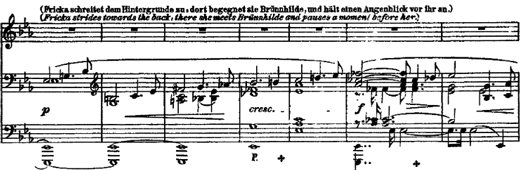
Preview: Fricka vs. Wotan --
The final confrontation*

*When we get to the main post, you'll see that we can maybe think of this as "Part 1a" of our Josephine Veasey remembrance.

Or: How Fricka & Wotan get from "Example 1" --


to "Example 2" --


Both clips: Berlin Philharmonic, Herbert von Karajan, cond. DG (1966)

by Ken

In a moment we're going to hear fuller versions of the above "examples," and in multiple performances. First I should explain, though, that (ever so unusually!) we're encountering a mild detour. I thought we would be continuing with the remembrance, begun two weeks ago, of the fondly remembered English mezzo Josephine Veasey (tentatively labeled "Part 1?"), and I've been pondering some intereting repertory. What I should have realized is that the chances were never great that we might tiptoe past the great Fricka-Wotan scene of Act II of Die Walküre with just a polite wave. Sure enough, I got sucked in.

Some of it had to do with the curious moment in time we stumbled into with the Covent Garden Walküre we sampled, from late September 1965, in which Veasey sang Fricka with Georg Solti conducting, as he was weeks away from heading to Vienna to complete the Ring recording, the first ever, with Walküre, with Christa Ludwig as Fricka, even as Herbert von Karajan was preparing to being the second-ever Ring recording the following year with, of all things, Walküre -- and with, of all people, Josephine Veasey as Fricka both in Walküre and, the following year, Das Rheingold. Meanwhile, when Karajan actually launched Ring stage production, in 1967 at the brand-new Salzburg Easter Festival (engineered by guess-who), the Fricka of the broadcast was not Veasey but Ludwig, who was also Karajan's Fricka when he brought the Salzburg Walküre production to the Met that fall! So I've been rooting around among this material, trying to hear what there is to hear.

Some of this we're going to hear in this week's main post, currently in production -- along with some of the other material I've retrieved from the Sunday Classics Archive, I mentioned in last week's under-construction post. Plus, I actually wound up typing out an English text for the whole Fricka-Wotan scene, which again has entailed all manner of complications -- and opportunities.


FOR NOW LET'S JUST HEAR OUR ASSORTED TAKES
ON THAT FULLER VERSION OF EXAMPLES 1 AND 2


Sunday, March 6, 2022

Josephine Veasey (1930-2022) [part 1?]

TUESDAY UPDATE: The Dido and Aeneas clip was too important to be left sounding so crummy. I swallowed hard and did what had to be done to upgrade it. I feel better. -- K
FOLLOW-UP UPDATE: The promised synopsis of the Walküre Act II Fricka-Wotan scene, time-cued to our audio clip, is in place, for better or worse (or both). -- K again


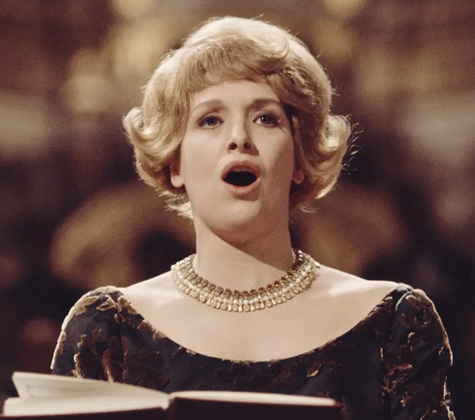
The fine London-born mezzo, retired since 1982, died Feb. 22 at 91.
Recit., Dido: Thy hand, Belinda. Darkness shades me;
on thy bosom let me rest.
More I would, but death invades me;
death is now a welcome guest.

Song: When I am laid in earth,
may my wrongs create
no trouble in thy breast.
When I am laid in earth, &c.
Remember me, remember me, but ah! forget my fate.
Remember me, but ah! forget my fate. &c.
-- libretto by Nahum Tate, based on Book IV of Virgil's Aeneid

["When I am laid in earth" at 1:04]
Josephine Veasey (ms), Dido; John Constable, harpsichord; Academy of St. Martin in the Fields, Colin Davis, cond. Philips-Pentatone, recorded in Walthamstow Assembly Hall, Aug. 5-8, 1970
[TUESDAY UPDATE: The new clip sounds swell, I think. Phew! -- Ed.]

by Ken

If you've listened to the clip of the not-quite-conclusion (the chorus still has some obligatory moaning to do) of Purcell's amazingly concise opera Dido and Aeneas, I'm thinking there's not much chance you'll forget Josephine Veasey. With that generous midrange vocal weight (and the needed upward reach too), not something we necessarily expect in a Purcell Dido, she makes those "Remember me"s pretty unforgettable.

The thing is, for anyone who had significant experience of her singing, there wasn't much chance she was going to be forgotten, thanks to the generous aural documentation of her fine 30-year career -- her significant body of commercial recordings supplemented by an array of good-quality live-performance material. She's never been out of my "listening rotation." As it happens, I'd just recently been resampling with undiminished pleasure her Béatrice in the first-ever recording of Berlioz's opera Béatrice et Bénédict. (Don't worry. Though we've heard the clip of Béatrice's heart-rending -- but ultimately inspiring -- Act II monologue before, we're going to be hearing it again momentarily.)


SOME COMMEMORATIVE ROADS NOT TAKEN

I hope the Dido excerpt isn't too "on the nose" for a "remembrance" piece, though I like to think she wouldn't mind being remembered for such classy piece of singing. Initially, as I thought about this piece, I expected it to open with a taste of her Fricka, specifically the Walküre Fricka. As longtime readers may recall, I'm a big fan of her Fricka, and we've heard samples of the very different Rheingold and Walküre roles, one of the unalloyed casting successes of the Karajan-DG Ring cycle. Again, don't worry, we're still going to hear that -- and not from the Karajan recording. In fact, we're going to hear a complete performance of the great Fricka-Wotan scene of Act II of Die Walküre, with the conductor most responsible for grooming her as a legit Wagnerian.

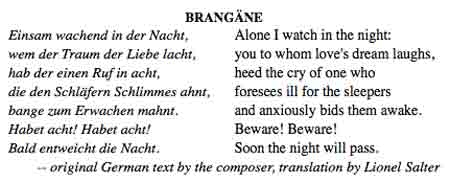
Alternatively, we could have opened with a different Wagner excerpt, if only for the sheer beauty of the singing, though with Veasey, at least in my hearing experience, "characterfulness" was never a separate thing from vocal production.


Josephine Veasey (ms), Brangäne; BBC Symphony Orchestra, Colin Davis, cond. Recorded for broadcast, 1969

Wednesday, January 27, 2021

Inaugural Edition, no. 3: While I toil away at this week's Inaugural-themed post, let's hear the end of The Magic Flute in our five performances -- plus a couple of "new" ones

There doesn't look to be much sense of danger from this, er, highly decorative band of conspirators: John Easterlin as Monostatos, Kathryn Lewek as the Queen of the Night, and Deborah Nansteel, Sarah Mesko, and Jacqueline Echols as the Second, Third, and First Ladies, as designed by Jun Kaneko in a joint production by five American opera companies, seen here at Washington National Opera in 2014. (Photo by Scott Suchman)
A rocky landscape. Night. The dark-spirited MONOSTATOS has entered stealthily with the QUEEN OF THE NIGHT, accompanied by her THREE LADIES carrying torches. There is thunder, and the sound of water.

MONOSTATOS: But hush, I hear a terrible rushing
like rolling thunder and a waterfall.
THE QUEEN and THE LADIES: Yes, fearful is this rushing,
like the distant echo of thunder!
MONOSTATOS: Now they are in the hall of the temple.
ALL [variously]: There we will fall upon them,
exterminate the pious ones from the earth
with glowing fire and mighty sword.
THE THREE LADIES and MONOSTATOS:
To you, great Queen of the Night,
let our revenge be brought as a sacrifice.
[There is loud thunder and lightning, followed by streaming holiness.]
THE QUEEN, THE THREE LADIES, and MONOSTATOS:
Shattered, destroyed is our might!
We are all plunged into eternal night!
[They sink into the ground.]

Change of scene (without curtain): The Temple of the Sun. SARASTRO stands elevated on an altar, TAMINO and PAMINA in front of him, both in priestly clothing. Beside them the priests of Egypt on both sides. THE THREE BOYS hold flowers.

SARASTRO: The rays of the sun drive away the night,
destroy the dissemblers' ill-gotten might.
CHORUS: Hail to you initiates!
You penetrate the night.
Thanks, thanks, thanks be to you, Osiris!
Thanks brought to you, Osiris!
[Allegro]
Strength conquers and crowns as reward
Beauty and Wisdom with an eternal crown!

Martti Talvela (bs), Sarastro; with Gerhard Stolze (t), Monostatos; Cristina Deutekom (s), Queen of the Night; Hanneke van Bork (s), Yvonne Minton (ms), and Hetty Plümacher (c), Three Ladies of the Queen of the Night; Vienna State Opera Chorus, Vienna Philharmonic, Georg Solti, cond. Decca, recorded 1969

Samuel Ramey (bs), Sarastro; with Aldo Baldin (t), Monostatos; Cheryl Studer (s), Queen of the Night; Yvonne Kenny (s), Iris Vermillion (ms), and Anne Collins (c), Three Ladies of the Queen of the Night; Ambrosian Opera Chorus, Academy of St. Martin in the Fields, Neville Marriner, cond. Philips, recorded July 1989

Kurt Moll (bs), Sarastro; with Robert Tear (t), Monostatos; Luciana Serra (s), Queen of the Night; Marie McLaughlin (s), Ann Murray (ms), and Hanna Schwarz (ms), Three Ladies of the Queen of the Night; Leipzig Radio Chorus, Staatskapelle Dresden, Colin Davis, cond. Philips, recorded January 1984

Franz Crass (bs), Sarastro; with Friedrich Lenz (t), Monostatos; Roberta Peters (s), Queen of the Night; Hildegard Hillebrecht (s), Cvetka Ahlin (ms), and Sieglinde Wagner (ms), Three Ladies of the Queen of the Night; RIAS Chamber Chorus, Berlin Philharmonic, Karl Böhm, cond. DG, recorded June 1964

Matti Salminen (bs), Sarastro; with Peter Keller (t), Monostatos; Edita Gruberová (s), Queen of the Night; Pamela Coburn (s), Delores Ziegler (ms), and Marjana Lipovšek (c), Three Ladies of the Queen of the Night; Chorus and Orchestra of the Zürich Opera House, Nikolaus Harnoncourt, cond. Teldec, recorded November 1987

by Ken

When last we met ("Post tease: Sarastro sings a mouthful when he sings, 'The sun's rays drive away the night'"), I was presenting the first of my three musical expressions of feelings I felt on Inauguration Day, namely the tiny block of two lines we had heard five notable Sarastros sing this tiny bit of the dénouement of The Magic Flute now heard buried in the above clips from the same five recordings, which we're hearing now in their proper context: the final minutes of Mozart's Magic Flute.

Our starting point last time comes a little after the one-minute mark.)
SARASTRO: The rays of the sun drive away the night,
destroy the dissemblers' ill-gotten might.

Martti Talvela (bs), Sarastro; Vienna Philharmonic, Georg Solti, cond. Decca, recorded 1969

Samuel Ramey (bs), Sarastro; Academy of St. Martin in the Fields, Neville Marriner, cond. Philips, recorded July 1989

Franz Crass (bs), Sarastro; Berlin Philharmonic, Karl Böhm, cond. DG, recorded June 1964

Matti Salminen (bs), Sarastro; Zürich Opera House Orchestra, Nikolaus Harnoncourt, cond. Teldec, recorded November 1987


WAIT, ISN'T THERE ONE MISSING?
SHOULDN'T THERE BE FIVE CLIPS?


Sunday, January 24, 2021

Inaugural Edition, no. 2: Post tease: Sarastro sings a mouthful when he sings, "The rays of the sun drive away the night"

UPDATED WITH AN ALARMING QUANTITY OF POST-POSTING
THOUGHTS ABOUT THE PERFORMANCES WE HEAR HERE


SARASTRO: The rays of the sun drive away the night,
destroy the dissemblers' ill-gotten might.

Martti Talvela (bs), Sarastro; Vienna Philharmonic, Georg Solti, cond. Decca, recorded 1969

Samuel Ramey (bs), Sarastro; Academy of St. Martin in the Fields, Neville Marriner, cond. Philips, recorded July 1989

Kurt Moll (bs), Sarastro; Staatskapelle Dresden, Colin Davis, cond. Philips, recorded January 1984
Franz Crass (bs), Sarastro; Berlin Philharmonic, Karl Böhm, cond. DG, recorded June 1964

Matti Salminen (bs), Sarastro; Zürich Opera House Orchestra, Nikolaus Harnoncourt, cond. Teldec, recorded November 1987

by Ken

As I mentioned in Wednesday's Sunday Classics "Inaugural Edition," I had very powerfully in mind some musical thoughts beyond the two noble marches we listened to, and I mentioned in particular moments from The Magic Flute and Pelléas et Mélisande. Add to that list Schoenberg's Gurre-Lieder, and you've got today's post laid out.


POST-POSTING THOUGHTS ABOUT THE PERFORMANCES
[NOTE (for those who saw my earlier note): The audio clips have now been resequenced to match (I think!) the order of discussion below.]

Friday, August 7, 2020

You remember those clips of Siegmund's monologue I mentioned?* Just for laughs, let's see what happens if I try to "publish" them

"A sword my father promised me": Stuart Skelton as Siegmund, so starkly alone and defenseless, literally and figuratively in the dark, in Seattle, 2012 (set by Thomas Lynch, photo by Elise Bakketun)

by Ken

Okay, this is maybe actually just possibly working, in a very limited way.*

[*To understand what I'm talking about, you would need to have read my earlier doom-engulfed outpouring. I'm not necessarily recommending it, I'm just saying.]

Much to my surprise, we've got the Walküre clips posted (I'll bet you thought I was making it up, about having them made and ready to go!), and I've successfully -- as far as I can tell -- taken the further step of adding the promised English texts, though typographically I can't help feeling that this is sort of the way Ben Franklin would have cobbled his blog together. Still, if it works, it works! (You'll notice that I've even managed to add images to the previous post and this one.) There's time ahead for contemplating the implications, if any.

So let's go ahead, in pursuit of our listening project, and listen to Siegmund's monologue from Act I of Die Walküre; then we'll rehear Florestan's Act II monologue from Fidelio sung by the same three tenors. The idea is to see whether, and in what ways, we can hear the strong vocal kinship between the roles of Florestan and Siegmund. First off, we're hearing, twice each, probably the two most notable Siegmunds since Melchior, Jon Vickers and James King, and then we'll hear no-sort-of-dramatic-tenor at all but instead that jack-of-all-tenor-trades Plácido Domingo.

The plan then, in the event that we can actually get away with this much madness, is to retrieve from last week's post ("The Minister is coming! The Minister is coming! Don Fernando and the lesson of Fidelio, Part 2) the Vickers, King, and Domingo performances of Florestan's monologue.

NOTE ON THE EDITING OF THE AUDIO CLIPS: This bothered me while I was doing it, and it bothers me now. Normally with multiple clips of a selection, I try to make them start and stop at pretty much the same points. In this case, though, with all six sources containing Siegmund's monologue by itself on a single CD track, in the interest of sanity I just went with the CD track placements; doing otherwise would have involved having, for all six versions, the preceding and following tracks at hand in case it proved necessary to edit in bits from them. I sorta wish I'd done it that way. (On second thought, maybe not. As it turns out, the clips start in pretty much the same place, though the King-Böhm and Domingo-Barenboim go back a bit farther. More importantly, the King-Böhm continues on significantly farther, and if I'd done the editing as per "rule" it might regrettably not have -- see below.)

WAGNER: Die Walküre: Act I, Scene 2, Siegmund's monologue
("Ein Schwert verhiess mir der Vater")

Sunday, April 26, 2020

Spun off from today's main post: All of Mahler 5!

Today's main post, "We hear the kinship between the Adagietto of Mahler 5 and 'Ich bin der Welt abhanden gekommen,' right? How about the differences?," is here.


The legendary Adolf Herseth, the Chicago Symphony Orchestra's trumpet principal for an amazing 53 years (1948-2001, plus three more in "emeritus" status!), launches the opening "Funeral March" of Mahler 5 in recordings made near the beginning and end of Georg Solti's 22-year tenure as music director -- the first in Chicago's Medinah Temple in March 1970, the second a CSO-on-tour performance recorded live in Vienna's Sofiensaal Nov. 30, 1990 (where you'll note that Sir Georg, as he'd been since 1972, is much more attentive to Mahler's dynamic marking of p [soft] for the first two bars, with sudden sf attacks just on the downbeats).

"Those closest to Mahler found the Fifth Symphony a particularly speaking likeness of his personality, and he too may therefore have wanted to make it as accurate as possible a self-portrait of himself in a particularly happy period of his life."
-- William Mann, from a booklet note on Mahler 5 (©1969)

by Ken

As I wrote in today's main post, "We hear the kinship between the Adagietto of Mahler 5 and 'Ich bin der Welt abhanden gekommen,' right? How about the differences?":
DON'T TELL ANYONE, BUT REMEMBER HOW I SAID
THAT WE REALLY NEED TO HEAR ALL OF MAHLER 5?


I've already made up audio clips for two complete performances. I may yet spin this off into a separate post, or postlet, with some added comment. But for now, here it is.
No, here it is, all spun off!

We're not going to attempt anything fancy here. The idea is just to be able to hear the whole of Mahler 5. As I noted in today's main post, as quoted above, the audio clips were all made and ready to roll: of two performances, a 2002 live one by Lorin Maazel and the Bavarian Radio Symphony Orchestra and the 1947 recording by Bruno Walter and the New York Philharmonic that features in today's earlier post. We're just going to hear them part by part, each part prefaced by some helpful guidance from critic William Mann (from the same booklet note on the symphony which is quoted from above).


WE'LL START WITH A QUICK OVERVIEW FROM W.M.
Mahler's division of the Fifth Symphony into three parts but five movements is not one of convenience alone: the first and second movements are materially connected, and the finale takes some of its subordinate themes from the Adagietto; the central Scherzo stands alone, longer than the rest, effectively carrying the main symphonic weight of the piece. This Scherzo is in D major, so is the Finale, and it would be right, I think, to feel the whole symphony as being in D major. Part I of the symphony begins in C-sharp minor and ends in A minor: its two movements form a sort of prologue to the rest of the symphony, in which Mahler postulates a series of pessimistic ideas and argues them symphonically until they seem to be conquered by the bright, clean light of D major which is glimpsed in the second movement and emerges with the scherzo. -- W.M.

NOW LET'S HEAR THE SYMPHONY!

Sunday, February 23, 2020

"On the breath of a fragrant breeze": More from Mirella Freni


After singing Nannetta at Covent Garden in 1961 (with Carlo Maria Giulini conducting), Freni made her La Scala debut in the role in January 1962 -- alongside Luigi Alva as Fenton. [photo by Erio Piccagliani © Teatro alla Scala]
FENTON [singing as he goes out]:
Kissed lips don't lose their good fortune.
NANNETTA [continuing FENTON's song as she joins the other women]: Instead they renew themselves as does the moon, as does the moon.

Luigi Alva (t), Fenton; Mirella Freni (s), Nannetta; Concertgebouw Orchestra (Amsterdam), Carlo Maria Giulini, cond. Live performance from the Hague, June 20, 1963

by Ken

If you were here for last week's first installment of a Mirella Freni remembrance, you know our immediate destination. Following the tease of one of the amazing stolen moments between Nannetta and her adored Fenton thrread through the first Garden Scene of Verdi's Falstaff, we have on promise "Nannetta's shimmering aria in her disguise as the Queen of the Fairies in the magical masquerade final scene."

So let's listen just to the aria, which just happens to have been included in that 1959 Eurodisc operatic recital we heard from last week. As part of the tormenting of Falstaff planned by our Merry Wives of Windsor, Sir John has been lured to the scary depths of Windsor Park at midnight for what he expects to be a tryst with Mistress Alice Ford. For this scheme, Mistress Ford has cast her radiant daughter Nannetta as the Queen of the Fairies.

VERDI: Falstaff: Act III, Scene 2,
Nannetta, "Sul fil d'un soffio etesio"

NANNETTA: On the breath of a fragrant breeze
fly, nimble spirits;
through the branches appears
the blue gleam of the rising moon.
Dance! and let your soft steps
fit the soft music,
joining magic
dancing to the song.

Let us wander beneath the moon,
choosing among the flowers;
every blossom carries
in its heart its own fortune.
With lilies and violets
let us write secret names;
from our enchanted hands
let there spring words,
words illuminated
with pure silver and gold,
poems and charms. The spirits
have flowers as their cyphers.
[translation by Lionel Salter]

Munich Radio Orchestra, Ino Savini, cond. Eurodisc-Vanguard Cardinal, recorded 1959


WE'RE NOT GOING TO GET FARTHER TODAY, BUT WE CAN
AT LEAST HEAR THE SCENE AS IT OCCURS IN THE OPERA


Monday, January 7, 2019

Yes, we're going to do a bit more Rheingold business, but first we have to solve a Mystery Baritone conundrum

Our watchword for the day: Remember the Crams!

Showbiz greats Phil Silvers and Nancy Walker catch their breath during the recording of the cast album of the Styne-Comden-Green musical Do Re Mi -- on Jan. 8, 1961, say my sources, though it's often listed as "1960." (The show opened on Dec. 26, 1960.) Of course, what I'm calling "my sources" is actually the first Web page I found which gave an actual date, so who knows? I just now found a site that says: "First LP release: December 30, 1960." Hmm, that'd make for mighty tight scheduling if the recording didn't happen till Jan. 8.)

From the OBC recording session we're going to have a special little "Sunday Classics Do Re Mi suite," whose connection to our subject will, I hope, be clear. The suite will include this song that we heard Sunday:

STYNE-COMDEN-GREEN: Do Re Mi: "Take a job" (The Crams)

Nancy Walker and Phil Silvers (Kay and Hubie Cram), vocals; OBC recording, Lehman Engel, cond. RCA, recorded Jan. 8, 1961

by Ken

As noted in the post title, in this, the "actual" post for this week, we are going to transact a bit more Das Rheingold business, continuing from Sunday's "tease" post, but maybe not so much as I was thinking when I posted that tease.

I might say that thanks to the stratagem of the tease post, and to your kind indulgence, once I had the tease posted I was able to salvage one out of the two movies I had tickets for today in the Museum of the Moving Image's current "Curators' Choice 2018" series, and better still, it was a humdinger: Paul Dano's first film as director, Wildlife, adapted from the Richard Ford novel by him and his partner, Zoe Kazan, who were both on hand for a post-screening discussion along with two actors from the terrific cast.

As I mentioned we're going to hear a little "suite" of Do Re Mi excerpts, which I think is relevant to our area of food-service inquiry. In addition, though, while I was at my clip-making, I did a couple of additional Do Re Mi numbers, written for a legit baritone. One of these numbers is quite famous; Wikipedia lists 23 performers who have also recorded it.

Act I, "I know about love" (John Henry Wheeler)

Act II, "Make someone happy" (John Henry Wheeler)

Mystery baritone (John Henry Wheeler), vocals; OBC recording, Lehman Engel, cond. RCA, recorded Jan. 8, 1961


SO WHO IS OUR HAPPY-MAKING MYSTERY BARITONE?

Sunday, September 9, 2018

On an operatic bad day you can sometimes see forever -- but oftentimes not

"Wicked world. -- There's no more virtue. -- Everything's in decline."
-- A man who knows a thing or two about, you know, things

A man staggers up to an inn . . .

The exterior of the inn, which along with its name bears the motto: "HONNY SOIT QUI MAL Y PENSE." A bench beside the door. It's the hour of twilight.

Our man is seated on the bench, meditating. Then he stirs himself, pounds on the bench with a big fist, and turning toward the interior of the inn calls to the host.


by Ken

Even if we make clear that by "an operatic bad day" I don't mean a bad day for the audience (of which I often feel I've experienced not just my own share but a whole bunch of other people's) but a bad day for the main character(s) onstage, it may seem oxymoronic to be talking about "operatic bad days." Aren't they mostly pretty rotten? Isn't this what opera is usually about? Isn't it a significant part of what we normally think it means for something to be "operatic"?

The kind of bad day I'm thinking of, though, isn't just a day when everything seems to go wrong, even disastrously wrong. I'm thinking of the kind of day when the victim realizes that he/she has played a major role in setting off the unfortunate chain of events, and as a result, despite a certain lack of totally accurate perspective, owing to the inevitable bleakness of spirit, sees truth(s) stretching out as far as the imagination can see.

The part about the victim realizing that he/she has played a major role in setting off the unfortunate chain of events clearly excludes out companion today. In Sir John Falstaff's imagination nothing is his fault, and never mind that it was his own crackpot scheme to seduce one or maybe two of the merry wives of Windsor, not even for libidinous satisfaction but to tap into their not-so-merry husbands' coffers to provide himself with a bit of working capital, blindly falling into separate traps set by both the women and men of Windsor, that resulted in his being dumped unceremoniously into the Thames in that giant basket full of rank laundry.


SIR JOHN'S FEELING OF VICTIMHOOD CERTAINLY
IS EPIC, THOUGH -- RUNNING DEEP AND, ER, WIDE


Sunday, June 24, 2018

'In modo di canzona': If it's singing we aim to talk about, how come we're listening to 'Le Tombeau de Couperin'? (Part 1)

Hints: It has to do with: (1) a birthday-gift concert of the Chamber Music Society of Lincoln Center and (2) the 2013 Carnegie Hall master class of master oboist Albrecht Mayer

Note: Updated with some expansions and Sunday Classics links,
notably in the section on the Brahms First Symphony


What is it?
The oboe is a woodwind instrument in the double reed family. It has a conical bore and a flaring bell, which gives it a clear, penetrating voice compared to other woodwind instruments. A person who plays the oboe is an oboist.
by Ken

And not just Ravel's Tombeau de Couperin, which I can reveal was included (in an unexpected form) in the above-hinted-at Chamber Music Society of Lincoln Center concert, which set off this whole line of inquiry. No, for reasons that will eventually become clear (though perhaps only clearish this week), we've also got music by Tchaikovsky, Brahms, and Rossini, none of it with any singing -- and never mind (maybe?) that all four of these are composers for whom vocal music was a prime concern.

At least there's no singing in the literal vocal sense. Consider this, however:

TCHAIKOVSKY: Symphony No. 4 in F minor, Op. 36:
ii. Andantino in modo di canzona


London Symphony Orchestra, George Szell, cond. Decca, recorded September 1962

RIAS Symphony Orchestra (Berlin), Ferenc Fricsay, cond. DG, recorded Sept. 9-10, 1952

Bournemouth Symphony Orchestra, Andrew Litton, cond. Virgin Classics, recorded 1988-91


AT THIS MOMENT, THIS IS MY FAVORITE MUSICAL
DIRECTION: "ANDANTINO IN MODO DI CANZONA"


Sunday, January 4, 2015

Sunday Classics inquiry: How can Mime solve his problem?

WAGNER: SiegfriedAct I Prelude


Vienna Philharmonic, Georg Solti, cond. Decca, May and Oct. 1962

Bayreuth Festival Orchestra, Daniel Barenboim, cond. Teldec, recorded live, June-July 1992

Berlin Philharmonic, Herbert von Karajan, cond. DG, recorded Dec. 1968 and Feb. 1969

Sadler's Wells Opera Orchestra, Reginald Goodall, cond. EMI-Chandos, recorded live, August 1973

by Ken

I would have liked, but couldn't find, a nice image of a darkened theater to accompany these miraculous opening pages of Siegfried, the third installment in Wagner's cycle The Ring of the Nibelung, mostly occupied with music associated with the dwarflike Nibelungs, plunging us into the crisis faced by the Nibelung we will re-meet when the curtain rises, Mime (that's two syllables: MEE-muh), the brother of "the" Nibelung, Alberich, the Nibelung of the title.

This is such amazing,music, starting with that weird trio for two bassoons and bass tuba over hushed timpani, punctuated by those stabbing fluorishes first from the cellos, then from the violas. It's music that's murky, growly, mysterious, music that seems to me to demand a heightening of all the senses -- and above all of the imagination, for both performers and listeners. From the performers' standpoint, this is where your musicianship and musicianly instincts are tested, or rather exploited.

You'd have to be a real dunderhead to miss the potent brew of expectation and dread trembling to life here. As it happens, I heard just such a dunderheaded performance; that's one of two recent encounters that I want to tell you a little about, encounters that landed us here at the start of Siegfried, the third installment in Wagner's Ring of the Nibelung.

I don't think any of our conductors here have anything to apologize for. Though I've arranged them in order of increasing range of inquisitiveness, Solti's performance seems to me quite lovely, alert and shiveringly alive. Barenboim, however, hears somewhat darker colors, and a more foreboding tread. Then Karajan really digs in, and finally Goodall takes the most searching view, taking nothing for granted here.


I HAD AN EXCHANGE WITH A NEW READER --

Sunday, September 15, 2013

The First Symphony sets out the modus operandi for Mahler's symphonic career

MAHLER: Songs of a Wayfarer:
iv. "Die zwei blauen Augen" ("The two blue eyes")

Thomas Allen sings the last of Mahler's Wayfarer Songs, "Die zwei blauen Augen" ("The two blue eyes"), with Václav Neumann conducting the Mahler Youth Orchestra, in Frankfurt's Alte Oper, 1991.

Christa Ludwig, mezzo-soprano; Philharmonia Orchestra, Sir Adrian Boult, cond. EMI, recorded Oct. 18, 1958

Maureen Forrester, contralto; Boston Symphony Orchestra, Charles Munch, cond. RCA-BMG, recorded Dec. 28, 1958

Thomas Quasthoff, baritone; Vienna Philharmonic, Pierre Boulez, cond. DG, recorded June 2003

by Ken

In Friday night's preview, preparing for today's assault on the Mahler First Symphony, we heard, or rather reheard, the transformation Mahler wrought to transform the second of his four Songs of a Wayfarer into the exposition of the symphony's first movement, something we first heard in the March 2012 preview post "From song to symphony -- the journey of Mahler's lonely wayfarer," when we were tackling the Wayfarer Songs. In another preview post a couple of weeks later we listened to the transformation of the second section of the final Wayfarer Song, "Die zwei blauen Augen" ("The two blue eyes"), which we just hear complete, into the haunting central section of the third movement of the First Symphony. As I also mentioned, we've also heard the second movement of the First, meaning that the only thing that will be (mostly) new for us is the Finale.


LET'S DIG RIGHT IN WITH THE FIRST MOVEMENT

Sunday, May 19, 2013

"Good night, thou false world!" -- (final) exit Papageno?

"Good night, thou false world!"

PAPAGENO: Right, then, that's still how it is!
Since there is nothing holding me back,
good night, thou false world!
-- most of our Magic Flute translations by Robert A. Jordan

Dietrich Fischer-Dieskau (b), Papageno; Berlin Philharmonic, Karl Böhm, cond. DG, recorded June 1964

Or in English: "Fare thee well, thou world of pain!"

[in English] John Brownlee (b), Papageno; Metropolitan Opera Orchestra, Bruno Walter, cond. Live performance, Dec. 26, 1942

by Ken

We were just looking at Mozart's and Beethoven's exceptional use of minor keys for opening movements of symphonies and concertos, and one point I could have made more explicit is how frequently -- among these admittedly infrequent cases -- the "thematic" material that inspires such a plan is more "motivic" than really melodic -- think of Mozart's D minor Piano Concerto (No. 20) or of Beethoven's Fifth and Ninth Symphonies.

But of course the minor mode doesn't preclude great tunes, and I think that's what planted the thought of this great moment from The Magic Flute in my head. It's the moment when Papageno the lowly bird-catcher is driven by his loneliness to the ultimate despair, and I think the Fischer-Dieskau performance in particular makes it clear that Mozart plays this moment "for real." (Not to worry, we're going to hear the complete scene, er, eventually.)

As I suggested in Friday night's "double preview," "Enter the bird-catcher; exit Sir Colin Davis," we're focusing this week on Papageno, though as we often do, we're going to start with the Overture.


OUR THREE PRINCIPAL PAPAGENOS
AND THEIR DISTINGUISHED CONDUCTORS


Sunday, May 12, 2013

What comes after Mozart's and Beethoven's minor-key symphonic opening movements?


What comes after the monumental, mysterious opening movement of the Beethoven Ninth Symphony, which we heard last week? At the link, Christian Thielemann conducts the Vienna Philharmonic in what seems to me a grindingly prosaic rendering of the thunderingly dramatic scherzo.

by Ken

I realize I should have been saying more about this amazing music we've been hearing, dipping into the two symphonies apiece for which Mozart and Beethoven composed opening movements in the minor mode. But really, when it comes to an incandescent movement like the opening one of Mozart's great later G minor symphony, No. 40, could I really have said anything more helpful than, say, "Wouldja listen to that?" And ditto when it comes to the opening movements of Beethoven's Fifth and Ninth Symphonies. I mean, we're talking here about two of the monuments of human civilization, and I thought talking should take distant second place to listening.

What we began pursuing in this week's preview is the question I raised last week: Where do you go from there?

My point was, if we accept that writing a minor-mode symphonic first movement is an uncommon and nervy thing to do, and is likely to happen only if a composer has been seized by some gripping musical material that requires it, where does he want to take his audience next?

Consider, for example, the most modest of the four Mozart and Beethoven symphonies we began last week: Mozart's earlier G minor symphony, No. 25. Let's add the second movement to the performances we heard last week of the first.

Saturday, March 9, 2013

Preview: Every day is a good day for an auto-da-fé


In the course of his travels, Candide finds himself in Lisbon just in time for both an earthquake and an auto-da-fé, the "act of faith" that was the Inquisitorial Church's patented mode of festivity built around the burning of heretics. Composer Leonard Bernstein conducts the London Symphony Chorus and Orchestra in this famous July 1982 concert performance of Candide, with Clive Bayley (Bear-Keeper), Neil Jenkins (Cosmetic Merchant), Lindsay Benson (Doctor), Richard Suart (Junkman), John Treleaven (Alchemist), Adolph Green (Dr. Pangloss), and Jerry Hadley (Candide). We're going to hear the start of a less jolly theatrical auto-da-fé.

by Ken

Lately we've heard some orchestral introductions that not only set the scenes for the memorable operatic scenes they introduce, but grab the listener's imagination unforgettably. For example, in February 24's "In Boris Godunov, the Russian people do just as they're told" we heard the introductions to the two scenes of the Prologue to Mussorgsky's Boris Godunov (heard here in Rimsky-Korsakov's edition).

MUSSORGSKY: Boris Godunov (ed. Rimsky-Korsakov):
Prelude


Opening of the Coronation Scene

Alexei Maslennikov (t), Prince Shuisky; Sofia Radio Chorus, Vienna State Opera Chorus, Vienna Philharmonic, Herbert von Karajan, cond. Decca, recorded November 1970

Here are three equally vivid and equally contrasting musical introductions, to consecutive events:
[1]

[2]

[3]

Orchestra of the Royal Opera House, Covent Garden, Georg Solti, cond. Decca, recorded 1965-66


No. [2] AT LEAST SHOULD SOUND FAMILIAR

Sunday, February 10, 2013

Sunday Classics chronicles: Remembering Eugen Jochum (4) -- Overtures Plus, part 2 (Wagner's "Lohengin" and "Parsifal")

Is there anyone who doesn't know this music?


As you probably know, the world's best-known wedding march isn't a wedding march at all. Elsa and her unknown knight were married at the end of Act II of Lohengrin. Here, at the start of Act III, they're being escorted to their bridal chamber. The 1954 Bayreuth Festival Chorus and Orchestra are conducted by our man of the hour, Eugen Jochum.

by Ken

We're forging ahead with our remembrance of that wonderful conductor Eugen Jochum (1902-1987) -- wearing his concert hat in Part 1 and Part 2 (devoted to his Haydn and Bruckner) and now his opera conductor's chapeau in Part 3 (snatches of Weber's Der Freiscütz and Beethoven's Fidelio) and today's installment -- and we still haven't gotten to his Mozart, which is where I was trying to get us. I thought maybe we'd throw in a little Boris Godunov too. But not today; we have too much to do. (And as usual it will look like we're doing more than we actually are, because the texts consume so much space relative to the amount of music they cover.)

One of the recordings I acquired recently -- one of the sources of the "archival" recordings we're featuring in these "chronicles" posts -- wasn't actually new to me. I just didn't have it on CD. It's Jochum's 1954 Bayreuth Lohengrin. (He actually made a studio recording of the opera around the same time, but it's not one of his happiest achievements. Perhaps even he, who often coaxed surprisingly successful results from dubious-looking casts, could do much with that one.)

In a late decision, we're not even going to get to our other Wagnerian destination: Jochum's extraordinarily beautiful 1971 Bayreuth Parsifal, which we sampled in the March 2010 post "Good Wagner conductors find what inside the music makes it move." I'd rather do that another time.

I'm calling these posts "Overtures Plus" because we're hearing a number of overtures and preludes that -- like the two we heard Friday night -- are also familiar as concert pieces. And I thought we'd start by hearing the Lohengrin Act I and Act III Preludes performed as concert pieces. While I actually do have Jochum studio versions, they're mono, so I thought we'd bring in some ringers.

We already heard this performance of the exhilarating Act III Prelude -- in the "Good Wagner conductors post.

WAGNER: Lohengrin:
Prelude to Act III


Philharmonia Orchestra, Otto Klemperer, cond. EMI, recorded February-March 1960

That's quite a "wow" piece, but if we go back to the start of the opera, to "the Prelude to Lohengrin, we encounter something even more astonishing, not least for those ethereally shimmering strings. (This is a performance we haven't heard before, from the remarkably beautiful series of Wagner orchestral LPs Sir Adrian Boult recorded in the early '70s. We already heard the Siegfried Idyll from this series in a March 2011 post on the piece.)

Sunday, December 30, 2012

Parting, though not without a struggle -- with "an increasingly calm acceptance of fate"

A symphonic finale in search of an ending


In the first not-quite-six minutes or so of this clip, Lenny B's comments are superimposed over a rehearsal, which gives way to the actual performance at about 5:55. We first saw this clip in the January 2012 post "At how bad a point did the cell-phone ring heard 'round the world interrupt the NY Phil's Mahler Ninth? Let's complete the symphony." (We also heard Lenny conducting the complete finale from a July 1979 Tanglewood performance with the Boston Symphony. Later we're going to hear the broadest of his recordings of the movement.)

by Ken

Well, when we attacked "Der Abschied" ("The Farewell"), the half-hour sixth and final song of the song-symphony Das Lied von der Erde (The Song of the Earth (in a July 2009 Maureen Forrester remembrance post), we pretty much just plunged in (in August 2010 we followed up with the three tenor songs), and I'm afraid that's what we're going to do as well with the other completed work composed after Mahler's diagnosis of terminal heart disease, the Ninth Symphony.

I noted when we listened to Mahler's "most characteristic" and "least loved" symphony, the Seventh (in November -- first the three middle movements, then the outer movements), that the composer would use this basic plan again. In the Seventh it's a pair of enormous outer movements bracketing a core of "other" musics: the two "Night Music"s wrapped around a scherzo. This is very much the plan of the unfinished Tenth Symphony, with a core consisting of a pair of scherzos bracketing the little "Purgatorio" movement (we heard this core of the Tenth later in November) -- with the crucial difference that those gigantic outer movements are now slow rather than normal symphonic fast ones.

That switch, of course, had already been made in the Ninth Symphony (which, as I noted in Friday night's preview, should properly have been the Tenth, if Mahler had had the courage to tempt fate and give Das Lied the dangerous-for-symphony-composers number nine). It's hard to think of words to convey the scale and dimension of the opening Andante commodo and concluding Adago of the Ninth.


AS I MENTIONED IN FRIDAY NIGHT'S PREVIEW . . .

Most listeners are likely to agree that the prevailing subject matter of the Mahler Ninth is farewell, the final parting -- as we can surely divine from the clip we've seen again up top, with Leonard Bernstein providing voice-over commentary over the final 10½ minutes of the finale. But even in those majestic outer movements the tone is hardly singlemindedly elegiac, and in those "otherish" middle movements the parting journey covers some very different ground.