Showing posts with label Mahler. Show all posts

Sunday, March 22, 2026

In "one of the mightiest shouts of human aspiration ever made in music," is this the most beautiful music ever? Or this? Or this?

Or, "FOUND" FREE MUSIC (SAMPLES), Part 2

In Part 1, we enjoyed Seattle Chamber Music Society's gift of the 1st movement of Schubert's String Quintet (plus bonus music). The unconscionably delayed Part 2 is inspired by a free video preview offered by the Berlin Philharmonic's Digital Concert Hall of the orchestra's January 2026 performances, under Chief Conductor Kirill Petrenko, of a work described by Deryck Cooke as "one of the mightiest shouts of human aspiration ever made in music," which the Philharmoniker hadn't played since opening night of the 2011-12 season, Sept. 18, 2011. -- Ed.
UPDATE: A new block of performances added from a special source
2nd UPDATE (Monday): Coming up next (at the end)
3rd UPDATE (later Monday): Semyon Bychkov on Mahler 8

There's a snatch on YouTube from that 2011 Berlin Phil performance under then-Chief Conductor Simon Rattle
[2:34] "Accende lumen sensibus" ("Kindle our senses with light")
[Eventually we're going to hear a little more of this performance.]

IN ALL LIKELIHOOD YOU ALREADY RECOGNIZE THE PIECE.
(IF NOT, WILL THIS LONGER EXCERPT GIVE IT AWAY?)


I've chosen an unusual start point. It just happens that this strategic moment is one of the most beautiful musical moments I know. Yes, yes, I say that, or words to that effect, a lot here. Why, it came up in Part 1 of this post, in the cases of both the first and the second movements of the Schubert C major String Quintet. In my defense, I would point out that since I'm in charge of the Sunday Classics program, and I get to choose all the music, an awful lot of it is music that's especially close to my heart.

Let's start by just listening through this little chunk I've carved out.
-- Ed.

"Imple superna gratia, gratia, quae tu creasti pectora"
("Fill with heavenly grace, grace, the breasts that thou created")


[4:10] Joyce Barker & Agnes Giebel (s), Kerstin Meyer (ms), Helen Watts (c), Kenneth Neate (t), Alfred Orda (b), Arnold van Mill (bs); Charles Spinks, organ; BBC Chorus, BBC Choral Society, Goldsmith's Choral Union, Hamp­stead Choral Society, Emanuel School Boys' Choir, Orpington Junior Sing­ers, "much-augmented" London Symphony Orchestra, Jascha Hor­en­stein, cond. Live performance from the Royal Albert Hall, Mar. 20, 1959

by Ken

In this case, the sheer beauty of the musical moment seems to me to have a crucial structural purpose, which is why I've made this seriously varied assortment of performance clips. And they really are very different -- in pacing, obviously (I've arranged them in "length" order, but performances that are closest in length may be the most different in everything else -- flow, tone(s), color(s), emphasis. Some of them may be barely recognizable as the same music. In each case, though, I encourage you to take note of how your experience is affected by the first voice we hear -- and to a lesser extent the second, and then the third, fourth, and fifth, who enter together. But especially the first, who not only introduces this melody but throughout the movement we're sampling will be sailing and soaring over the musical staff and over the ensemble.

If there's one thing our composer knew, it was voices. He spent the major part of his career in the pit of opera houses. But that didn't incline him to make life easy for singers when he wrote for them. It's more that he had ideas about how he could stretch those voices. In this case, for his top voice, the first soprano, he understood that coming in un-warmed-up she couldn't be asked to leap straight to high B-flats and Cs, and at first asked her only to show great fluidity and tonal sheen and be able to sustain crucial high A-flats. But gradually he worked in the B-flats and, yes, a couple of sustained high Cs.

Sunday, December 15, 2024

The start of an all-too-quick remembrance of a special singer we'll be hearing from (too briefly) in an upcoming Mahler 3 post

[(MORE) PROPER EXPLANATION TO COME,
plus another whole installment (though not today for that!)]


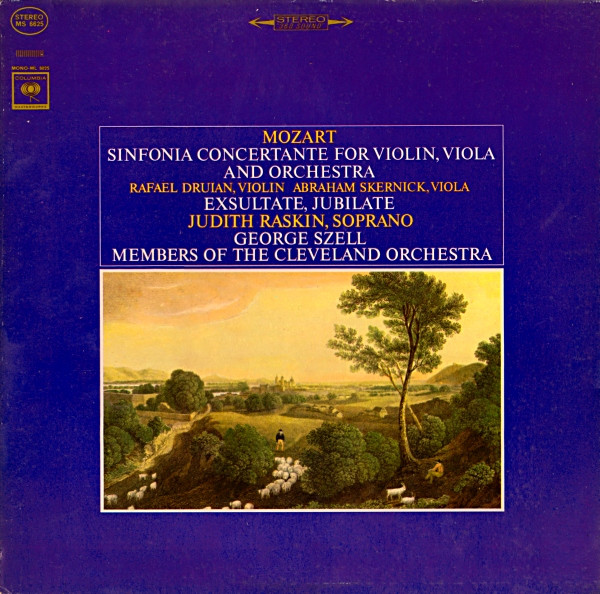
MOZART: Exsultate, jubilate (motet, Exult, rejoice),
K. 165: iv. Alleluja


Judith Raskin, soprano; Cleveland Orchestra members, George Szell, cond. Columbia-CBS-Sony, recorded in Severance Hall, May 11, 1964

by Ken

Yes, yes, we have some things to talk about, but not just now. There's all kinds of things in the works, which I'll tell you a bit more about when I get the rest of this "sampler" post up -- execept to note that when we return to Mahler 3, we're going to be hearing, all too briefly, from a singer I worry has been forgotten. Although she had a lovely voice, it wasn't one of the sort that by itself thrills you, and you didn't necessarily feel you'd had a chunk of repertory suddenly illuminated for you. But Judith Raskin (1928-1984) did something maybe better: A performance of hers pretty much always left you feeling good.

I have these clips ready (though the Stravinsky is so fresh, it's still warm), and I really wanted to get something posted on Sunday. But even in so skimpy a sampler, there's more I want to share -- like some moments from her Nannetta when Leonard Bernstein conducted Falstaff at the Met, and more Mozart, and some songs . . . and, well, I'm still not quite sure what else. Maybe I'll have something to say about these excerpts, or then again maybe I won't. Anyway, I hope you enjoy.

(1) ABOUT THE "ALLELUJA"

This luscious performance comes from an Exsultate, jubilate that originally occupied one side of a Szell Mozart LP that otherwise didn't have absolutely tight logic, in spite of which it became one of the readiest "go to" record in my collection.
Most of a lifetime later I can vouch that I adore both works, but I can't imagine that at the time I was looking for this particular coupling -- and I honestly don't remember which work I was shopping for. The Exsultate you now know something about; the Sinfonia Concertante -- featuring Cleveland concertmaster Rafael Druian and principal violist Abraham Skernick -- is still possibly my favorite recording of a piece I adore. I guess it worked out, because both sides of that LP got plenty of play. Nevertheless, it seems worth noting that since that original LP issue I don't believe the two performances have ever shared a disc. I have them both on CD, but on separate CDs. The Exsultate is still only semi-logically coupled, sharing a CD with the performance we're about to hear --

Sunday, November 3, 2024

As we've noted, there's more than one reason to care about Mahler's loopy little Wunderhorn song "Ablösung im Sommer," Part 1

FOR STARTERS, IS THIS THE SAME SONG?

MAHLER: Lieder aus der Jugendzeit (Songs from Youth):
"Ablösung im Sommer" ("Summer Replacement")

Cuckoo has fallen to his death
on a green willow tree.
Cuckoo is dead!
Fallen to his death.

Who then for us this whole summer
will while away the time?
Cuckoo! Cuckoo!
Hey! Lady Nightingale must do so!

She sits on a green branch:
the small, delicate Nightingale,
the dear, sweet Nightingale!
She sings and hops, is ever happy,
even when other birds are silent.

We'll wait for Lady Nightingale,
who lives in green hedgerows.
And if the cuckoo is at an end,
then she will start to warble.
-- original text "based on" Des Knaben Wunderhorn but
mostly by Mahler, translation (mostly) by William Mann
Listen on YouTube (audio only)
Or click here to go to Internet Archive, then press ► to play


Janet Baker, mezzo-soprano; Geoffrey Parsons, piano. Hyperion, recorded in Rosslyn Hill Unitarian Chapel, Hampstead, London, Feb. 24-25, 1983

Or click here to go to Internet Archive, then press ► to play


Diana Damrau, soprano; Stephan Matthias Lademann, piano. Telos Music, recorded in Telos Music Studios, Mechernich-Floisdorf, Germany, May or Sept. 2003

Click here to listen on Internet Archive, then press ► to play


Anny Felbermayer, soprano; Viktor Graf, piano. Vanugard, recorded in Vienna, 1952

Click here to listen on Internet Archive, then press ► to play


Judith Raskin, soprano; George Schick, piano. Epic-CBS-Sony, recorded in New York City, June 1965
A NOTE ON THIS WEEK'S MUSIC (AND SOME
CONSIDERATIONS GOING FORWARD)


Happily, Internet Archive seems back to something like normal functioning, meaning that it's once again possible to draw on Sunday Classics clips that reside there. However, this post, as you may recall, was originally conceived to depend on YouTube for music, and so a fair amount of today's music is so sourced, though it's all audio-only.

A number of today's performances already existed in the SC Archive (chez Internet Archive), and I've returned to embedding clips, hoping they'll play normally. But for these selections I've also included links to their Internet Archive pages. And I've included them in a particular form: with the "Webamp" player active. I've done this for another reason. While I.A. was grounded, the team was also working on a new version of its player, which is what 's used to play the clips that are embedded here. So that even after access to the archive was restored, for a while it was necessary, even if you were listening on-site, to switch to the Webamp option in order to hear anything.

At some point the new player must have been activated, but it appears that, understandably, it wasn't designed to work on old, no-longer-supported browser versions. So anyone who's dependent on such browsers isn't going to be hearing much music. If there are any SC readers in that situation, I'd love to know about it, because this means that all those years' worth of posts are going to be music-less for you. K can at least continue going forward to provide on-site links.

by Ken

In last week's post ("Not that it takes much, but I'm in an 'Urlicht' frame of mind -- and we're going to have some other Mahler Wunderhorn songs too," Oct. 28) we listened to a pair of Mahler's great song hits, "
Urlicht" and "Father Anthony's Fish Sermon," both settings of texts drawn from the folk-song anthology Des Knaben Wunderhorn" ("The Youth's Magic Horn") -- and a little wisp of a third, less consequential Wunderhorn song: the song we've just heard again in an almost confounding range of renderings, "Ablösung im Sommer." It's one of Mahler's early Wunderhorn settings, which he felt no need (or reason) to orchestrate himself, though we've already heard it with orchestra (and we have in store performances with orchestratations by several different hands).


IT'S A CHARMING, PERHAPS GOOFY
OR MAYBE EVEN WEIRD LITTLE SONG


Monday, October 28, 2024

Not that it takes much, but I'm in an "Urlicht" frame of mind -- and we're going to have some other Mahler Wunderhorn songs too

AND DO WE HAVE A KNOCKOUT "URLICHT" COMING UP!


TODAY WE HAVE MUSIC!!!  (It's just not in our usual form)

Internet Archive, where SC's music is lodged, has been dealing with major cyber-attacks (see below). While it's back online (hooray!), it's still in "read-only" form, so I still had to find another way to "re-musicalize" an SC post.


zart  adj  sensitive, delicate, tender
[from Mahler's directive to the singer of "Urlicht":
"durchaus zart" -- "throughout zart"]

MAHLER: Symphony No. 2 in C-sharp minor (Resurrection):
iv. "Urlicht" ("Primal Light")
: Sehr feierlich, aber schlicht (Choralmässig) (Very solemn, but simple/plain/truthful) (Chorale-like)
Then at bar 3: "Nicht schleppen" ("Don't drag")


Per the 2015 YT posting: "the first known footage of Glenn Gould conducting"
O little red rose,
Man lies in greatest need,
Man lies in greatest pain,
I would rather be in heaven.
Then I came upon a broad path,
then came a little angel and wanted to turn me away.
Ah no, I didn't let myself be turned away:
I am from God and want to return to God,
the dear God will give me a little light,
will light the way for me to eternal blissful life.
-- original German text from Des Knaben Wunderhorn
Maureen Forrester, contralto; orchestra, Glenn Gould, cond. Live performance filmed in Loew's Uptown Theatre, Toronto, for the CBC's 1956-57 Chrysler Festival series, aired Feb. 20, 1957

by Ken

To quote myself from the Oct. 2 Sunday Classics post:
Mahler had access to sheer beauty in a way that only Schubert could rival (think of "Urlicht," the radiant alto setting drawn from Achim von Arnim and Clemens Brentano's three-volume German folk-poetry anthology Des Knaben Wunderhorn, which sets the stage for the monumental finale of the Resurrection Symphony). In addition, for all Mahler's command of musical tragedy, he was the genuinely wittiest composer the classical world has produced (think of "Father Anthony's Fish Sermon," a very different Wunderhorn settting).
Now, the above text chunk contains a basic breach of Sunday Classics protocol -- did you spot it? It's the, er, inspiration for the form this blogpost has finally taken: to rectify that error, which we'll talk about -- after:

(1) We deal with the Internet Archive disaster;
and (2) we hear more Mahler songs based on Des Knaben Wunderhorn.


(1) NOW, ABOUT INTERNET ARCHIVE: FINGERS CROSSED
FOR A RETURN TO NORMAL (BUT MORE SECURE) SERVICE

[Feel free to skip this section -- I really had to include it, though. -- Ed.]

You've probably noticed that we haven't had music on Sunday Classics since early October, and that's because essentially all our music is lodged on the indispensable Internet Archive, which describes itself as "a non-profit library of millions of free texts, movies, software, music, websites, and more." The Archive took itself offline in response to massive cyber-assaults beginning Oct. 8-9 (prefigured by lesser attacks in the spring). This update was posted by I.A.'s director of Library Services. (There are numerous links, which you can see in the online posting.)
Internet Archive Services Update: 2024-10-21
Posted on October 21, 2024 by Chris Freeland

Tuesday, July 23, 2024

Setting out to trace the lineage of Boston Symphony concertmasters back to 1962, we wind up trapped in the gigantic first movement of the Mahler Third Symphony

"It is well known that I cannot be without trivialities, but this time all permissible bounds have been passed, and 'one frequently feels he has landed in a tavern or a pigsty.' "
-- Gustav Mahler, writing to his 19-year-old assistant Bruno Walter
in July 1896 about his nearly completed Third Symphony, sarcastically
incorporating critical characterizations of his work as a composer


Joseph Silverstein, BSO concertmaster 1962-84,
talks about what it takes to be a concertmaster


From a December 2014 interview (Joseph S., age 82): "William Steinberg once said to me -- and he was certainly a marvelous conductor and a great man to work with -- said to me one day, 'You're playing everything louder, softer, longer, and shorter than everybody in the section.' And I said, 'I thought that was my job.' And he said, 'It is, but don't do it too well.' "

[NOTE: Eventually we'll have a fuller version of Joseph S.'s answer.]


We hear (sort of) Nathan C.'s two predecessors playing the lyrical
countersubject of the first movement of Mahler's Third Symphony


Joseph Silverstein, violin; Boston Symphony Orchestra, Erich Leinsdorf, cond. RCA, recorded in Symphony Hall, Oct. 10-11, 1966

Malcolm Lowe, violin; Boston Symphony Orchestra, Seiji Ozawa, cond. Philips, recorded in Symphony Hall, April 1993

by Ken

I should look up the quote, but my recollection is that Bruno Walter expressed his diffidence about the Mahler Third Symphony in terms of a fear that somewhere in that gigantic first movement the devil had crept in.

Sorry, but for a change I haven't been able to piece together the post I was aiming for, a proper end to the series celebrating the accession of the Boston Symphony's new concertmaster, Nathan Cole. I hoped some of the fragments might stand on their own, and instead wandered into a trap. I'm sorry that my experiment with homing in on that lyrical second subject of the first movement of Mahler 3, as played by Nathan C.'s two immediate BSO predecessors, for whom he has expressed such admiration, didn't work out so well -- it just isn't so easy to hear either of our star fiddlers dispatching the solo.

But it's not a bad thing to make sure we all understand why I wanted to focus on the BSO concertmaster succession -- to appreciate by sight and especially sound the legacy that Nathan Cole is so aware of inheriting. It's also maybe a chance to linger a little over that gigantic first movement of Mahler 3 -- the movement where, Bruno Walter once wrote, he felt sure the devil had crept in. In his lifetime Bruno W. -- to whom the responsibility fell for conducting the premieres of Das Lied von der Erde and the Mahler Ninth Symphony, would remain probably the leading champion of Mahler's still-widely-patronized music, but even he turned his back on Mahler 3, 6, 7, and 8, which would have an even longer, more arduous path to repertorial daylight.


WOULD YOU BELIEVE WE HAD ONLY ONE RECORDING OF
THE FIRST MOVEMENT OF MAHLER 3 IN THE SC ARCHIVE?


Monday, June 17, 2024

The BSO's soon-to-be-seated new concertmaster, 'the other Nathan,' is only its 4th in the last 104 years

"We had immense pleasure collaborating with Nathan last January on Shostakovich’s Lady Macbeth of Mtsensk."
-- from Boston Symphony music director Andris Nelsons's statement
on the naming of Nathan Cole as the orchestra's new concertmaster

"I feel fortunate to have known two people who held the position before me, Malcolm Lowe and Joseph Silverstein. Silverstein [pictured at right, c2008] was one of my idols, and I grew up with many of the Boston Symphony Chamber Players recordings. Any time that I had to learn a piece, BSCP would have a recording of it with Silverstein leading, so I had his sound in my ear early on and was lucky to get to work with him before he passed away. He was extremely generous with his time and wisdom. He took himself seriously enough to continue working on his craft all the way through the end of his life. But I always got the sense that he knew he was a custodian of the position, and that everything he did was for his colleagues and for the music, and that’s something that I want to carry forward." -- from Nathan C.'s statement (same link)


In October 2017, preparing for his first performance of the Beethoven Violin Concerto, Nathan C. video-recorded his choice for the first-movement cadenza, by "one of my heroes," Nathan Milstein (1904-1992). Nathan C. is playing the 1716 Strad formerly owned by Nathan M., which he had on loan for the occasion, an experience he detailed in a genuinely must-read account for Violinist.com: "Speed-dating a Strad: one week with Milstein's ex."

Welcome to natesviolin.com! Mentoring the next generations of violinists has been a longtime passion of the BSO's new concertmaster. An abundance of videos can be found online, and NatesViolin.com provides a wealth of resources and support for aspiring violinists as well as considerable interest for music lovers with curiosity about the nuts 'n' bolts of the medium (not to mention failed -- or shall we say "unaspiring"? -- fiddlers).

by Ken

I know that's a mouthful of a quote I've reproduced above from Nathan Cole on his appointment as BSO concertmaster. I expected to edit it down to a "tease" here, as I did with Andris Nelsons's statement, which we'll be reading in full later. But the danged quote just wouldn't edit down. I loved it when I first read it, and after several weeks of poking around Nathan C.'s career and gathering materials for some sort of overview of the succession of these three concertmasters, I'm even more impressed -- and touched. (I have pretty high regard for Joseph Silverstein myself.) And I felt even more strongly that the quote needs to be taken in one fell swoop. One thing you learn about Nathan C. is that not only is he highly knowing and communicative as a musician (we're going to be coming back to that 2017 performance of the Beethoven Concerto), but he's remarkably communicative with words.

If you were here for last week's SC pre-post, "At home with Nathan and Akiko (aka 'Stand partners for life')," you already heard Nathan C., at the time first associate concertmaster of the Los Angeles Philharmonic, "pre-performing" his choice of a third-movement cadenza, Fritz Kreisler's, for that October 2017 performance of the Beethoven Violin Concerto. We'll come back to that performance, but first I guess we should focus on the not-quite-breaking news.

When the Boston Symphony launches its Tanglewood season on July 5, with an all-Beethoven program under music director Andris Nelsons (who this year takes on the added role of Tanglewood "head of conducting"), the orchestra will at last have a new occupant for the Charles Munch Chair, which is to say the concertmaster's seat -- named of course for the BSO's 1949-62 music director [pictured at right]. The Charles Munch Chair hasn't been filled since 35-year incumbent Malcolm Lowe retired after the 2019 Tanglewood season. (The onset of the pandemic can't have had a salutary effect on the replacement process.)


THE ANNOUNCEMENT OF MALCOLM LOWE'S RETIREMENT . . .

Monday, April 8, 2024

Rassling with the symphonic adagios of Bruckner and Mahler, Part 2

We left off Part 1 of this post:
BEFORE WE PROCEED TO THE LAST THREE BRUCKNER SYMPHONIES, LET'S CONNECT WITH A MAHLER ADAGIO --
Which is where we'll pick up in Part 2.


FIRST LET'S CONSIDER A COUPLE OF NEAR-ADAGIOS

First, let's consider a couple of near-adagios. Mahler 1 and 2 have slow movements we wouldn't even think to call adagios. Mahler 3, about as strange a pile of symphonic construction as I'm aware of, actually concludes with an extended slow movement that might qualify, and the precedent of concluding a large symphony with a large slow movement is certainly going to catch fire with Mahler, but in M3 I think he's playing at something else here, especially when we consider the long opening section that begins all-strings and then for a good piece allows only small-bore wind intrusions. Let's listen -- I think you'll hear what I mean.

MAHLER: Symphony No. 3 in D: vi. Langsam. Ruhevoll. Empfunden. (Slow. Peaceful. Felt.)


Chicago Symphony Orchestra, Sir Georg Solti, cond. Decca, recorded in Orchestra Hall, November 1982

Boston Symphony Orchestra, Erich Leinsdorf, cond. RCA, recorded in Symphony Hall, Oct. 10-11, 1966

London Symphony Orchestra, Jascha Horenstein, cond. Unicorn-Kanchana, recorded in Fairfield Hall, Croydon, London, July 27-29, 1970

New York Philharmonic, Leonard Bernstein, cond. DG, recorded live in Avery Fisher Hall, Nov. 25-28, 1987

Rassling with the symphonic adagios of Bruckner and Mahler, Part 1

NOTE TO READERS: It was hard enough getting this post strung out from start to finish. When that was done, I knew that one thing I'd most feared had happened: There are too many files, and these files are big ones, to have much hope of the post loading properly or easily. It already wasn't going to be finished at the finish line, but now it would have to be split in two. Part 2 will post pretty much any time now. -- Ken

[No. 7] Adagio - Sehr feierlich und sehr langsam
(Adagio - Very solemn and very slow)


[No. 8] Adagio - Feierlich langsam, doch nicht schleppend
(Adagio - Solemnly slow, yet not dragging)


The first statement of the main theme of the Adagios of Anton Bruckner's Seventh and Eighth Symphonies, played by, respectively: [7] the Berlin Phil under Seiji Ozawa and [8] the Vienna Phil under Herbert von Karajan


WHILE ALL ADAGIOS ARE SLOW MOVEMENTS,
ONLY SOME SLOW MOVEMENTS ARE ADAGIOS


And here we hear prime specimens of "NOT AN ADAGIO" slow movements from the undisputed masters of symphonic adagio-making:

BRUCKNER: Symphony No. 4 in E-flat:
ii. Andante quasi allegretto


Munich Philharmonic, Rudolf Kempe, cond. Acanta, recorded in the Bürgerbräukeller, Dec. 14-15, 1975 & Jan. 20-21, 1976
MAHLER: Symphony No. 6 in A minor:
iii. [or ii.] Andante moderato

[Mahler himself, you'll recall, was of two minds about the order of the symphony's middle movements, the Andante moderato and the Scherzo]

Cleveland Orchestra, George Szell, cond. Columbia-CBS-Sony, recorded live in Severance Hall, October 1967
by Ken

In last week's post, we "chart[ed] our course from Beethoven's visionary symphonic adagio to the great symphonic adagios of Bruckner and Mahler," which is the course that lies ahead of us. It hasn't worked out quite the way -- that is, any of the ways -- it was meant to, but here we are, somewhere between Plan C and Plan D, forging ahead, starting with this idea I had (it seemed like a good idea at the time) that it might be helpful, in getting a handle on these symphonic adagios, to separate out slow movements that aren't adagios.

Okay, the performances I've slotted in above are skewed just a little, in the direction of "non-adagio-tizing" these specimen movements -- with performances that underscore these movements' non-adagio-ness, in particular Szell's almost breezy take on the Mahler 6's "Andante moderato" tempo marking. Still just drawing on the SC archive (meaning that these are performances we've heard before, unless a clip was made for a post that never got posted), which is overflowing with performances of this movement, which I love a lot, I could have inserted these broader and emotionally weightier statements --

MAHLER: Symphony No. 6 in A minor:
iii. [or ii.] Andante moderato


New Philharmonia Orchestra, Sir John Barbirolli, cond. EMI, recorded in Abbey Road Studio No. 1, London, Sept. 26-27, 1969

London Philharmonic Orchestra, Klaus Tennstedt, cond. EMI, recorded live in the Royal Festival Hall, November 1991
I love pretty much everything about the Barbirolli M6, not least the bold and soul-stirring Andante moderato, and I also love the darker, more insinuating quality of the Tennstedt live M6 Andante moderato. (I very much like the 1983 studio recording Tennstedt made as part of his LPO Mahler cycle, but I'm happy EMI also issued the later live performances of M6 and M7.)

Similarly with the Bruckner 4 Andante quasi allegretto --

Sunday, March 31, 2024

In which we chart our course from Beethoven's visionary symphonic adagio to the great symphonic adagios of Bruckner and Mahler

(And we run smack into the dread Ninth Symphony snafu)

Maestro Furtwängler will get us from Beethoven's sublime symphonic adagio to Bruckner; then Carlo Maria Giulini will carry us on to Mahler.

BEETHOVEN: Symphony No. 9 in D minor, Op. 125:
iii. Adagio molto e cantabile


Bayreuth Festival Orchestra, Wilhelm Furtwängler, cond. EMI, recorded live in the Festspielhaus, July 29, 1951

Berlin Philharmonic, Carlo Maria Giulini, cond. DG, recorded in the Philharmonie, Feb. 1989 & Feb. 1990

by Ken

Last week, you may recall, "Our ongoing Seiji Ozawa remembrance sidetracked me into some aural pondering of the symphonic adagio." I'm afraid we're not going to get much farther today than scouting the route, but that still leaves us in for some remarkable music.

You'll note that in last week's post I've upgraded the audio clip of the 1951 Furtwängler Beethoven Ninth, and this week we've heard it again, paired with Carlo Maria Giulini's performance, and that duo will escort us to -- in fact, all the way through -- Anton Bruckner's symphonic adagio-ing, to his final Adagio, the last movement he composed, the Adagio of his Ninth Symphony, whose intended finale he ran out of either time or inspiration to "complete."

The sound of Furtwängler's 1944 Bruckner 9 is less happy even than that of his 1951 Beethoven 9 [AFTERTHOUGHT: however, the upgraded Beethoven 9 audio clip sure sounds better (how 'bout those timpani?), and for that matter the Bruckner 9 clip sounds a lot better than I expected -- Ed.], but it's good enough, and will have to do, since it's the only Bruckner 9 he left us. And if there's one thing classical-music lovers generally agree on (there aren't many!), it's that the Furtwängler Bruckner 9 is one of the greatest and least dispensable recordings we have. That said, Carlo Maria Giulini's Bruckner 9 seems to me of comparable stature. In the fullness of his long career, Maestro G. had the opportunity to show us how deep and darkly perceiving an artist he was -- I've described this performance as "dripping blood."

Finally for this week, Maestro Furtwängler not being a Mahler guy, Maestro Giulini will lead us the final step to Mahler, represented by a movement I don't think is often thought of as a "symphonic adagio" -- only it is, isn't it?


LISTENING TO FURTWÄNGLER'S AND GIULINI'S
PERFORMANCES OF THE ADAGIO OF BRUCKNER 9 . . .


Monday, February 26, 2024

Seiji Ozawa (1935-2024)
Part 2a: Thinking big musically doesn't preclude making every moment fully alive

MAHLER: Kindertotenlieder (Songs on the Death of Children):
No. 4, "Oft denk' ich, sie sind nur ausgeganen!"
("Often I think they've only gone out!")


Jessye Norman, soprano; Boston Symphony Orchestra, Seiji Ozawa, cond. Philips, recorded live in the Alte Oper, Frankfurt, December 1988

MAHLER: Symphony No. 8 in E-flat:
Part I, Allegro impetuoso, "Veni, Creator Spiritus"


Faye Robinson, Judith Blegen (and Deborah Sasson?), sopranos; Florence Quivar, mezzo-sorano; Lorna Myers, contralto; Kenneth Riegel, tenor; Benjamin Luxon, baritone; Gwynne Howell, bass; Tanglewood Festival Chorus, Boston Symphony Orchestra, Seiji Ozawa, cond. Philips, recorded live in Symphony Hall, Oct.-Nov. 1980
[SOPRANO NOTE: A third soprano is called for in Part II but not Part I. However, I can't swear that there's been no redistribution of parts in Part I.]

by Ken

If you've visited the previous installment of this series, "Seiji Ozawa (1935-2024), Part 1: Being the preface to a probably-inappropriately-impressionistic (at least at the start) musical remembrance" (Feb. 11), you know that this isn't where we expected to be beginning Part 2. We had, by gosh, a formal agenda! And we'll be coming back to it, though I'm afraid not completing it in this installment.

That plan changed, or at least got rejiggered, as I pondered the possibilities suggested by the presence, among the large volume of Ozawa holdings in the SC Archive, of the complete Part I of his BSO recording of Mahler's grandest symphony, the Eighth, his setting of the old Latin hymn "Veni, Creator Spiritus" -- one of his most extraordinary, and extraordinarily dense, musical concoctions, unlike anything else I know in the musical literature, definitely including Part II of the Eighth, his cherry-picked rendering of Part II of Goethe's Faust, which is as discursive and, er, spaced out (in more ways than one) as Part I is concentrated and compact.

Then, since the content list for this musical talking point already included Nos. 3 and 4 of the Mahler Kindertotenlieder (settings of, altogether, five of Friedrich Rückert's poems on the death of children) in the powerful live recording Seiji and the BSO made with Jessye Norman on tour in Frankfurt, I slipping one of them in here, partly to hear Jessye and Seiji -- whom we've heard collaborating so splendidly in Gurre-Lieder Part I -- together again, but more to illustrate both Mahler's and Seiji's complete comfort with the formally simple and wildly complex musical structures.


WE'll RETURN TO THE "PART 2 TALKING POINTS," BUT FOR READERS GRIPPED BY "VENI, CREATOR SPIRITUS" MANIA --

Monday, June 19, 2023

Let's open this book of spells and see if we find a Stanley Drucker "moment" or two lurking inside

Okay, Des Knaben Wunderhorn (The Youth's Magic Horn) isn't really a "book of spells," but the three volumes of wildly diverse German folk poetry were a creative wellspring for Mahler. (Wikipedia can get you up to speed.)


LET'S START OFF WITH WHAT CYNTHIA PHELPS*
MIGHT CALL A STANLEY DRUCKER MAHLER "MOMENT"

*You recall from last week NY Phil principal violist Cynthia P.'s quote at the time Stanley D. retired (2009), at which point they'd been fellow principals since she joined the orchestra in 1992:
"I think the thing I'll miss most about Stanley is his unbelievable creativity, his ability to make a moment anytime he has the opportunity."

OH, ONE MORE THING: As we listen to a pair of performances of one itty-bitty Wunderhorn song setting, just for now I'm not going to identify the performers. For this moment, we can call them, oh, "Team X" and "Team Y."


MAHLER: Songs from "Des Knaben Wunderhorn":
"Lob des hohen Verstandes" ("In Praise of High Intellect")

Once in a deep valley,
a cuckoo and nightingale
struck a wager:
Whoever would sing a masterpiece,
whether he won by art or luck,
he would win the bet.

The cuckoo spoke: "If you consent,
I have chosen a judge."
And he instantly appointed the ass.
"For since he has two large ears,
he can hear all the better,
and know what is right."

Soon they flew before the judge.
When he was told about the matter,
he decreed that they should sing.
The nightingale sang out sweetly!
The ass spoke: "You confuse me!
Hee-haw! Hee-haw!
I can't get it into my head."

Thereupon the cuckoo immediately began
his song with thirds, fourths, and fifths.
It pleased the ass, who said only: "Wait!
I will pronounce your judgment.

"You have sung well, nightingale!
But cuckoo, you sing a true anthem!
And held the beat precisely!
I say that from my great wisdom!
And even if it costs a whole country,
I thus pronounce you the winner."
Cuckoo, cuckoo! Hee-haw!
-- translation by Cecilia H. Porter
Team X

Team Y


by Ken

The song, of course, is one of the dozen free-standing settings Mahler made in his first fully mature years -- roughly the decade 1892-1901 -- from the strange and wonderful, almost indescribably diverse three-volume collection of German folk verse Des Knaben Wunderhorn (The Youth's Magic Horn). (Again, keep the Wikipedia link handy.) "Lob des hohen Verstandes" falls in a category we might call "Wacky-Satirical Plays on Nature," the most familiar of which would be the riverside sermon preached to the wild assortment of fishes by the good St. Anthony of Padua: "Des Antonius von Padua Fischpredigt." We're going to be hearing that too.

Speaking of diversity, our two performances sure embody it, don't they? One thing they have in common is some pretty spiffy clarinet-playing (we'll talk about that later), but even that is different. Obviously one performance is sung by a man and the other by a woman, and just as obviously, one performance is a good deal perkier, if nothing else just plain quicker, than the other, which gives the song a markedly different character, I think. Maybe less obviously, or at least more subjectively, I would venture that one is warmer, more endearing, more user-friendly, though the other is equally, and cherishably, precise in its realization of the wealth of detail Mahler has crafted into both the vocal line and the orchestral setting.


WHICH REMINDS ME: WE CAN ACTUALLY SEPARATE
THE SONG FROM ITS ORCHESTRAL SWADDLING


After all, like Mahler's other Wunderhorn settings, "Lob des hohen Verstandes" was composed first for voice and piano. If we get the orchestras cleared away, making room to wheel in the piano so Team Z can take their places, it'll sound like this:

Team Z


AS I'M SURE YOU'VE FIGURED OUT, TEAM Z . . .

Sunday, June 18, 2023

Just to give you a taste of what I'm working on for this week's post, here's, er, a taste of what I'm working on for this week's post

HINT: We want to be thinking about those Stanley Drucker "moments" of outsize creativity we heard NY Phil principal violist Cynthia Phelps citing in last week's post ("Still remembering Stanley Drucker (who's got me hearing voices -- including a lot from one source"), and also those "voices" I started talking about. I still haven't quite figured out how I'm going to work those in. I guess we'll find out. -- Ken

MAHLER: Songs from "Des Knaben Wunderhorn":
"Lob des hohen Verstandes" ("In Praise of High Intellect")

Once in a deep valley,
a cuckoo and nightingale
struck a wager:
Whoever would sing a masterpiece,
whether he won by art or luck,
he would win the best.

The cuckoo spoke: "If you consent,
I have chosen a judge."
And he instantly appointed the ass.
"For since he has two large ears,
he can hear all the better,
and know what is right."

Soon they flew before the judge.
When he was told about the matter,
he decreed that they should sing.
The nightingale sang out sweetly!
The ass spoke: "You confuse me!
Hee-haw! Hee-haw!
I can't get it into my head."

Thereupon the cuckoo immediately began
his song with thirds, fourths, and fifths.
It pleased the ass, who said only: "Wait!
I will pronounce your judgment.

"You have sung well, nightingale!
But cuckoo, you sing a true anthem!
And held the beat precisely!
I say that from my great wisdom!
And even if it costs a whole country,
I thus pronounce you the winner."
Cuckoo, cuckoo! Hee-haw!
-- translation by Cecilia H. Porter
Team X

Team Y

Team Z

Saturday, November 6, 2021

Bernard Haitink (1929-2021),
part 2

In 1961-63 Haitink's career path merged with Eugen Jochum's. We'll hear them side-by-side in Bruckner, and in Mahler side-by-side-by-side with their Concertgebouw predecessor Eduard van Beinum

HOLD EVERYTHING! We're going to need a "part 3," for a Haitink-Jochum Beethoven Ninth face-off: an anticipated five performances of the Finale ranging in time from 1938 to 2005 -- coming soon!

Bruckner in Vienna's Stadtpark (City Park) -- bronze bust by Viktor
Tilgner
, crop of photo by Mealisland from Wikipedia Commons


Concertgebouw Orchestra (Amsterdam), Bernard Haitink, cond. Philips, recorded Nov. 1-3 1966

Concertgebouw Orchestra (Amsterdam), Eugen Jochum, cond. Live performance, Mar. 3, 1970

Vienna Philharmonic, Karl Böhm, cond. DG, recorded 1976

Orchestre National de France, Eugen Jochum, cond. Live performance from the Théâtre des Champs-Elysées, Feb. 6, 1980

by Ken

Do you notice any progression in the four clips above, of what I'm calling the "main theme" of the second-movement Adagio of the Bruckner Seventh Symphony, even though it comes maybe half a minute into the movement? We could hear it as a continuation or branch of the opening theme, but in harmony and orchestration it seems so clearly a new, benedictory idea, and an idea of such physical power, intersecting with that opening theme that it seems to me clearly a second theme, and one of such power that it can only be the "main" theme, can't it?

The progression I'm thinking of happened fairly accidentally. It started with the Böhm clip, simply for convenience -- we've heard it before, so it was sitting in the SC Archive waiting to be called upon again, and indeed for a time it saved me from having to make a new clip. Except I felt guilty that it left us starting off without reference to the conductor we're remembering, or the conductor who's our secondary focus today. So I must have made first the 1966 Haitink clip and then, still feeling guilty, the 1970 Jochum one. And still I coudln't relinquish the Böhm clip, even though it seemed to have outlived its purpose and usefulness; the problem was that I like, I really like it. Eventually, many thousands of clips later, it seemed only natural to tack on the 1980 Jochum-in-Paris clip.

Okay, so this is part 2 of our remembrance of Bernard Haitink, who died peacefully in his sleep, we're told, on October 21, at the age of 92. Since he remained active through 2019, that leaves us a heap of remembering to do, and I thought we would start with a point I kept meaning to make last week, in "Bernard Haitink (1929-2021), part 1." In fact, we've got a subhead left over from the drafting of last week's installment, when I still imagined that all our Haitink remembering could get remembered in one fell swoop. This subhead was planned to be the first of a series of them; now it seems a good way to get us started on part 2.

(1) IT'S GREAT TO BE GOOD, BUT
IT'S ALSO SMART TO BE LUCKY


That's "lucky" as in, for example, being in the right place at the right time, which in Haitink's case meant being an up-and-coming young Dutch conductor at a time when a critical need arose for just such a commodity.

He'd had a formal relationship with the Netherlands Radio Philharmonic Orchestra since 1955, and been its principal conductor since 1957, when the Concertgebouw Orchestra's chief conductor, Eduard van Beinum [right], died suddenly (though his health seems to have been iffy for a long while) following a heart attack in April 1959, creating an urgent need for a Dutch conductor capable of taking the reins of what was not just the Netherlands' premiere orchestra but one of the world's elite ones. The 30-year-old Haitink was offered the position of "first conductor" (previously given in 1941-43 to a fellow name of . . . Eugen Jochum), but there was clearly still reluctance to elevate him to the chief conductorship. For the record, Van Beinum himself had served a period as "second conductor" to Mengelberg before being made co-chief conductor, remaining as sole chief in 1945 when the orchestra severed ties with Mengelberg over his overfriendliness with the Nazi occupiers. Van Beinum thankfully had an unimpeachable anti-Nazi record.


HAITINK FINALLY GOT HIS BUMP-UP, IN 1961,
BUT PROBABLY NOT THE WAY HE HAD HOPED


Sunday, October 31, 2021

Bernard Haitink (1929-2021),
part 1

1st Addition: Finale of the Beethoven Ninth Symphony (added at the end)
2nd Addition: the Adagio of the Shostakovich Seventh Symphony, plus texts for the Siegfried scene (now moved toward the end of the post) and for the Mahler songs -- and, oh yes, some blocks of text.
Final Addition: Note the "part 1" now appended to the post title. Rather than continue stuffing more stuff into this post, I decided it makes more sense to spin it off into a separate post. Prime exhibit: what we might call -- if we were the sort of person who was inclined to think in such terms -- "Haitink vs. Jochum, in Mahler and Bruckner." Of course it's not really a competition (and so, as Dave Letterman used to say, "No wagering!"). Nevertheless, the careers of these two important conductors, of decidedly different generations, intersected importantly in Amsterdam in the early 1960s. Among the exhibits (and helping plug the Bruckner gap so troubling in part 1 of this post): the Adagio from Haitink's first and last recordings, from September 1966 and June 2019, thus more than half a century apart, of the Bruckner Seventh Symphony.
Wait, One Post-Final Addition: a block of text explaining the inclusion of the Beethoven Ninth finale.

Now, back to business --


FIRST, SOME QUICK MUSICAL IMPRESSIONS OF B.H.

Haitink, who turned 92 in March, remained active up to the end [well, not quite the end; I note that he did a round of "farewell" performances in 2019 -- Ed.], and is reported to have died peacefully in his sleep on the 21st of this month. Not a fancy or excess-prone conductor, but a committed and sincerely musical one -- it was a heckuva career.

HANDEL: Music for the Royal Fireworks:
i. Ouverture


Concertgebouw Orchestra (Amsterdam), Bernard Haitink, cond. Philips, recorded in the Concertgebouw, c1962

BRAHMS: Double Concerto in A minor, Op. 102:
ii. Andante


Henryk Szeryng, violin; János Starker, cello; Concertgebouw Orchestra (Amsterdam), Bernard Haitink, cond. Philips, recorded in the Concertgebouw, September 1970

SHOSTAKOVICH: The Age of Gold (ballet suite), Op. 22a:
iii. Polka: Allegretto


London Philharmonic Orchestra, Bernard Haitink, cond. Decca, recorded in Kingsway Hall, November 1979

SHOSTAKOVICH: Symphony No. 6 in B minor, Op. 54:
iii. Presto


Concertgebouw Orchestra (Amsterdam), Bernard Haitink, cond. Decca, recorded in the Concertgebouw, December 1983
[NOTE: For those unfamiliar with the strange musical beast that is Shostakovich 6, it begins with a fairly long and quite lovely Largo -- worthy of Mahler, who has to have been on Shostakovich's mind -- and then dashes into a startlingly goofy Allegro that segues into this giddy, dare I say foot-stomping Presto, about the last thing we could have seen coming from that opening Largo. AFTERTHOUGHT: I'm thinking we ought to spend some time with Shostakovich 6, perhaps with some hindsight-driven wonder at its position in the otherworldly sequence of Shostakovich's Sixth through Ninth Symphonies.]

by Ken

After I'd been thinking for a while as to what music might go into a proper Haitink memorial, I thought I'd just take a peek in the DWT Archive. I had no idea how much there is there, so at this preliminary stage, before I've given much thought to making this a proper Haitink memorial post, I thought we might just listen to a small portion of music we've already heard from him, starting with another Brahms concerto slow movement, hearing how he adjusts to noticeably different sorts of soloist -- note how he's a little more assertive with Brendel, more supportive with the more self-starting Arrau (with whom, we might recall, Haitink had already recorded a cycle of the five Beethoven piano concertos).

BRAHMS: Piano Concerto No. 2 in B-flat, Op. 83:
iii. Andante


Claudio Arrau, piano; Concertgebouw Orchestra (Amsterdam), Bernard Haitink, cond. Philips, recorded in the Concertgebouw, October 1969

Alfred Brendel, piano; Concertgebouw Orchestra (Amsterdam), Bernard Haitink, cond. Philips, recorded in the Concertgebouw, December 1973

And while we're following up on our opening selections, we might look at a very different side of Shostakovich from the jolly music we heard above: the searing Adagio of the Leningrad Symphony. Haitink, we might recall, recorded all 15 Shostakovich symphonies, split between the Concertgebouw and his beloved second orchestra, the London Philharmonic.

SHOSTAKOVICH: Symphony No. 7 in C, Op. 60 (Leningrad):
iii. Adagio


London Philharmonic Orchestra, Bernard Haitink, cond. Decca, recorded in Kingsway Hall, 1979


OF COURSE WE'VE GOT MAHLER . . .

Tuesday, May 5, 2020

Part 2a: As we backtrack from Mahler 5 to the Wunderhorn era, the Berlin Phil reemerges playing Mahler 4 as chamber music

Finally we hear our "(Nearly) All-Berlin Phil Mahler 4"!


Heard here twice over we have the opening minute and three-quarters of Mahler 4, up to the entry of the 1st movement's 2nd theme.

by Ken

The first clip is literally (allowing for intermediate digitizing, mp3-ifying, and blog transmission and reception) how I made my first aural contact with Mahler 4, in the Columbia Masterworks recording by the New York Philharmonic under Leonard Bernstein made in February 1960; the second clip is how Lenny B heard the music 27 years later, as executed by Amsterdam's Concertgebouw Orchestra in a live recording made by DG for his final Mahler symphony cycle -- kind of similar, I guess, but in important ways quite different. In 1987 don't you get the distinct sense that the music is figuring out as it moves where and how it's going? That under the surface, so pungently and confidently presented in 1960, there are things going on that could lead to who-knows-what? Note how in 1987, as our clip unfolds in much more varied forward movement, just as the music has really gathered momentum, seemingly toward something, it suddenly stops dead -- to give way (as we'll hear later) to the movement's about-to-sound second theme.


SINCE PROMISING "ALL OF MAHLER 4" ON SUNDAY, I'VE
ATTEMPTED SEVERAL VERSIONS OF A FOLLOW-UP POST


And the thing is, "all of Mahler 4" has been ready to go since, well, Sunday. The "several versions of a follow-up post" haven't necessarily displeased me; they just haven't gotten me where we needed to get, in Sunday Classics's blogiferous "re-creation but with added musical context" of the Mahler program that formed Episode 2 of the four-episode virtual Easter Festival that the Berlin Philharmonic's Digital Concert Hall offered to inject some live-streamed music into the time space that was to have occupied the orchestra for its real-world annual Baden-Baden Easter Festival, an early casualty of the worldwide cancellation of live performances.
[See the April 12 Sunday Classics post "Hokey-smoke, it's like we're actually in Berlin (well, sort of) for Easter week" and its successors:
• the two-paragraph "Reminder: Episode 4 of the Berlin Philharmonic's Easter@Philharmonie Festival live-streams at 2pm EDT" (April 13);
• "Do we need a reason to remember Jan DeGaetani? No, but today we do need her to sing a special song" (April 20, not even posted on Sunday but in the wee hours of Monday);
• "We hear the kinship between the Adagietto of Mahler 5 and 'Ich bin der Welt abhanden gekommen,' right? How about the differences?" (April 26, early);
• "Spun off from today's main post: All of Mahler 5!" (April 26, later);
• and this past Sunday's "Part 1: As we backtrack from Mahler 5 to the Wunderhorn era, the Berlin Phil reemerges playing Mahler 4 as chamber music" (May 3).]
In a moment we're going to hear a darned close approximation to how My Very First Mahler would have sounded, with one notable exception: that the recording was made in the Boston Symphony's acoustically legendary Symphony Hall while I heard it in the old, unimproved, but acoustically very friendly spaces of the Brooklyn Academy of Music, which I don't recall anyone ever calling "BAM" back before Harvey Lichtenstein took directorship and began working his famous miracles of restoration and repurposing, taking head-on the challenge that proper New Yorkers famously wouldn't schlepp over or under the East River to the unknown wilds of Brooklyn.

It's often forgotten that in those prehistoric days the Boston Symphony did travel to Brooklyn, something like five times a year, in tandem with its regular visits to Carnegie Hall. And for a 10th-grader who had moved to NYC just a year before, at the ripe old age of 12, while the Brooklyn Academy was an exotic destination, it didn't involve any stinking river crossing because Bkln is where he lived, and where -- at James Madison High School -- he discovered he could get a mimeographed (as he recalls) form that could be swapped at the not-yet-BAM box office, along with a dollar (yes, $1!), for an actual concert ticket!
MAHLER: Symphony No. 1: i. Langsam. Schleppend (Slow. Dragging)

So this would be just about how My Very First Mahler sounded, in the RCA Red Seal recording made by Erich Leinsdorf and the Boston Symphony on October 20-21, 1962.

BUT THIS IS A STORY FOR ANOTHER DAY; WE NEED TO GET
TO WHERE MAHLER 4 FITS INTO OUR PRESENT BLOGPATH

Sunday, May 3, 2020

Part 1: As we backtrack from Mahler 5 to the Wunderhorn era, the Berlin Phil reemerges playing Mahler 4 as chamber music

So we're going to hear a (nearly) all-Berlin Phil
Mahler 4 -- OK, maybe not today, but very soon


TUESDAY-INTO-WEDNESDAY UPDATE: Note that Part 2a is now posted.


The back-from-the-dead miniature-format version of their annual European Concert which members of the Berlin Philharmonic played Friday evening under the direction of chief conductor Kirill Petrenko, including a performance of a chamber version of the Mahler Fourth Symphony, which was broadcast live on TV and radio and then live-streamed free yesterday in the orchestra's Digital Concert Hall, will be -- as you can see -- "available soon" in the DCH archive.

SOME MAHLER-BERLIN PHIL HISTORY

I'm probably forgetting something, but as best I recall, the first recording of a Mahler symphony by the Berlin Philharmonic was Sir John Barbirolli's utterly beautiful EMI Ninth in January 1964. (The only previous Berlin Phil Mahler recording I can think of is the Kindertotenlieder done by baritone Dietrich Fischer-Dieskau in June 1955 with Rudolf Kempe.) Since then, recordings of Mahler 9 have been made by Kirill Petrenko's three predecessors as chief conductor, Herbert von Karajan (1954-89), Claudio Abbado (1989-2002), and Simon Rattle (2002-2018), plus a mighty important guest conductor where Mahler is concerned, Leonard Bernstein (in his only appearance with the orchestra).

We're going to talk a little about the orchestra's history with Mahler in the continuation of this post. Meanwhile I thought it might be fun -- OK, it's my idea of fun -- to hear all these performances of the vast, always-amazing opening movement of Mahler 9.-- Ken

MAHLER: Symphony No. 9:
i. Andante comodo


Berlin Philharmonic, Sir John Barbirolli, cond. EMI, recorded January 1964

Berlin Philharmonic, Leonard Bernstein, cond. DG, recorded live in the Philharmonie, Oct. 4, 1979

Berlin Philharmonic, Herbert von Karajan, cond. DG, recorded in the Philharmonie, Nov. 1979-Sept. 1980

Berlin Philharmonic, Herbert von Karajan, cond. DG, recorded live in the Philharmonie during the Berlin Festival Weeks, Sept. 30, 1982

Berlin Philharmonic, Claudio Abbado, cond. DG, recorded live in the Philharmonie, Sept. 6-7, 1999

Berlin Philharmonic, Simon Rattle, cond. EMI, recorded live in the Philharmonie, Oct. 24-27, 2007
by Ken

Friday evening a concert was performed in Berlin's Philharmonie, home of the Berlin Philharmonic. This was a big deal because the building has been closed to the public since March 11.

The orchestra did squeeze in one more concert, on March 12 -- with the orchestra seated normally on the stage floor, but with no audience, former chief conductor Simon Rattle conducted Luciano Berio's Sinfonia and Bartók's Concerto for Orchestra, a concert that can be viewed in the orchestra's Digital Concert Hall.

Since then, before Friday, in-hall activities were limited to events cooked up for live-streaming via (and then archiving in) the orchestra's Digital Concert Hall:

• First, there was the four-event virtual Easter Festival("Hokey-smoke, it's like we're actually in Berlin (well, sort of) for Easter week"). Each episode had a theme (notably, Episodes 2 and 4 were devoted to a single composer, Mahler and Beethoven, respectively), around live activity from the near-empty Philharmonie -- narration by host Sarah Willis (of the Berlin horn section), conversations with musicians, and an assortment of small-format chamber performances -- framed and spaced out an assortment of orchestral performances chosen from the DCH archive

• Then, following the same model -- in-auditorium conversation and chamber performances -- has been applied to two ongoing series: a Berlin Phil Series, Saturdays at 7pm Berlin time (1pm ET, 10am PT), with programs built around themes to be championed by particular orchestra members. "Vive la France" featured Emmanuel Pahud, one of the two principal flutists; 1st principal violist Amihai Grosz; and harpist Marie-Pierre Langlamet; and the program was capped by an archival Abbado performance of Debussy's La Mer. "An American in Berlin" was built around violinist Noah Bendix-Balgley, the American among the three "1st concertmasters." Up next is "An Evening in Vienna" featuring the orchestra's two Austrian principal clarinetists, redheaded Wenzel Fuchs and Andreas Ottensamer. In addition, now there are to be programs of orchestra members' "Favorites," drawn from the DCH archive; so far I've been able to access this on my computer but not (so far) my TV -- I started watching the program of Noah Bendix-Balgey's faves, which I can tell you beings with a Tchaikovsky Pathétique Symphony with chief conductor Petrenko. I've looked at the online listing and see that it consists of a ginormous playlist -- yes! We're told that the "Favorites" events will be available free for the first week that they're posted.


FRIDAY'S CONCERT WAS IMPORTANT TO THE
ORCHESTRA -- AND MUSIC LOVERS EVERYWHERE