Showing posts with label Mozart. Show all posts

Sunday, December 15, 2024

The start of an all-too-quick remembrance of a special singer we'll be hearing from (too briefly) in an upcoming Mahler 3 post

[(MORE) PROPER EXPLANATION TO COME,
plus another whole installment (though not today for that!)]


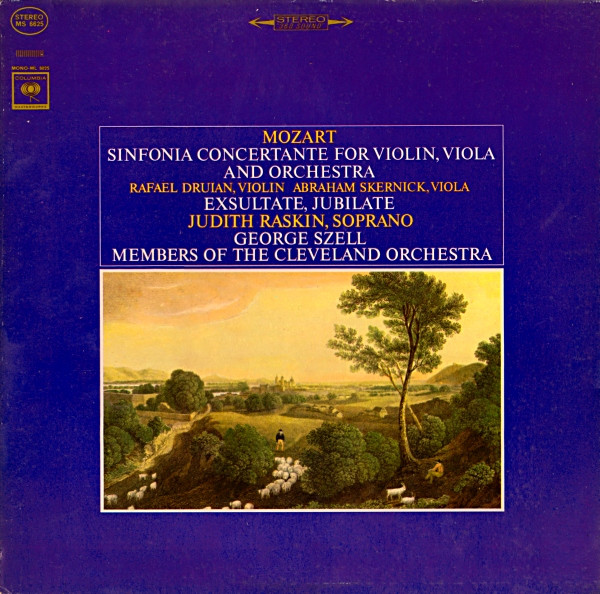
MOZART: Exsultate, jubilate (motet, Exult, rejoice),
K. 165: iv. Alleluja


Judith Raskin, soprano; Cleveland Orchestra members, George Szell, cond. Columbia-CBS-Sony, recorded in Severance Hall, May 11, 1964

by Ken

Yes, yes, we have some things to talk about, but not just now. There's all kinds of things in the works, which I'll tell you a bit more about when I get the rest of this "sampler" post up -- execept to note that when we return to Mahler 3, we're going to be hearing, all too briefly, from a singer I worry has been forgotten. Although she had a lovely voice, it wasn't one of the sort that by itself thrills you, and you didn't necessarily feel you'd had a chunk of repertory suddenly illuminated for you. But Judith Raskin (1928-1984) did something maybe better: A performance of hers pretty much always left you feeling good.

I have these clips ready (though the Stravinsky is so fresh, it's still warm), and I really wanted to get something posted on Sunday. But even in so skimpy a sampler, there's more I want to share -- like some moments from her Nannetta when Leonard Bernstein conducted Falstaff at the Met, and more Mozart, and some songs . . . and, well, I'm still not quite sure what else. Maybe I'll have something to say about these excerpts, or then again maybe I won't. Anyway, I hope you enjoy.

(1) ABOUT THE "ALLELUJA"

This luscious performance comes from an Exsultate, jubilate that originally occupied one side of a Szell Mozart LP that otherwise didn't have absolutely tight logic, in spite of which it became one of the readiest "go to" record in my collection.
Most of a lifetime later I can vouch that I adore both works, but I can't imagine that at the time I was looking for this particular coupling -- and I honestly don't remember which work I was shopping for. The Exsultate you now know something about; the Sinfonia Concertante -- featuring Cleveland concertmaster Rafael Druian and principal violist Abraham Skernick -- is still possibly my favorite recording of a piece I adore. I guess it worked out, because both sides of that LP got plenty of play. Nevertheless, it seems worth noting that since that original LP issue I don't believe the two performances have ever shared a disc. I have them both on CD, but on separate CDs. The Exsultate is still only semi-logically coupled, sharing a CD with the performance we're about to hear --

Sunday, December 10, 2023

Josef Krips's Requiem

INTERIM UPDATE (Monday afternoon): I've begun raiding the SC Archive for the promised Krips music files, which should have been just a copy-and-paste job, in itself way more laborious and persnickety than it sounds (I can't help rethinking things), and totally stalled when I came to Schoenberg's Gurre-Lieder. I've wound up not just remaking the three existing clips from Part I -- to ensure contextually fuller lead-ins and lead-outs (in some cases overlapping them), and while I was at it resampling them at a higher rate -- but in addition making a new and larger clip: the climax of Part I, with Christa Ludwig singing the transfixing "Song of the Wood-Dove."

That's still a work in progress, but I have added some music: (a) the start of the Meistersinger performance from which we were already hearing the start of Act III, and also the scene change in Act III, and (b) our first Mozart: as full-throated and open-hearted a performance as I've heard of the Marriage of Figaro Overture.
-- Ken


Maestro Krips (1902-1974)

MOZART: Requiem, K. 626:
i. Introitus: Requiem aeternam


Lucia Popp, soprano; Margaret Lilowa, mezzo-soprano; Anton Dermota, tenor; Walter Berry, bass-baritone; Vienna Singverein, Vienna Philharmonic, Josef Krips, cond. Live perforamnce from the Musikverein, Dec. 13, 1973
[Note: FWIW, this isn't the CRQ edition.]

by Ken

Sorry about the long silence. But even as I was reconciling myself to yet another week's failure to bring to completion my latest brainstorm for a publishable post, I clicked through a link to a "New release from CRQ Editions," which describes itself as "a specialist label devoted to the re-release of unusual out-of-copyright recordings which are of interest to collectors world-wide," available via "Streaming + Download," which "includes unlimited streaming via the free Bandcamp app, plus high-quality download in MP3, FLAC and more." The "unusual out-of-copyright recordings," include both out-of-copyright commercial recordings and live peformances, often never-previously-released ones.

From CRQ I've bought a download of long-OP Sibelius by Alexander Gibson, as a result of which I'm on their e-mail list, and since then I've been motivated a number of times by notices of new releases to learn my way a bit around their website -- enough to know that the page for each release includes, along with lots of other information, a complete list of tracks with "play" icons, and I've been under the impression that clicking "play" for Track 1 enabled me to hear for free not just Track 1, as I would have expected, but the whole blessed release.

Recalling this, I decided that -- even as I had other important matters to tend to, like sealing the lid on yet another failed-to-post Sunday -- I just had to click through to find out more about:
CRQ 591 JOSEF KRIPS: THE FINAL PERFORMANCE: MOZART REQUIEM: VIENNA 13 12 1973
As long-time readers may recall, I have a special affection for Krips (see, for example, the March 2013 post "Our 'J' and 'K' conductors shine in Mozart's Don Giovanni and Così fan tutte" (the other "J" and "K" conductors, fyi, were Eugen Jochum and Rudolf Kempe), who despite (or maybe because of?) a life marked with serious hardships, had an innate kindness, geniality, and generosity that often lifted his performances to a special realm, and if there's any composer whose music thrives on such qualities, it's Mozart. Krips's now-ancient Decca recording of Don Giovanni is still the performance that more than any other I've encountered (in a substantial lifetime of Don Giovanni encounters) embodied the full dimension of this centerpiece of our musical heritage, including its celebration of the power of human interconnectedness.


SO THERE I WAS, ON THE CRQ 591 WEB PAGE --

Sunday, November 20, 2022

In last week's tracing of Imogen Cooper's "Music that changed me," I always intended to pluck some samples of Dame Imogen's piano-playing from the SC archive

by Ken

I got so caught up in arranging our musical examples to enable us to trace Dame Imogen's five choices for "Music that changed me" that I just never got around to plucking those samples out of the archive. So, here are some samples.

MOZART: Piano Concerto No. 23 in A, K. 488:
i. Allegro


Piano Concerto No. 9, in E-flat, K. 271:
ii. Andantino


Northern Sinfonia, Imogen Cooper, piano and cond. Avie Records, recorded live in Hall One of the Sage Gateshead, Gateshead (across the River Tyne from Newcastle-upon-Tyne), England, Oct. 18-20, 2005

Try listening to just the orchestral opening of each of these concerto movements, up to the entrance of the piano. Of course, in the case of the first movement of K. 488, this means the entire exposition, and just listen to the way the conductor shapes the music: so flowing yet soulful, unfussy yet singing in gripping musical poetry.

Then listen to what happens when the soloist enters, taking over the material the orchestra has just introduced us to. Isn't it devilish how uncannily the two statements dovetail, and yet they're not quite the same, because, after all, an orchestra and a solo piano don't "hear" music exactly the same way -- and so the working out of the whole movement is set up: I think the basic reason I love Mozart's piano concertos so much is that somehow or other his unique dramatic imagination oversees them in much the say it does his great operas -- and I realize that that statement of the exposition of K. 488 could be the work of a great opera conductor.

All these musical roles are being played, of course, by one person: our pianist-conductor. Of course K. 488 is a masterpiece, but it isn't one of the Mozart piano concertos I eternally hunger for. Performed this way, though . . . .

K. 271, however, is one of the Mozart piano concertos I just plain adore. It doesn't come competely out of nowhere; we can hear intimations of it in any number of works Mozart composed shortly before it, including its predecesor, the Concerto No. 8 in C, K. 246. And yet, K. 271 explodes in at least my consciousness that had never existed before and maybe would never exist again -- except that Mozart kept performing this feat over and over. There are so many great slow movements among the Mozart piano concertos, and once again in her dual role as conductor and soloist Cooper leaves no doubt that the Andantino of K. 271 can stand with any of its successors.


GETTING INTIMATE WITH BRAHMS

Sunday, October 9, 2022

Taking our good old time with
the Gabrieli String Quartet

[STILL STITCHING THE THING TOGETHER, BUT THE MUSIC IS ALL IN PLACE (I THINK!)]

MONDAY MORNING UPDATE: I'm still stitching, and have to pause the effort. As it turned out, there was more music added, but I think now it's all here. (Further consideration of Schubert's song "Death and the Maiden," which we hear here, will come in a separate post.


The Gabrieli Quartet of the era 1969-86: violinists Kenneth Sillito and Brendan O'Reilly, cellist Keith Harvey, and violist Ian Jewel, whom we heard last week playing the first and second movements of . . .

BRAHMS: Clarinet Quintet in B minor, Op. 115:
ii. Adagio


Keith Puddy, clarinet; Gabrieli Quartet (Kenneth Sillito and Brendan O'Reilly, violins; Ian Jewel, viola; Keith Harvey, cello). Classics for Pleasure-EMI, released 1970

by Ken

It was over the identification of the players in this recording, for the EMI-affiliated budget-price Classics for Pleasure label, that I got bogged down in last week's "Do I hear a clarinet?" In the Gabrieli's early recordings, strangely, the individual musicians weren't identified, and even in a CD reissue still weren't. As regular readers know, in this department we like to know who the people are who are performing for us.

For three-fourths of the early Gabrieli String Quartet there's no problem. From its founding, in 1966 or 1967 (we'll come back to this in a moment), until the departure of its founding first violinist two decades later, there was only one change of personnel: Sometime in 1969 the original second violinist, Claire Simpson, gave way to Brendan O'Reilly. I don't know when in 1969, but I do know, at least according to the original Classics for Pleasure LP label (which we saw last week), that the Brahms Clarinet Quintet recording was published (I still don't know when it was made) sometime in 1970, the year Classics for Pleasure was born. Was there time for Brendan O. to take his place with the quartet in time for the recording? Or might Claire S. still have been in place?

Admittedly, I further confused the point by mis-associating an entirely other young violin-playing Claire Simpson, who suffered a gruesome fate at the knife-wielding hands of a jealous ex-boyfriend, with the Gabrieli's second violinist. I thought I knew why Claire S. had left the Gabrieli; now I have no idea, just that according to Wikipedia a Simpson-to-O'Reilly succession happened sometime in 1969. However . . . .


A NEW CONFUSION ARISES IN MY GABRIELI TIMELINE

It surprised me that one of the Gabrieli Quartet's earliest recordings should have been a quintet with a clarinet soloist. Now it appears that before they recorded the Brahms quintet -- as much as three years before -- they had recorded the Mozart Clarinet Quintet, also with Keith Puddy. And now I realize that the association with Keith P. actually predates the formation of the Gabrieli String Quartet. In a 2003 interview for the Internet Cello Society, Keith Harvey, speaking of his time as principal cello with the English Chamber Orchestra (after some five years as the very young principal cello of the London Philharmonic) recalled:
During my time in the English Chamber Orchestra, the co-leader Kenneth Sillito and I, together with the pianist John Streets and clarinettist Keith Puddy, formed the Gabrieli Ensemble, which later became the Gabrieli String Quartet. In the Ensemble, we performed Messaien's Quartet for the End of Time at least two hundred times. The composer was present at one of these performances and wrote a glowing appreciation.
Let's leave for another the alarming image of four people performing the Quartet for the End of Time, in a fairly short span of time, 200-plus times. (It's not a terribly long piece, really, but in performance it always seems to me to last for two or three weeks. It amazes me that a piece can be simultaneously so tedious and so repulsive.) So Keith P. was already partnering with Kenneth S. and Keith H. before there even was a Gabrieli String Quartet!

A theory about the quartet's origin date: Maybe 1966 is when the oddly configured quartet calling itself the Gabrieli Ensemble was born in 1966, and 1967 the Gabrieli String Quartet in 1967. Of course this doesn't leave an awful lot of time for those 200-plus performances of the Quartet for the End of Time. So all we can say for sure is that somewhere in there the transformation took place. And in any case, it's interesting that the year 1967 should have popped up. Because --


LET'S GET BACK TO THE MOZART CLARINET QUINTET

Monday, May 2, 2022

Radu Lupu (1945-2022) [1]

Part 1: We've got a really terrific performance to hear [UPDATE:] two really terrific performances, actually!
GENERAL UPDATE (MONDAY EVENING): There's updating scattered through the post, now that I've been able to look at it and listen to some of the music in context. (Importantly, the clip of the Symphonic Dances from "West Side Story" is fixed, so that it now plays the whole thing, not just track 1!) -- Ed.

"Everyone tells a story differently, and that story should be told compellingly and spontaneously. If it is not compelling and convincing, it is without value."
-- Radu Lupu, quoted by the YouTube poster of a Lupu Brahms First
Piano Concerto
with Jukka-Pekka Saraste (which we'll be hearing)


MOZART: Piano Concerto No. 19 in F, K. 459:
iii. Rondo: Allegro assai


Radu Lupu, piano; Deutsche Kammerphilharmonie Bremen, David Zinman, cond. Live performance in the Sophiensaal, Munich, July 12, 1990
[UPDATE: Not to worry, we're gonna hear the whole concerto -- which you can watch here. And by the way, note (especially if you look at the video) the average age of the poised German Chamber Philharmonic players playing their young hearts out! -- Ed.]

by Ken

Say, in our clip above (and the linked complete video), is this Radu Lupu being playful in the rondo finale of Mozart K. 459? Playful? Radu Lupu?

I guess we need to back up. We're supposed to be talking about Kurt Moll and Massenet's Werther -- unfinished business from last week's "We're going to be hearing Kurt Moll in his famously 'Unexpected French Role' -- so curtain up!," April 20, and " 'I don't know if I'm awake or if I'm still dreaming' (Do those poets know how to make an entrance?)," April 24. But, well, while progress is being made, that has bogged down a wee bit. And meanwhile I've found myself thinking about -- and listening to -- the Romanian-born pianist Radu Lupu, who died April 17 at 76.

I hadn't taken much notice of Lupu's passing. While I certainly have no lack of respect for a musician of his professional skills and career accomplishments, he wasn't exactly a favorite pianist of mine. I don't think he would crack my Top 50 list -- even a Top 50 list of pianists I've actually heard in performance. Actually, the live performances of his I recall attending were kind of, um (how to put this delicately?), stultifying. After the last of those, I kind of tended to pay less close attention to his career.

At some point, quite possibly a point when I meant to be plowing forward with matters relating to Werther and Kurt Moll, I happened upon a piece by The Guardian's Andrew Clements, "Radu Lupu: Five key performances," which begins:
We have the Leeds Piano Competition to thank for first showcasing the unique poetry of Radu Lupu’s playing: the young Romanian pianist won first prize there in 1969. That success launched his international career, but as the years went by he became a more and more reticent performer, both in the concert hall and on disc. Yet every rare opportunity to hear him was a reminder of just how special a pianist he was, in a repertory that extended from Mozart and Beethoven to Bartók and Janáček, and who was quite peerless in Schubert, Schumann and Brahms. Here are just a few examples of his art.
Ooh, there's that word: "poetry." Somehow a legend came into being that Lupu was a "poetic" performer. Maybe that made me curious to see which performances Andrew C was commending to Guardian readers. Which made me curiouser, because I was unfamiliar with most of the performances, and although I'm still in the midst of processing it all, I can say I'm enjoying taking a new look at, or listen to, Lupu. There's an abundance of interesting music-making here, and I may even be getting some sense of why performances that don't hold great interest for me may please other listeners.

The project unquestionably got off to a great start, because --

AT THE TOP OF ANDREW C'S LIST IS MOZART K. 459!

Sunday, April 17, 2022

Quite right, Sir Georg: We'll need to hear not just Haydn's orchestral depiction of "pre-Creation" chaos but the "breathtaking" explosion when suddenly "there was light!"

[PLUS: Some serial aural remembrances of Kurt Moll]

[MONDAY EVENING UPDATE: Now with various sorts of upgrading, to bring the post a tiny bit closer to what I'd hoped to make -- notably fleshing out the section of Moll archival clips, with English text added, along with minimal comments and some non-Moll performances]

CHORUS: "Und es ward licht!" ("And there was light!")
[from "The First Day," in Part I of Haydn's Creation]

"I can think of no other work by any composer in which a single chord comes as such a surprise." -- Georg Solti (see below)

Bavarian Radio Chorus and Symphony Orchestra, Leonard Bernstein, cond. DG, recorded live in the Herkulessaal of the Residenz, Munich, June 1986

Stockholm Radio Chorus, Stockholm Chamber Chorus, Berlin Philharmonic, James Levine, cond. DG, recorded in the Jesus-Christus-Kirche, December 1987

Chicago Symphony Chorus and Orchestra, Sir Georg Solti, cond. Decca, recorded live in Orchestra Hall, Oct. 29-30 & Nov. 2, 1993

"A personal note by Sir Georg Solti" -- from the CD booklet for his 1993 re-recording of Haydn's Creation

The older I get, the more deeply I love the genius of Haydn, especially his two late oratorio masterpieces, The Creation and The Seasons.
In re-recording The Creation, I was struck by the incredible modernity as well as the startling originiality of so much of the score. To mention just two examples: the opening "Representation of Chaos," with music that so poignantly symbolizes the emptiness and hopelessness before creation; and, immediately thereafter, the breathtaking C major of "Light." I can think of no other work by any composer in which a single chord comes as such a surprise. How completely I can understand the reactions at the first public performance, as my friend Robbins Landon so well describes in his article [a reprint in the CD booklet of a long, wide-ranging background piece by the great Haydn scholar H. C. Robbins Landon].

I was joined in my excitement and passion for this work by all my colleagues, soloists, orchestra and chorus alike. Rarely can I recall such exuberant joy and sheer enchantment as we shared during these Chicago concerts. I hope this will come across to the listener.


[Note: In the first paragraph I've taken the shocking liberty of reversing the order of Sir Georg's reference to the great late-Haydn oratorios, so that The Creation comes before The Seasons, as they did in real life. Is it possible that an editor suggested this to him c1994? I don't think so; I think he'd not only have approved but been grateful. Now I'm afraid it's too late to ask. -- Ed.]
by Ken

I was surprised how moved I was re-encountering this "personal note" from Georg Solti (1912-1997) about his experience re-recording Haydn's Creation -- days after his 81st birthday. In that late period of his life he memorably re-recorded a number of big vocal works that were clearly close to his heart, some of which had gone just fine in his earlier efforts -- I think in particular of Mozart's Così fan tutte and Magic Flute and Verdi's Falstaff; the latter two, notably if possibly coincidentally, are works that as a fledgling conductor in the 1930s he had helped Arturo Toscanini prepare at Salzburg) -- and others, at least to me, not so fine, like Mozart's Don Giovanni, Wagner's Meistersinger, Verdi's Otello -- and The Creation. (Among those happy late-life "big works" recording projects we should note as well Sir Georg's companion recording, this one his first ever, of Haydn's final "big work," The Seasons.)

What's so moving about Solti's Creation note is that it rings so true. "The older I get, the more deeply I love" declarations are so common as to be commonplace as applied to, say, Mozart, but Haydn [seen here as sculpted on the Frieze of Parnassus, encircling the base of London's Albert Memorial -- from the blog London Remembers], not so much. In fact, real imaginative identification with Haydn isn't common at all. A lot of performers you sense approach Haydn's music as kind of like Mozart's only not quite -- an approach that hardly ever works. We can talk about this more after we've heard today's Creation clips.

For those who weren't here for yesterday's preview post ("I won't go out on a limb and say this is the most beautiful bass voice I've ever heard, or this the most beautiful minute-and-a-half of singing. Then again --"), the explosions of light we "heard" above are from the same recordings of The Creation I teased therein, offering their accounts of the remarkable hushed lines uttered by the angel Raphael -- the first singing heard in the oratorio, Haydn's setting of some of the most famous words in the human record, the opening of the Book of Genesis.

The plan for today, in addition to filling in the somehow-missing performer identifications (notably of the bass soloists), was to fill in Haydn's introductory orchestral depiction of the chaos out of which the world would be created. Now in addition, inspired by Sir Georg's personal note, I've realized we also have to continue on a few extra minutes, to hear God conjure up light. I've remade the ready-made audio clips accordingly.

Tuesday, February 22, 2022

I wonder how much these three singers -- whom we heard recently, and who not so long ago would have been instantly recognizable (or almost) -- are even known now


Let's call our first singer "Singer A" --


Singer A; National Philharmonic Orchestra, Charles Gerhardt, arr. and cond. RCA, recorded in Walthamstow Town Hall, London, May 10-13, 1982

by Ken

As I sort-of-explained in a post-placeholder that was up briefly, untold numbers of posts-in-progress, and in particular intersecting (or overlapping) cycles of posts, have been piling up in various state of incompletion, or maybe incompletability. What I put up briefly -- for the usual reason, that since the sh*ttification wrought by the Googlefiends since their takeover of Blogger, I still haven't found any way of seeing and hearing all the working parts of a post work short of actually publishing the thing -- was essentially a fleeting bit of what now stands to be the next-up post-cycle, and yet even so that pair of more or less self-contained scenes from a well-known show, totaling just about 15 minutes' playing time, had consumed a troubling number of hours over a bunch of days. For once instead of bitching and moaning about the grueling prospect of tending to all the details large and small, oh-so-many of them involving seemingly endless picayune picky-work, I had summoned uncommon stores of patience to just do it all, and by the end both excerpts were "done up" just about properly, including even the fully inserted vocal texts.

And "the end" is all too literally the case, since an hour or so after that chunk was posted, complete with a covering note explaining that at this point, now that I had the opportunity to check out and test those post-portions, I really no longer had any need to have them in "published" state but nevertheless meant to leave them up for a while in case any readers happened by -- well, at that hour-plus mark I worked my way through to the painful decision that I really couldn't use them, that thanks in part to the unaccustomed fastidiousness of the work product, it strayed too dangerously into copyright-infringement territory. So crashing down that stuff came.

Oh well.

SO, WE PROCEED -- TOWARD SOME CONSIDERATION OF
THE THREE SINGERS YOU'RE HEARING (AGAIN) TODAY


So much for my fleeting sensation of having brought all those grueling labors to an at least somewhat satisfactory result, not to mention the fleeing sensation of having finally gotten something, if not actually posted, finally, then at least made available for perusal.

So, to work. Before proceeding to Singers B and C --

Let's hear SINGER A sing the whole "Battle Hymn of the Republic"

Monday, January 3, 2022

We now hear our "elite" violin concertos in their entirety

As we edge forward with our Mendelssohn "sidebar" -- as I just explained -- it's time to hear these concertos in full.
[TUESDAY UPDATE: You might watch for updates to this post, like the one I just added for the Brahms Concerto.]

Last week ("Rondomania: A quick hit at violin-concerto rondo finales looking back from Mendelssohn to Mozart and Beethoven and ahead to Brahms and Sibelius"), pursuing the Mendelssohn "sidebar" that grew out of the Nov. 28 post "One Sunday afternoon in
August 1943 in Carnegie Hall . . .
," we listened to the great chain of violin concertos with rondo finales stretching out before and after Mendelssohn. I said at the time that I'd really like to be able to present those concertos in full. Well, here they are!


This all still needs to be integrated with a mostly written first part that continues the Mendelssohnian thread. And probably it should be improved in all sorts of other ways. I wouldn't hold my breath about that part, though. -- Ken

AGAIN, WE REALLY HAVE TO START WITH MOZART

In our original consideration of the place of the rondo finale in the line of the great violin concertos, we started with Mozart --

• not because he invented either the violin concerto or the rondo or even the use of the rondo in violin (and other) concertos, which he didn't, but because he grasped the possibilities of this combination in a way, or ways, that made it stick.

• and not because Mozart's violin concertos, taken on their own, are equivalent in stature to the line of violin concertos they did so much to inspire. The form -- the Classical concerto, that is, not to be confused with the Baroque one -- was still too new to aspire to that stature. (Thank you once again, Herr Beethoven.)

Not that the three "mature" concertos (which followed with scarcely any separation from the not-yet-mature ones) can't still hold their own on a concert platform. But you kind of feel that the audience needs at minimum a somewhat bigger kick, and the performer has to put out a portion more to earn his/her fee. So, with no disrespect to any of these much-loved works, I'm thinking of them maybe more as a collective than as separate entires in our violin-concerto sweepstakes. (If it were piano concertos we were tracking, I'm not sure I would take the same position. But Mozart's piano concertos come from a more developed stage of his creative energies. There are at least half a dozen Mozart piano concertos I'd consider worthy of inclusion in such a survey.

BUT: We're skipping the Mozart Violin Concertos Nos. 1-2

Monday, December 27, 2021

Rondomania: A quick hit at violin-concerto rondo finales looking back from Mendelssohn to Mozart and Beethoven and ahead to Brahms and Sibelius

UPDATED with assorted touches here and there and at the end some promises of some "Mozart Rondo Bonuses" to come -- and maybe some other goodies.

FRIDAY UPDATE: Hey, what about the Dvořák Violin Concerto? Well, especially since we're focused on rondo finales, Dvořák needs to be here -- has anybody used the form better? (Note, by the way, how closely bunched in time the Brahms, Tchaikovsky, and Dvořák concertos are. Isn't this kind of amazing?)

rondo  n.  Music.  A composition having a principal theme that occurs at least three times in its original key between contrasting subordinate themes.
-- The American Heritage Dictionary of the
English Language
, 3rd ed., 1992
by Ken

No, Mozart didn't invent either the rondo (as we know it from the Classical era) or the idea of plunking it into emerging Classical sonata-form forms, let alone the idea of making it the standard way of rounding out the shape of the emerging Classical concerto. In the 1770s, it was just in the air. And if there's one thing that Mozart, growing out of adolescence into young adulthood, was alert to, it was what was in the air music-wise.

We know that he was interested early on in this newfangled kind of concerto that was coming into being. Goodness knows there'd been a ton of concertos in the now-passed Baroque era, but the burgeoning Classical world was developing something significantly different, and the 19-year-old Mozart had a good idea that he could do something with it.


MOZART SURE FIGURED OUT FAST WHAT THE RONDO COULD COULD DO FOR HIM -- AND HE COULD DO FOR THE RONDO

Which is why we're going to start our rondomania quick hit with the binge of concerto-writing Mozart did in 1775. As I mentioned in this week's main post (or, rather, main pre-post: "(Maybe one more little pre-post?) No, these 14 bars aren't The Most Beautiful Music Ever Written; they're what comes right after it"), these audio files were ready to go, and I'm putting them up in raw form so they'll be available for listening. And once the raw form is posted, I can listen to them too, and who knows? Maybe I'll figure out something to say about them.

[NOTE: While I don't usually include dates in composition listings, I've done so here since our vantage point here is the Mendelssohn E minor Violin Concerto and the place of its rondo finale in the line of the landmark violin concertos.]

Wednesday, September 1, 2021

Soon to be a post of some sort (or maybe not), for anyone in need of some bucking up (courtesy of the master bucker-up, W. A. Mozart)

FRIDAY UPDATE: Now doubled in size!
(See "BACK TO THE BEGINNING" addition below)

Gerhard Unger as David in Die Meistersinger at Bayreuth, 1951


MOZART: Die Entführung aus dem Serail (The Abduction from the Seraglio), K. 384:
Act II, Aria (Pedrillo), "Frisch zum Kampfe" ("Brightly into battle")


Gerhard Unger (t), Pedrillo; Royal Philharmonic Orchestra, Sir Thomas Beecham, cond. EMI, recorded in Kingsway Hall, May 9-25, 1956

Gerhard Unger (t), Pedrillo; Vienna Philharmonic, Josef Krips, cond. EMI, recorded in the Theater an der Wien, February 1966

Murray Dickie (t), Pedrillo; Vienna Philharmonic, George Szell, cond. Live performance from the Salzburg Festival, July 25, 1956

Michel Sénéchal (t), Pedrillo; Paris Conservatory Orchetra, Hans Rosbaud, cond. Live performance from the Aix-en-Provence Festival, July 11, 1954

Robert Gambill (t), Pedrillo; Vienna Symphony Orchestra, Bruno Weil, cond. Sony, recorded in the Sofiensaal, Apr. 2-10, 1991

Plácido Domingo, tenor; Munich Radio Orchestra, Eugene Kohn, cond. EMI, recorded in Bavarian Radio Studio 1, January 1991

by Ken

While I continue to struggle -- or maybe not so much "struggle" as "be paralyzed by" -- writing about things that oughtn't to be that difficult, more of a struggle than with some other things I expected would be hard, I thought I could use some bucking up. Which for me means channeling the master bucker-up, in particular a number that would do the job for me if music could really do this job: Pedrillo's Act II aria, in which he does his best to buck himself up -- to give himself courage he's probably pretty sure he doesn't have. With [UPDATE! now --] two exceptions, we've heard the performances arrayed above before. I don't see why we shouldn't hear them again, though.

Plot-function-wise Pedrillo, the second tenor of Die Entführung aus dem Serail, is a comic foil to the romantic lead, Belmonte. Still, it can be a swell role, with a string of great ensemble and also solo opportunities. It's written for what's usually called a Spieltenor, a "play" or comic tenor, of which perhaps the most distinguished recorded specimen we have is Gerhard Unger (1916-2011), who sang, and I mean really sang, these roles for so long with such distinction. And he needed all his vocal resources for Pedrillo's bravura aria, which takes him high up and drops him way down -- notably in all the settings of that line that so haunts Pedrillo, "Nur ein feiger Tropf verzagt" ("Only a cowardly rascal loses heart"). With regard to the "Frisch zum Kampfe" with Beecham, I have to say, doesn't Sir Thomas create a whoppingly grand -- I think we might say utterly battle-worthy -- framework?

[UPDATE -- re, our 2nd "new" clip (for the 1st, see below):

Monday, August 9, 2021

You might still catch the Chamber Music Society of Lincoln Center's Schubert Quintet before 7:30pm tonight (Aug. 9). But if not --

Violinists Arnaud Sussmann and Paul Huang, cellists David Finckel and Nicholas Canellakis, and violist Matthew Lipman performed the sublime Schubert String Quintet in C in the "Evenings at the Frederick R. Koch Foundation Townhouse" concert streamed free on the Chamber Music Society of Lincoln Center website for a week beginning last Monday (August 2), and theoretically available until 7:30 tonight, when --
This week's program streams live --

with Paul Huang and Nicholas Canellakis returning, joined by violinist Sean Lee and violists Misha Amory and Hsin-Yun Huang, for (as I described it recently) Dvořák's "strange and surprising and also singularly luscious" Terzetto for two violins and viola, Op. 74 (which we listened to in the June 6 post, "At the very least, we can listen to this vaguely weird and utterly beguiling little Dvořák piece"), and Mendelssohn's added-viola Second String Quintet. Still to come: on August 16, Ravel's Violin Sonata and Rachmaninoff's Cello Sonata; from August 23, "Schubert Fantasies" (the great F minor for piano four hands, D. 940 and the C major for violin and piano, D. 934); and on August 23, the First Piano Trios of Beethoven and Saint-Saëns played by pianist Anne-Marie McDermott, violinist Chad Hoopes, and cellist Dmitri Atapine.

General tip: Keep an eye on the CMS website's "Watch & Listen" page to see what's currently available and coming up.

by Ken

Call it simple dereliction of duty, on account of that's what it is. When I got the idea for this stopgap post, stalling for time while I try to make one of the dozen or so stalled posts materialize, you would have had a good day, or maybe two, to catch the Chamber Music Society of Lincolin Center's offering of the above-referenced concert performance of the one-of-a-kind Schubert String Quintet. By now, alas, unless you've super-quickly found this post with enough time to spare, it's too late, since at 7:30 tonight (August 9) the next program in CMS's Evenings at the Frederick R. Koch Foundation Townhouse series takes over the slot, with two more programs to follow, starting August 16 and 23.

Assuming you've mised the CMS Schubert Quintet, and have finished venting (altogether appropriate under the circumstances), in partial compensation -- or even if you managed to squeeze it in -- here's a taste in the form of what may be the single most beautiful movement of music ever concocted.

SCHUBERT: String Quintet in C, D. 956:
ii. Adagio


Josef Suk and Jiří Baxa, violins; Ladislav Černý, viola; Saša Večtomov and Josef Simandl, cellos. Praga, recorded live in Dvořák Hall in the Rudolfinum, Prague, Jan. 31, 1971

Melos Quartet Stuttgart (Wilhelm Melcher and Gerhard Voss, violins; Hermann Voss, viola; Peter Buck, cello); Mstislav Rostropovich, cello. DG, recorded 1977

(If you're still feeling cheated, I can reveal that we're going to hear the whole of the quintet, in an interesting assortment of performances, including the entirety of the two we've just sampled. I hope you noticed, in the 1971 Prague performance, the special glow of the Adagio's gorgeous violin solos. It's worth remembering that the first violinist here, Josef Suk, one of the 20th century's great violinists, was also a compulsive chamber-music player, who from 1951 on pretty much always found time in his concert and recording schedules to accommodate a standing piano trio. Cellist Saša Večtomov, by the way, was a member of that inaugural 1951 Suk Trio.)


YOU'RE PROBABLY WONDERING WHAT THE PLAN IS
(OR WHETHER THERE'S ANY KIND OF PLAN AT ALL)

Monday, July 26, 2021

Still not ready for the imagined "regular post," so here's some more-substantive post-teasing

"My collaboration with Wolfgang Holzmair goes back over 20 years. We got together through a joint manager at the time and had an instant musical rapport despite our different backgrounds. I was taken not only by the sheer beauty of his voice, then a rather silvery high baritone, but also by his passionate attention to text and its meaning, which ultimately dictated all his decisions. We have never needed to rehearse for long hours and have never argued. He is also not the sort of singer who needs support and advice over vocal matters, which is good because I do not know so much, still, about the process of singing -- and he always encourages his partner to really be that, a partner, not an accompanist (a word I dislike)."
-- from the "Lieder and chamber music" section of Imogen
Cooper's website (2010 photo by Benjamin Ealovega)

by Ken

Like it says in the title, I'm still not where I need/want to be for the post I was projecting ("Post tease: A special artist finds her way into our Brahms piano party"). I thought I knew what I needed to do, and I sort of did. I may, however, have underestimated (by several thousand percent?) what I would have to do to get there. So I thought I'd tease you all a bit more with some of the audio files that have been waiting patiently for public airing.

And an obvious way to start, since as I mentioned I first encountered Imogen Cooper as a song accompanist, so good that I was riveted -- meaning not that she was stealing attention from her partner, specifically the fine baritone Wolfgang Holzmair, but that she was supporting him so ably while digging out everything she could about what the piano part could do to further the experience of the song. We also learn above that she doesn't much like the word "accompanist," much preferring "partner" -- and while I've got a whole bunch of Holzmair-Cooper song clips ready to go, I thought we might start this round of post-teasing with two songs that are especially challenging and exposed for the pianist.


FROM SCHUBERT'S GREAT NARRATIVE SONG CYCLES,
LET'S HEAR THE END OF NO. 1 AND THE START OF NO. 2


Wednesday, January 27, 2021

Inaugural Edition, no. 3: While I toil away at this week's Inaugural-themed post, let's hear the end of The Magic Flute in our five performances -- plus a couple of "new" ones

There doesn't look to be much sense of danger from this, er, highly decorative band of conspirators: John Easterlin as Monostatos, Kathryn Lewek as the Queen of the Night, and Deborah Nansteel, Sarah Mesko, and Jacqueline Echols as the Second, Third, and First Ladies, as designed by Jun Kaneko in a joint production by five American opera companies, seen here at Washington National Opera in 2014. (Photo by Scott Suchman)
A rocky landscape. Night. The dark-spirited MONOSTATOS has entered stealthily with the QUEEN OF THE NIGHT, accompanied by her THREE LADIES carrying torches. There is thunder, and the sound of water.

MONOSTATOS: But hush, I hear a terrible rushing
like rolling thunder and a waterfall.
THE QUEEN and THE LADIES: Yes, fearful is this rushing,
like the distant echo of thunder!
MONOSTATOS: Now they are in the hall of the temple.
ALL [variously]: There we will fall upon them,
exterminate the pious ones from the earth
with glowing fire and mighty sword.
THE THREE LADIES and MONOSTATOS:
To you, great Queen of the Night,
let our revenge be brought as a sacrifice.
[There is loud thunder and lightning, followed by streaming holiness.]
THE QUEEN, THE THREE LADIES, and MONOSTATOS:
Shattered, destroyed is our might!
We are all plunged into eternal night!
[They sink into the ground.]

Change of scene (without curtain): The Temple of the Sun. SARASTRO stands elevated on an altar, TAMINO and PAMINA in front of him, both in priestly clothing. Beside them the priests of Egypt on both sides. THE THREE BOYS hold flowers.

SARASTRO: The rays of the sun drive away the night,
destroy the dissemblers' ill-gotten might.
CHORUS: Hail to you initiates!
You penetrate the night.
Thanks, thanks, thanks be to you, Osiris!
Thanks brought to you, Osiris!
[Allegro]
Strength conquers and crowns as reward
Beauty and Wisdom with an eternal crown!

Martti Talvela (bs), Sarastro; with Gerhard Stolze (t), Monostatos; Cristina Deutekom (s), Queen of the Night; Hanneke van Bork (s), Yvonne Minton (ms), and Hetty Plümacher (c), Three Ladies of the Queen of the Night; Vienna State Opera Chorus, Vienna Philharmonic, Georg Solti, cond. Decca, recorded 1969

Samuel Ramey (bs), Sarastro; with Aldo Baldin (t), Monostatos; Cheryl Studer (s), Queen of the Night; Yvonne Kenny (s), Iris Vermillion (ms), and Anne Collins (c), Three Ladies of the Queen of the Night; Ambrosian Opera Chorus, Academy of St. Martin in the Fields, Neville Marriner, cond. Philips, recorded July 1989

Kurt Moll (bs), Sarastro; with Robert Tear (t), Monostatos; Luciana Serra (s), Queen of the Night; Marie McLaughlin (s), Ann Murray (ms), and Hanna Schwarz (ms), Three Ladies of the Queen of the Night; Leipzig Radio Chorus, Staatskapelle Dresden, Colin Davis, cond. Philips, recorded January 1984

Franz Crass (bs), Sarastro; with Friedrich Lenz (t), Monostatos; Roberta Peters (s), Queen of the Night; Hildegard Hillebrecht (s), Cvetka Ahlin (ms), and Sieglinde Wagner (ms), Three Ladies of the Queen of the Night; RIAS Chamber Chorus, Berlin Philharmonic, Karl Böhm, cond. DG, recorded June 1964

Matti Salminen (bs), Sarastro; with Peter Keller (t), Monostatos; Edita Gruberová (s), Queen of the Night; Pamela Coburn (s), Delores Ziegler (ms), and Marjana Lipovšek (c), Three Ladies of the Queen of the Night; Chorus and Orchestra of the Zürich Opera House, Nikolaus Harnoncourt, cond. Teldec, recorded November 1987

by Ken

When last we met ("Post tease: Sarastro sings a mouthful when he sings, 'The sun's rays drive away the night'"), I was presenting the first of my three musical expressions of feelings I felt on Inauguration Day, namely the tiny block of two lines we had heard five notable Sarastros sing this tiny bit of the dénouement of The Magic Flute now heard buried in the above clips from the same five recordings, which we're hearing now in their proper context: the final minutes of Mozart's Magic Flute.

Our starting point last time comes a little after the one-minute mark.)
SARASTRO: The rays of the sun drive away the night,
destroy the dissemblers' ill-gotten might.

Martti Talvela (bs), Sarastro; Vienna Philharmonic, Georg Solti, cond. Decca, recorded 1969

Samuel Ramey (bs), Sarastro; Academy of St. Martin in the Fields, Neville Marriner, cond. Philips, recorded July 1989

Franz Crass (bs), Sarastro; Berlin Philharmonic, Karl Böhm, cond. DG, recorded June 1964

Matti Salminen (bs), Sarastro; Zürich Opera House Orchestra, Nikolaus Harnoncourt, cond. Teldec, recorded November 1987


WAIT, ISN'T THERE ONE MISSING?
SHOULDN'T THERE BE FIVE CLIPS?


Sunday, January 24, 2021

Inaugural Edition, no. 2: Post tease: Sarastro sings a mouthful when he sings, "The rays of the sun drive away the night"

UPDATED WITH AN ALARMING QUANTITY OF POST-POSTING
THOUGHTS ABOUT THE PERFORMANCES WE HEAR HERE


SARASTRO: The rays of the sun drive away the night,
destroy the dissemblers' ill-gotten might.

Martti Talvela (bs), Sarastro; Vienna Philharmonic, Georg Solti, cond. Decca, recorded 1969

Samuel Ramey (bs), Sarastro; Academy of St. Martin in the Fields, Neville Marriner, cond. Philips, recorded July 1989

Kurt Moll (bs), Sarastro; Staatskapelle Dresden, Colin Davis, cond. Philips, recorded January 1984
Franz Crass (bs), Sarastro; Berlin Philharmonic, Karl Böhm, cond. DG, recorded June 1964

Matti Salminen (bs), Sarastro; Zürich Opera House Orchestra, Nikolaus Harnoncourt, cond. Teldec, recorded November 1987

by Ken

As I mentioned in Wednesday's Sunday Classics "Inaugural Edition," I had very powerfully in mind some musical thoughts beyond the two noble marches we listened to, and I mentioned in particular moments from The Magic Flute and Pelléas et Mélisande. Add to that list Schoenberg's Gurre-Lieder, and you've got today's post laid out.


POST-POSTING THOUGHTS ABOUT THE PERFORMANCES
[NOTE (for those who saw my earlier note): The audio clips have now been resequenced to match (I think!) the order of discussion below.]

Sunday, June 28, 2020

'In this life scoundrels always receive their just desserts': Now that we know the lesson of Don Giovanni, how does it square with the lesson of Fidelio?

(And say, what fate exactly did Don Giovanni deserve?)


AND NOW, THE MORALS OF OUR STORIES


THE MORAL OF OUR STORY NO. 1:
from the six survivors of the fiery demise of Don Giovanni

"This is the end that befalls evildoers,
and in this life scoundrels
always receive their just desserts."

Claire Watson (s), Donna Anna; Christa Ludwig (ms), Donna Elvira; Mirella Freni (s), Zerlina; Nicolai Gedda (t), Don Ottavio; Walter Berry (bs-b), Leporello; Paolo Montarsolo (bs), Masetto; New Philharmonia Orchestra, Otto Klemperer, cond. EMI, recorded June-July 1966

THE MORAL OF OUR STORY NO. 2:
from Florestan, Leonore, and the rest of the Fidelio crew

"He who has won such a wife
may join in our rejoicing.
Never can we too much hymn
the savior of her husband's life."

Jon Vickers (Florestan), Sena Jurinac (Leonore), et al., with Otto Klemperer conducting, Covent Garden, February 1961

by Ken

We've put in a fair amount of effort, first in the June 14 post "If you're just dying to know, is Don Giovanni a comedy or a tragedy?, you've come to the wrong place," then in last week's post, ("Homing in on that moment in Don Giovanni when 'Everything returns to normal' -- or should we say 'the new normal'?"), to extract the moral of da Ponte and Mozart's Don Giovanni, which is so tidily contained in the opera's final lines, as we just heard them again above, in a form described as "l'antichissima canzon" (which I've been translating as "the most antique refrain," even though a canzon is really just a song) by the incantators themselves -- as we've heard previously, and are going, by gosh, to hear again.

As I mentioned last week, the episode of homiletic moralizing that follows hard upon the tumultuous scene of Don Giovanni resolutely consigning himself to a descent into the fires of hell, brings this epic tale to a seemingly incongruous end -- and we know that in the early decades of the opera's performing history the whole postlude was often simply lopped off, sending audiences off on a more satisfyingly cathartic note.

I also suggested that this wielding of the editorial hatchet seems to me a truly ghastly idea, and that the issue arises again with the homiletically moralizing ensemble that will in time draw Beethoven's one and only opera, Fidelio, to a close.


IT'S CERTAINLY TRUE -- ISN'T IT? -- THAT "IN THIS LIFE
SCOUNDRELS ALWAYS RECEIVE THEIR JUST DESSERTS"?


Sunday, June 21, 2020

Homing in on that moment in Don Giovanni when "Everything returns to normal" -- or should we say "the new normal"?

CAUTIONARY NOTE (MONDAY): Maybe it was just supercharged enjoyment of the bounties of Internet Archive on a Pandemic Summer Sunday, but yesterday I had a dickens of a time both uploading audio clips and getting them to load in posts. If they aren't loading for you, try refreshing once or twice (or ----). Sometimes it helps.
JUST-POSSIBLY-FINAL UPDATE (MONDAY): We now have our answer to the question: What happens after Don Giovanni is dragged down into the flaming underworld? We didn't get to the related destination I intended, as explained in my "STILL TO COME" note, but for now, back to Don Giovanni.

FINAL UPDATE (WEDNESDAY): The music was all ready to go, with the Fidelio part of the project seemingly well in hand. Until, alas, it began expanding, the way these things usually do, and I've decided to let it do so, because this is, you know, a piece so close to my heart. So what do you say we just reconvene on Sunday, then start with some Don Giovanni review and proceed to Fidelio? I'll just give you a tease at the end.


Is there anything more miraculous than the way
this monumental opera ends? A mere 12 seconds:


New Philharmonia Orchestra, Otto Klemperer, cond.

Or, to back up just a bit . . .
This is the end that befalls evildoers,
and in this life scoundrels
always receive their just desserts.

Claire Watson and Mirella Freni, sopranos; Christa Ludwig, mezzo-soprano; Nicolai Gedda, tenor; Walter Berry, bass-baritone; Paolo Montarsolo, bass; New Philharmonia Orchestra, Otto Klemperer, cond.

by Ken

We've already heard (first in our John Macurdy remembrance, then again last week) -- which isn't going to stop us from hearing it again! -- that amazing scene in which the statue of the Commendatore shows up at Don Giovanni's place for that Last Supper he was invited to, the whole shebang ending with the Don being dragged down into the flames of Hell.

We always read that in the early history of da Ponte and Mozart's Don Giovanni -- let's call it the first century -- this was where the curtain was rung down, and a mighty impressive final picture and sound it must have made. It's not hard to see the logic of it. After all, there's only about seven minutes' worth of music still to come, and none of it can begin to compete for sheer drama with what we've just witnessed. At the same time, though, how bone-headedly wrong!

My original plan was to really do up the opera's final scene right, going back first to the portion we skipped over when we first heard Don Giovanni's dramatic (to put it mildly confrontation with his invited and yet still hardly expected supper guest, and then work our way through to the end. My second thought was, yes, to rehear that great climactic scene, but from there just to pursue those final seven minutes, where we take leave of the six other characters we've seen interacting with the Don in the final plot arc of his life.


WE CAN CONSIDER THE "FORM" OF THESE FINAL MINUTES
LATER. FOR NOW LET'S JUST HEAR THEM -- IN THREE PARTS


Sunday, June 14, 2020

If you're just dying to know, is Don Giovanni a comedy or a tragedy?, you've come to the wrong place

REVISED VERSION: In addition to inserting texts, I've rejiggered the post to make a bit more sense. (I also added a few performances, including a couple that were always meant to be here.)


Most often a statue won't come to supper even if you ask nice. Other times you may wish, like Don Giovanni above, that the statue didn't come. (Here we see Miklós Sebestyén and Gavan Ring at Welsh National Opera, 2018.)


YOU REMEMBER THIS SNATCH OF DON GIOVANNI, RIGHT?
THIS TIME WE'RE HEARING SOME EXTRA PERFORMANCES

STATUE OF THE LATE COMMENDATORE:
"Don Giovanni, a cenar teco
m'invitasti, e son venuto
"

("Don Giovanni, to sup with you
you invited me, and I've come")

John Macurdy (bs), Commendatore; Orchestra of the Theâtre National de l'Opéra de Paris, Lorin Maazel, cond. CBS-Sony, recorded June-July 1978

Giorgio Tozzi (bs), Commendatore; Metropolitan Opera Orchestra, Karl Böhm, cond. Live performance, Dec. 14, 1957

Kurt Moll (bs), the Commendatore; London Philharmonic Orchestra, Sir Georg Solti, cond. Decca, recorded Oct.-Nov. 1978

Matti Salminen (bs), Commendatore; Berlin Philharmonic, Daniel Barenboim, cond. Erato, recorded April 1991
[REVISION NOTE: We were always supposed to hear Kurt Moll here. Don't know what happened -- maybe I didn't realize the audio clip was already made! Still, aren't you happy to hear him now?]

by Ken

In a moment for just a single time [REVISION NOTE: now just two times] this week I'm going to let the scene run on (we've actually heard it to the end, a few weeks ago), so that we'll have it all in our ears for what we're going to hear next, which may surprise you -- or then again may not. (It involves going backwards, and in case you weren't aware, doing things backwards is almost a way of life here at Sunday Classics.)

First, though, I have to explain that I was pleasantly surprised by the number of folks who seem to have at least dropped in on the post in which we previously heard the final scene of Don Giovanni, as part of a sampling I offered of the work of the stalwart bass John Macurdy (1929-2020) -- "as Verdi's King of Egypt and Grand Inquisitor, Wagner's Fafner (x2), and Mozart's Commendatore." It was a grueling post to do, one I thought I wrestled to the end pretty much for me, and of course for the memory of the subject, a singer whom I found myself enjoying in this wild assortment of roles that all happened to be at the center of operatic arguments that after a hear-lifetime of close contact have been woven into my conscious being.

Naturally this suggested further listening, especially in another context we've been dabbling with: a crisis of artistic belief I went through awhile back, from which I've managed a sort of comeback with an assist from an unexpected source: a performance offered by the Chamber Music Society of Lincoln Center of a work that had been hardly known to me: the Piano Quintet of Edward Elgar, which documents the composer's heroic struggle against the sense of public and private despair in the cataclysmic year 1918.


WOULDN'T THIS BE A GOOD TIME TO HEAR THE
DON GIOVANNI SUPPER SCENE TO ITS FIERY END?

Sunday, May 24, 2020

John Macurdy (1929-2020): as Verdi's King of Egypt and Grand Inquisitor, Wagner's Fafner (x2), and Mozart's Commendatore

LATE, LATE THURSDAY UPDATE: Zounds, I think we've got the whole thing in place (though without an even minimally respectable proofreading, and I expected to have more things to say along the way, but I'm afraid this may have to be good enough).
WELL, ONE MORE THING (from the wee hours of Friday): Just when I thought we were done, it occurred to me that the order had to be switched, moving the Don Giovanni excerpts, until then sandwiched between the Verdis and the Wagners, to the end. By happy coincidence this put the five performances we're sampling to represent John Macurdy's career in chronological order. What really happened, though, is that once the Don Giovanni texts were finally in place, it suddenly became obvious that we had to finish with Don Giovanni.


OK, this isn't the king we want -- it's King Heinrich of Brabant (Lohengrin) rather than the King of Egypt (Aida) -- but a king's a king, right? And a sturdy all-purpose bass like the late John Macurdy is gonna sing a bunch of kings, not to mention priests, and of course papas -- and the odd inquisitor. Photo by Louis Mélançon/Metropolitan Opera

From the Triumphal Scene (Act II, Scene 2) of Verdi's Aida


John Macurdy (bs), King of Egypt; Carlo Bergonzi (t), Radamès; Metropolitan Opera Chorus and Orchestra, Georg Solti, cond. Broadcast performance, Dec. 7, 1963
[NOTE: Yeah, the Italian original of the King's first line should be italicized, but by the time I noticed this, fixing it would have required retyping the whole danged thing. -- Ed.]
by Ken

In the prepost to this remembrance of John Macurdy, I said we'd be hearing this 38-year Met mainstay in three characteristic roles, but in the event it'll be four or possibly five: two Verdis (the King of Egypt and the Grand Inquisitor), one Mozart (the Commendatore), and either one or two Wagners, depending on how we count the Rheingold and Siegfried Fafners.

It's seems only right that we begin with the King of Egypt. I think it was the first role I heard him in, and I'm pretty sure the first I saw him in, not long after he joined the Met. For the decades following he and Paul Plishka, whose Met career overlapped his , were pleasant constants in my early decades of Met experience.

It's interesting, though, to go back and hear just how fine a sound Macurdy made back then as the King, both above and in this additional Aida clip.

The King prepares the Egyptians for war

Tuesday, May 19, 2020

John Macurdy (1929-2020)


In Act II of Götterdämmerung (in Seattle, 1984) John Macurdy as the sleeping Hagen is "visited" by his late, little-lamented father, Alberich (Julian Patrick). Photo by Chris Bennion

by Ken

Sorry, searching quickly I couldn't find John Macurdy as the giant Fafner in Wagner's Das Rheingold, but I think Hagen is a not-too-bad substitute. I'm working on a more proper remembrance of that fine, ever-dependable bass, who died May 7 at 91, having logged 1,001 performances (in 62 roles!) at the Met between 1962 and 2000. At the moment it's looking like we'll hear from both the Rheingold and Siegfried Fafners and two Met standbys: the Commendatore in Don Giovanni and the King of Egypt in Aida. (For the record, we did wind up hearing these roles, and another as well: the Grand Inquisitor in Don Carlos. With an unexpected last-minute twist in the order of presentation.)

For now, though, I couldn't resist sharing this wonderful rendering of one of those gorgeous little set pieces that stud the Ring cycle, in which Fafner tries to explain to his more sentimental, thick-headed brother Fasolt the tangible value, as far as the gods are concerned, of having their beloved goddess Freia in their midst.


John Macurdy (bs), Fafner; Metropolitan Opera Orchestra, Sixten Ehrling, cond. Broadcast performance, Feb. 15, 1975


WELL, MAYBE JUST ONE MORE TEASE:
Is this the most dramatic 40 seconds in all opera?


John Macurdy (b), Commendatore; Orchestra of the Théâtre National de l'Opéra de Paris, Lorin Maazel, cond. CBS-Sony, recorded June-July 1978


NOTE THAT TONIGHT'S MET FREE "NIGHTLY OPERA STREAM" --

is a January 1986 Lohengrin conducted by James Levine with Macurdy as King Heinrich (and Eva Marton as Elsa, Peter Hofmann as Lohengrin, Leonie Rysanek as Ortrud, and Leif Roar as Telramund).
#

Sunday, May 10, 2020

On pause from our Mahler matters, we play with yesterday's live-streamed-from-Berlin "Evening in Vienna"

Post-in-progress (now with Mon & Tues updates)
[See the opening paragraph as well as "Still to come" notes
and, now, updates from both Monday and Tuesday]


In this unusual socially distanced configuration, with the clarinetist's back to the string players, Mozart's Clarinet Quintet was performed yesterday in the live-streamed Berlin Phil Series program "An Evening in Vienna" by Wenzel Fuchs, clarinet; Daishin Kashimoto and Romano Tommasini, violins; Naoko Shimizu, viola; and Ludwig Quandt, cello.


NO, THIS ISN'T THE MOZART CLARINET QUINTET
BUT THE OTHER FEATURED WORK YESTERDAY:


i. Allegro con brio

ii. Adagio

iii. Theme with variations ("Pria ch'io l'impegno"): Allegretto

Of the three recordings sampled above, one is American, one British, and one Czech -- think you can tell which is which? (All will be revealed eventually.)

MONDAY UPDATE: Um, hold on a sec! Obviously the continuation of this proto-post has been taking way longer than anticipated (see note below), but while playing with the new audio clips, I was waylaid by one you really ought to hear, like now. (For sure, we'll be talking about it eventually.)

It's the finale,
Allegretto con variazioni, of the Mozart Clarinet Quintet:


Nash Ensemble: Michael Collins, clarinet; Marcia Crayford and David Ogden, violins; Roger Chase, viola; Christopher van Kampen, cello. CRD, recorded July 1-2, 1986

by Ken

For today we're taking a break from Mahler (while I ruminate on how to proceed with Mahler 4 and the world of Mahler's Des Knaben Wunderhorn songs), in the form of a happy lookback at yesterday's live-streamed Berlin Phil Series program "An Evening in Vienna," featuring both of the orchestra's principal clarinetists, Wenzel Fuchs and Andreas Ottensamer, who happen both -- as I learned from the Digital Concert Hall's promotional note -- to be Austrian!

This "Evening in Vienna" was not, as the title led me to expect, a toe-tapping program of waltzes, polkas, and such by the Vienna Strausses and kindredly Viennese composing spirits, as you can tell from the above screen grab from the opening work: Mozart's sublime (a word I don't throw around casually) Clarinet Quintet. Which is one reason I decided to create this blog interlude -- I couldn't remember whether we've ever heard the Mozart Clarinet Quintet here at Sunday Classics. I couldn't remember a post that included it, but I've learned not to trust memory for, well, all sorts of things, but certainly not each and every blogpost past. As best I can tell, though, looking in the SC audio archive, we haven't. I guess I never found what seemed a fit peg on which to hang it.

This omission ends today. We've got a lot of music to cover today, including a more leisurely stroll through the Clarinet Quintet, but let's jump in and plug this particular hole right now.

MOZART: Clarinet Quintet in A Major, K. 581

i. Allegro (at 0:02)
ii. Larghetto (at 8:41)
iii. Menuetto (at 14:59)
iv. Allegretto con variazioni (at 21:12)


Peter Simenauer, clarinet; Pascal Quartet (Jacques Dumont and Maurice Crut, violins; Léon Pascal, viola; Robert Salles, cello). Musical Masterpiece Society, recorded c1953 (digital transfer by F. Reeder)


MONDAY UPDATE ABOUT THE CONTINUATION OF THIS
PROTO-POST'S TAKING WAY LONGER THAN ANTICIPATED