Showing posts with label Judith Raskin. Show all posts

Monday, April 21, 2025

Schubert understood that life sometimes works out and other times . . . well, it doesn't

PANICKY MONDAY 12:15pm UPDATE: OMG, after the heap of fixing and tinkering I've done, suddenly the audio clips aren't loading! I think it's an Internet Archive website problem and, um, maybe it'll fix itself? Please check back, and maybe pray? -- Ed.

RELIEVED MONDAY 12:50pm UPDATE: I think we're OK! In the meantime, I've fixed yet another incorrect clip. Sigh! -- Ed.

The world's first superstar flutist, Jean-Pierre Rampal, with his frequent collaborator -- on both harpsichord and piano -- Robert Veyron-Lacroix

I THINK SOMETHING OF A MIRACLE HAPPENS AT
THE VERY START OF THIS ROUSING MUSICAL BIT


For now let's call it "Flute & Piano Bit A," and note that it consists of a mere eight bars of music, repeated. Note too how differently our two elite performing teams imagine it. (If you need a hint, start by noting the timings.)

Jean-Pierre Rampal, flute; Robert Veyron-Lacroix, piano. EMI, ℗1959
Emmanuel Pahud, flute; Eric Le Sage, piano. Valois, recorded in the Salle de Châtonneyre (Switzerland), February 1994

BUT TO APPRECIATE WHAT HAPPENS AT THE START OF 'BIT A,'
WE NEED TO HEAR SOMETHING REALLY QUITE DIFFERENT


We can call it "Flute & Piano Bit B" -- and note again how differently our performers hear this music. (A word of caution: Be careful not to crank your volume up. Note that this bit begins pp [very soft] for the piano and p [soft] for the flute, and while it does heat up, it quickly cools back down.)

Jean-Pierre Rampal, flute; Robert Veyron-Lacroix, piano
Emmanuel Pahud, flute; Eric Le Sage, piano

by Ken

Before we go on, there are a few more things you should perhaps know about "Flute & Piano Bit A."

(1) My proffer of "something of a miracle" may be misleading, given that we usually think of "miracles" as happy-making events. I think the composer was well aware of this, and really meant for what's happening here to sound happy-ish, but I don't want you to blame me if the "miracle" turns out to seem fairly catastrophic.

Sunday, December 15, 2024

The start of an all-too-quick remembrance of a special singer we'll be hearing from (too briefly) in an upcoming Mahler 3 post

[(MORE) PROPER EXPLANATION TO COME,
plus another whole installment (though not today for that!)]


MOZART: Exsultate, jubilate (motet, Exult, rejoice),
K. 165: iv. Alleluja


Judith Raskin, soprano; Cleveland Orchestra members, George Szell, cond. Columbia-CBS-Sony, recorded in Severance Hall, May 11, 1964

by Ken

Yes, yes, we have some things to talk about, but not just now. There's all kinds of things in the works, which I'll tell you a bit more about when I get the rest of this "sampler" post up -- execept to note that when we return to Mahler 3, we're going to be hearing, all too briefly, from a singer I worry has been forgotten. Although she had a lovely voice, it wasn't one of the sort that by itself thrills you, and you didn't necessarily feel you'd had a chunk of repertory suddenly illuminated for you. But Judith Raskin (1928-1984) did something maybe better: A performance of hers pretty much always left you feeling good.

I have these clips ready (though the Stravinsky is so fresh, it's still warm), and I really wanted to get something posted on Sunday. But even in so skimpy a sampler, there's more I want to share -- like some moments from her Nannetta when Leonard Bernstein conducted Falstaff at the Met, and more Mozart, and some songs . . . and, well, I'm still not quite sure what else. Maybe I'll have something to say about these excerpts, or then again maybe I won't. Anyway, I hope you enjoy.

(1) ABOUT THE "ALLELUJA"

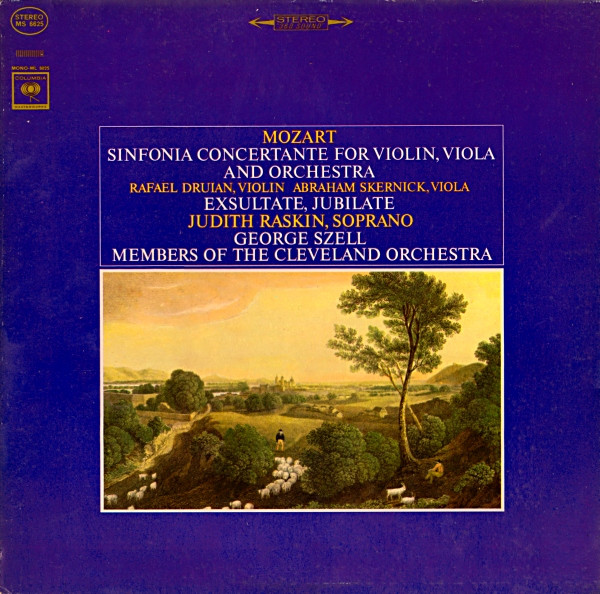
This luscious performance comes from an Exsultate, jubilate that originally occupied one side of a Szell Mozart LP that otherwise didn't have absolutely tight logic, in spite of which it became one of the readiest "go to" record in my collection.
Most of a lifetime later I can vouch that I adore both works, but I can't imagine that at the time I was looking for this particular coupling -- and I honestly don't remember which work I was shopping for. The Exsultate you now know something about; the Sinfonia Concertante -- featuring Cleveland concertmaster Rafael Druian and principal violist Abraham Skernick -- is still possibly my favorite recording of a piece I adore. I guess it worked out, because both sides of that LP got plenty of play. Nevertheless, it seems worth noting that since that original LP issue I don't believe the two performances have ever shared a disc. I have them both on CD, but on separate CDs. The Exsultate is still only semi-logically coupled, sharing a CD with the performance we're about to hear --

Sunday, November 3, 2024

As we've noted, there's more than one reason to care about Mahler's loopy little Wunderhorn song "Ablösung im Sommer," Part 1

FOR STARTERS, IS THIS THE SAME SONG?

MAHLER: Lieder aus der Jugendzeit (Songs from Youth):
"Ablösung im Sommer" ("Summer Replacement")

Cuckoo has fallen to his death
on a green willow tree.
Cuckoo is dead!
Fallen to his death.

Who then for us this whole summer
will while away the time?
Cuckoo! Cuckoo!
Hey! Lady Nightingale must do so!

She sits on a green branch:
the small, delicate Nightingale,
the dear, sweet Nightingale!
She sings and hops, is ever happy,
even when other birds are silent.

We'll wait for Lady Nightingale,
who lives in green hedgerows.
And if the cuckoo is at an end,
then she will start to warble.
-- original text "based on" Des Knaben Wunderhorn but
mostly by Mahler, translation (mostly) by William Mann
Listen on YouTube (audio only)
Or click here to go to Internet Archive, then press ► to play


Janet Baker, mezzo-soprano; Geoffrey Parsons, piano. Hyperion, recorded in Rosslyn Hill Unitarian Chapel, Hampstead, London, Feb. 24-25, 1983

Or click here to go to Internet Archive, then press ► to play


Diana Damrau, soprano; Stephan Matthias Lademann, piano. Telos Music, recorded in Telos Music Studios, Mechernich-Floisdorf, Germany, May or Sept. 2003

Click here to listen on Internet Archive, then press ► to play


Anny Felbermayer, soprano; Viktor Graf, piano. Vanugard, recorded in Vienna, 1952

Click here to listen on Internet Archive, then press ► to play


Judith Raskin, soprano; George Schick, piano. Epic-CBS-Sony, recorded in New York City, June 1965
A NOTE ON THIS WEEK'S MUSIC (AND SOME
CONSIDERATIONS GOING FORWARD)


Happily, Internet Archive seems back to something like normal functioning, meaning that it's once again possible to draw on Sunday Classics clips that reside there. However, this post, as you may recall, was originally conceived to depend on YouTube for music, and so a fair amount of today's music is so sourced, though it's all audio-only.

A number of today's performances already existed in the SC Archive (chez Internet Archive), and I've returned to embedding clips, hoping they'll play normally. But for these selections I've also included links to their Internet Archive pages. And I've included them in a particular form: with the "Webamp" player active. I've done this for another reason. While I.A. was grounded, the team was also working on a new version of its player, which is what 's used to play the clips that are embedded here. So that even after access to the archive was restored, for a while it was necessary, even if you were listening on-site, to switch to the Webamp option in order to hear anything.

At some point the new player must have been activated, but it appears that, understandably, it wasn't designed to work on old, no-longer-supported browser versions. So anyone who's dependent on such browsers isn't going to be hearing much music. If there are any SC readers in that situation, I'd love to know about it, because this means that all those years' worth of posts are going to be music-less for you. K can at least continue going forward to provide on-site links.

by Ken

In last week's post ("Not that it takes much, but I'm in an 'Urlicht' frame of mind -- and we're going to have some other Mahler Wunderhorn songs too," Oct. 28) we listened to a pair of Mahler's great song hits, "
Urlicht" and "Father Anthony's Fish Sermon," both settings of texts drawn from the folk-song anthology Des Knaben Wunderhorn" ("The Youth's Magic Horn") -- and a little wisp of a third, less consequential Wunderhorn song: the song we've just heard again in an almost confounding range of renderings, "Ablösung im Sommer." It's one of Mahler's early Wunderhorn settings, which he felt no need (or reason) to orchestrate himself, though we've already heard it with orchestra (and we have in store performances with orchestratations by several different hands).


IT'S A CHARMING, PERHAPS GOOFY
OR MAYBE EVEN WEIRD LITTLE SONG