Showing posts with label Tristan und Isolde. Show all posts

Sunday, March 6, 2022

Josephine Veasey (1930-2022) [part 1?]

TUESDAY UPDATE: The Dido and Aeneas clip was too important to be left sounding so crummy. I swallowed hard and did what had to be done to upgrade it. I feel better. -- K
FOLLOW-UP UPDATE: The promised synopsis of the Walküre Act II Fricka-Wotan scene, time-cued to our audio clip, is in place, for better or worse (or both). -- K again
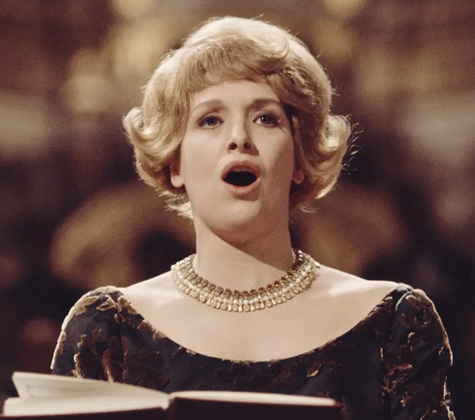

The fine London-born mezzo, retired since 1982, died Feb. 22 at 91.
Recit., Dido: Thy hand, Belinda. Darkness shades me;
on thy bosom let me rest.
More I would, but death invades me;
death is now a welcome guest.

Song: When I am laid in earth,
may my wrongs create
no trouble in thy breast.
When I am laid in earth, &c.
Remember me, remember me, but ah! forget my fate.
Remember me, but ah! forget my fate. &c.
-- libretto by Nahum Tate, based on Book IV of Virgil's Aeneid

["When I am laid in earth" at 1:04]
Josephine Veasey (ms), Dido; John Constable, harpsichord; Academy of St. Martin in the Fields, Colin Davis, cond. Philips-Pentatone, recorded in Walthamstow Assembly Hall, Aug. 5-8, 1970
[TUESDAY UPDATE: The new clip sounds swell, I think. Phew! -- Ed.]

by Ken

If you've listened to the clip of the not-quite-conclusion (the chorus still has some obligatory moaning to do) of Purcell's amazingly concise opera Dido and Aeneas, I'm thinking there's not much chance you'll forget Josephine Veasey. With that generous midrange vocal weight (and the needed upward reach too), not something we necessarily expect in a Purcell Dido, she makes those "Remember me"s pretty unforgettable.

The thing is, for anyone who had significant experience of her singing, there wasn't much chance she was going to be forgotten, thanks to the generous aural documentation of her fine 30-year career -- her significant body of commercial recordings supplemented by an array of good-quality live-performance material. She's never been out of my "listening rotation." As it happens, I'd just recently been resampling with undiminished pleasure her Béatrice in the first-ever recording of Berlioz's opera Béatrice et Bénédict. (Don't worry. Though we've heard the clip of Béatrice's heart-rending -- but ultimately inspiring -- Act II monologue before, we're going to be hearing it again momentarily.)


SOME COMMEMORATIVE ROADS NOT TAKEN

I hope the Dido excerpt isn't too "on the nose" for a "remembrance" piece, though I like to think she wouldn't mind being remembered for such classy piece of singing. Initially, as I thought about this piece, I expected it to open with a taste of her Fricka, specifically the Walküre Fricka. As longtime readers may recall, I'm a big fan of her Fricka, and we've heard samples of the very different Rheingold and Walküre roles, one of the unalloyed casting successes of the Karajan-DG Ring cycle. Again, don't worry, we're still going to hear that -- and not from the Karajan recording. In fact, we're going to hear a complete performance of the great Fricka-Wotan scene of Act II of Die Walküre, with the conductor most responsible for grooming her as a legit Wagnerian.

Alternatively, we could have opened with a different Wagner excerpt, if only for the sheer beauty of the singing, though with Veasey, at least in my hearing experience, "characterfulness" was never a separate thing from vocal production.
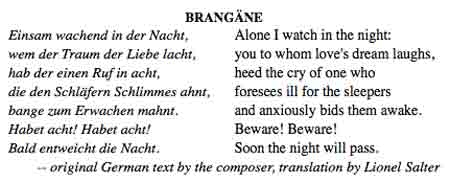

Josephine Veasey (ms), Brangäne; BBC Symphony Orchestra, Colin Davis, cond. Recorded for broadcast, 1969

Sunday, December 9, 2018

To return to Caballé for a moment (a moment of love-death) --


How softly and gently
he smiles,
how sweetly
his eyes open -
can you see, my friends,
do you not see it?
How he glows
ever brighter,
raising himself high
amidst the stars?
Do you not see it?
How his heart
swells with courage,
gushing full and majestic
in his breast?
How in tender bliss
sweet breath
gently wafts
from his lips -
Friends! Look!
Do you not feel and see it?
Do I alone hear
this melody
so wondrously
and gently
sounding from within him,
in bliss lamenting,
all-expressing,
gently reconciling,
piercing me,
soaring aloft,
its sweet echoes
resounding about me?
Are they gentle
aerial waves
ringing out clearly,
surging around me?
Are they billows
of blissful fragrance?
As they seethe
and roar about me,
shall I breathe,
shall I give ear?
Shall I drink of them,
plunge beneath them?
Breathe my life away
in sweet scents?
In the heaving swell,
in the resounding echoes,
in the universal stream
of the world-breath -
to drown,
to founder -
unconscious -
utmost rapture!

Montserrat Caballé (s), Isolde; Strasbourg Philharmonic Orchestra, Alain Lombard, cond. Erato, recorded September 1977

by Ken

We're in I-forget-how-many-levels of digression from our serial remembrance of Montserrat Caballé. As of last week's post ("Word is that 'Today we are not shocked by Salome.' Really?") we've been drawn in -- by way of Caballé's (in my experience) unique recording of Salome -- to what seems to me the inescapable shockfulness of the 40-year-old Richard Strauss's breakthrough opera, which even when we're done we're going to have to pursue, without a Caballé connection, into the equally inescapable shockfulness of the Strauss opera that followed it, Elektra.

So this week I thought we'd pause that and return for a moment to just-plain-Caballé, and a recording I'd been saving for the final installment of this series, whatever and whenever that happens. Which, actually, we've now just heard: that Erato studio recording of Isolde's "Liebestod," which for me shows beautifully what Caballé could do when the big, beautiful voice was really well controlled technically and interpretively. It is, I think, just a gorgeous performance, and gorgeous in the ways that were specifically hers.


SO, AS LONG AS WE'RE HERE --

I thought we might as well bring back Liebestod performances we've already heard (I'm now enmeshed in what turns out to be the monumental job of technically rehabilitating the 2000 post that was the source for a number of them) and adding a couple more. We've got an assortment here: a couple of the all-time great Isoldes (Flagstad heard in her shimmering prime, Nilsson in what's still my favorite Tristan recording of hers), some singers who sensibly never essayed the complete role plus some who didn't but you wish had.

WAGNER: Tristan und Isolde: Act III, Isolde, "Mild und leise wie er lächelt" (Liebestod)

Sunday, September 16, 2018

Promissory note for one of our still-to-come Operatic Bad Days

Along the way, we hear how Wagner made it
possible for folks everywhere to get married


MONDAY NIGHT UPDATE: Okay, I think we've got something more like a post. There's still work to be done, notably the addition of texts, but for now, whew!
TUESDAY NIGHT UPDATE: I wound up substantially rejiggering and in some aspects entirely reconstituting the Tristan and Meistersinger lineups, in addition to adding the promised texts for each, so progress is being made. I feel a keen need for fuller context-setting of the "days" dramatized in these excerpts, but fear that trying to plug the gap will lead to utterly exploding the post. Hmm. Still to come for sure: texts for Lohengrin [done!] and Tannhäuser.
WEDNESDAY AFTERNOON UPDATE: I've not only done the Tannhäuser texts but popped in as-brief-as-possible situation-setters for Tannhäuser, Tristan, and Meistersinger. At least for now, I think we're there, wherever "there" is, except for whatever cleanup of the wreckage I'm able to undertake.


by Ken

Last week we started talking about Operatic Bad Days ("On an operatic bad day you can sometimes see forever -- but oftentimes not"), looking first at the case of Sir John Falstaff (courtesy of Maestro Verdi), dragging himself out of the Thames to drown his sorrows at the Garter Inn. Sir John, I think we can agree, got what he deserved and deserved what he got, but not so much with the two OBD sufferers whose cases always crowd my mind. By way of setting the mood, while I struggle with what was supposed to be an "easy" post, here's a tease. [SUNDAY UPDATE: Now filled out a little more!]

WAGNER: Tannhäuser: Act III Prelude


Philharmonia Orchestra, Otto Klemperer, cond. EMI, recorded Oct.-Nov. 1961

Staatskapelle Berlin, Daniel Barenboim, cond. Teldec, recorded June 2001

London Philharmonic Orchestra, Sir Adrian Boult, cond. EMI, recorded Dec. 13-14. 1972

WAGNER: Tristan und Isolde: Act III Prelude


Symphony of the Air, Leopold Stokowski, cond. RCA, recorded 1960-61

Vienna State Opera Orchestra, Carlos Kleiber, cond. Recorded during a live performance of the opera, Oct. 7, 1973

Staatskapelle Berlin, Wilhelm Furtwängler, cond. From a live performance of most of Acts II and III, Oct. 3, 1947

WAGNER: Die Meistersinger von Nürnberg: Act III Prelude


London Philharmonic Orchestra, Sir Adrian Boult, cond. EMI, recorded January 1974

Bavarian Radio Symphony Orchestra, Rafael Kubelik, cond. From a broadcast performance of the complete opera, October 1967

Chicago Symphony Orchestra, Sir Georg Solti, cond. Decca, recorded during concert performances of the opera, Sept. 23-27, 1995

WAGNER: Parsifal: Act III Prelude


London Symphony Orchestra, Sir Adrian Boult, cond. EMI, recorded January 1973

Bayreuth Festival Orchestra, Hans Knappertsbusch, cond. Philips, recorded live at the 1962 festival

Welsh National Opera Orchestra, Reginald Goodall, cond. EMI, from a recording of the complete opera, June 1984

THEN AGAIN, IN CASE YOU THINK YOU'VE STARTED
TO SENSE A PATTERN HERE, THERE'S ALSO THIS


Sunday, June 24, 2012

Among our team of operatic avengers, which does Saint-Saëns's Dalila resemble most?


Shirley Verrett sings Dalila's Act II aria "Amour! Viens aider ma faiblesse" with Julius Rudel conducting in San Francisco, 1981. If the staging at the opening makes you wonder whether the stage director ever listened to the music (forget reading the libretto), we're on the same page.
Samson, seeking my presence again,
this evening is to come to this place.
Here is the hour of vengeance,
which must satisfy our gods.

Love! come aid my weakness!
Pour the poison in his breast!
Make it happen that, conquered by my artfulness,
Samson is in fetters tomorrow!
In vain would he wish to be able
to chase me out of his soul, to banish me.
Could he extinguish the flame
that memory feeds?
He is mine! my slave!
My brothers fear his wrath;
I, along among all, I defy him
and hold him at my knees!

Love! come aid my weakness!
Pour the poison in his breast!
Make it happen that, conquered by my artfulness,
Samson is in fetters tomorrow!
Against strength is useless,
and he, the strong among the strong,
he, who broke his people's chains,
will succumb to my efforts.

by Ken

Okay, here's where we are. Last week, in both the preview ("In which we hear a lady weighted by a heap of hurt") and the main post ("Meet Saint-Saëns's Dalila"), we heard the seductive side of Dalila -- and also the side, whatever you want to call it (I called it deep hurt) displayed in the great solo she sings when she's finally alone at the start of Act II. Then in Friday night's preview we heard her in "vengeance" mode, swearing along with the High Priest of Dagon, to bring Samson down -- and I also introduced several other operatic vengeance-seekers: Mozart's Queen of the Night, Beethoven's prison governor Don Pizarro, and the heroine of Wagner's Tristan und Isolde.

I certainly didn't mean to suggest any equivalence among our team of avengers. I wanted to lay the groundwork, because the text of Samson et Dalila doesn't give us much factual background to work with, for the best case I can make that Dalila's closest kin here is Isolde.

First we're going to hear from an actual monster, Don Pizarro in Fidelio, who has been forced into the decision to put an end to the suffering he has been inflicting on his old nemesis, Don Florestan, in a secret dungeon (where, you'll recall, we heard him languishing last month. Then, in the click-through, we'll hear from the Queen of the Night and Isolde, and finally we'll come back to Dalila.

(Note that I've juggled the lineup of recordings somewhat from the samples we heard in Friday night's preview. I wrote a bunch of long-winded explanations and exegeses, and then threw them out. We can talk about some of those issues some other time. Maybe. And note too that inclusion of a recording here doesn't necessarily constitute endorsement. There are some I'm not crazy about but have included for particular reasons.)

BEETHOVEN: Fidelio, Op. 72: Act I, Don Pizarro, "Ha! Welch ein Augenblick" ("Ha! What a moment!")
Ha! What a moment!
My vengeance I will cool;
your fate is calling you!
In its heart dwell,
oh live, good luck!
Already I was nearly in the dust,
by the loud scorn robbed,
there to be stretched.
Now it is up to me,
to commit the murder myself.
In his last hour,
the steel in his wound,
to cry in his ear:
Triumph! Victory is mine!
-- translation by Katharina Fink

Zoltán Kélémen (b), Don Pizarro; Chorus of the Deutsche Oper Berlin, Berlin Philharmonic, Herbert von Karajan, cond. EMI, recorded 1970

Ekkehard Wlaschiha (b), Don Pizarro; Dresden State Opera Chorus, Staatskapelle Dresden, Bernard Haitink, cond. Philips, recorded November 1989

Walter Berry (bs-b), Don Pizarro; Vienna State Opera Chorus and Orchestra, Leonard Bernstein, cond. Live performance, June 9 or 14, 1970

Hans Hotter (b), Chorus and Orchestra of the Royal Opera House, Covent Garden, Otto Klemperer, cond. Testament, recorded live, Feb. 24, 1961

AVENGERS STILL TO COME: WAGNER'S ISOLDE AND
MOZART'S QUEEN OF THE NIGHT. THEN BACK TO DALILA