Sunday, May 31, 2020
Can we talk? Or maybe for now mostly listen? (Coming up we've got Beethoven and Elgar, both worth hearing!)
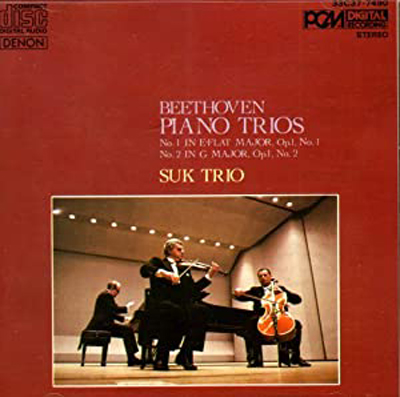
BEETHOVEN: Piano Trio No. 1 in E-flat, Op. 1, No. 1:
i. Allegro
Suk Trio (Josef Suk, violin; Josef Chuchro, cello; Josef Hála, piano). Denon-Supraphon, recorded in Prague, December 1983
by Ken
Sometimes the eerie solitude of this space has its advantages. It is, notably, a not-so-bad place to come to be alone. And after the exhaustive purposelessness of last week's remembrance of bass John Macurdy, I have a couple of quasi-self-therapeutic goals to attempt, starting with this presentation of the opening movements of the first two of the three piano trios that make up Beethoven's Op. 1. I spent what is for me a lot of money to acquire this CD, one of two I was missing from the series of "complete" Beethoven piano trios ("complete" in quotes because of the numerous questions that come into play when we try to define what constitutes "all" of Beethoven's works for piano trios) as recorded by the Suk Trio as constituted above in the early 1980s, the dawn of the digital era, as coproduced by the Japanese and Czechoslovak companies Denon and Supraphon.
For reasons I can't begin to understand, these CDs have been out of print for ages, and the prices of used copies of some of them have risen to weird levels. Over the years I have periodically gone to the shelf to: (a) figure out which CD or CDs exactly I was missing and (b) reconnoitre online to see what it would cost to complete my holdings. Each time I eventually figured out that I was missing the CDs that contain what we traditionally think of as "the first four" Beethoven piano trios: the three trios of Op. 1 and the Op. 11 Trio, written for clarinet rather than violin but playable either way. Some of you may recall that one of the many Sunday Classics threads currently suspended in mid-air is some consideration of this very trio, Op. 11, alongside Mozart's sublime Clarinet Quintet. This may have been the proximate cause of my most recent reinvestigation of the Suk Trio Beethoven lacunae.
THE DECISION I MADE . . .
Labels:
Beethoven,
Chilingirian Quartet,
Elgar,
Jan Panenka,
Josef Chuchro,
Josef Hala,
Josef Suk,
Nash Ensemble,
Op. 1 No. 3,
Op. 11,
Piano Quintet,
Piano Trio,
Schubert Ensemble of London,
Suk Trio
Sunday, May 24, 2020
John Macurdy (1929-2020): as Verdi's King of Egypt and Grand Inquisitor, Wagner's Fafner (x2), and Mozart's Commendatore
LATE, LATE THURSDAY UPDATE: Zounds, I think we've got the whole thing in place (though without an even minimally respectable proofreading, and I expected to have more things to say along the way, but I'm afraid this may have to be good enough).
WELL, ONE MORE THING (from the wee hours of Friday): Just when I thought we were done, it occurred to me that the order had to be switched, moving the Don Giovanni excerpts, until then sandwiched between the Verdis and the Wagners, to the end. By happy coincidence this put the five performances we're sampling to represent John Macurdy's career in chronological order. What really happened, though, is that once the Don Giovanni texts were finally in place, it suddenly became obvious that we had to finish with Don Giovanni.

OK, this isn't the king we want -- it's King Heinrich of Brabant (Lohengrin) rather than the King of Egypt (Aida) -- but a king's a king, right? And a sturdy all-purpose bass like the late John Macurdy is gonna sing a bunch of kings, not to mention priests, and of course papas -- and the odd inquisitor. Photo by Louis Mélançon/Metropolitan Opera
From the Triumphal Scene (Act II, Scene 2) of Verdi's Aida

John Macurdy (bs), King of Egypt; Carlo Bergonzi (t), Radamès; Metropolitan Opera Chorus and Orchestra, Georg Solti, cond. Broadcast performance, Dec. 7, 1963
In the prepost to this remembrance of John Macurdy, I said we'd be hearing this 38-year Met mainstay in three characteristic roles, but in the event it'll be four or possibly five: two Verdis (the King of Egypt and the Grand Inquisitor), one Mozart (the Commendatore), and either one or two Wagners, depending on how we count the Rheingold and Siegfried Fafners.
It's seems only right that we begin with the King of Egypt. I think it was the first role I heard him in, and I'm pretty sure the first I saw him in, not long after he joined the Met. For the decades following he and Paul Plishka, whose Met career overlapped his , were pleasant constants in my early decades of Met experience.
It's interesting, though, to go back and hear just how fine a sound Macurdy made back then as the King, both above and in this additional Aida clip.
The King prepares the Egyptians for war
WELL, ONE MORE THING (from the wee hours of Friday): Just when I thought we were done, it occurred to me that the order had to be switched, moving the Don Giovanni excerpts, until then sandwiched between the Verdis and the Wagners, to the end. By happy coincidence this put the five performances we're sampling to represent John Macurdy's career in chronological order. What really happened, though, is that once the Don Giovanni texts were finally in place, it suddenly became obvious that we had to finish with Don Giovanni.

OK, this isn't the king we want -- it's King Heinrich of Brabant (Lohengrin) rather than the King of Egypt (Aida) -- but a king's a king, right? And a sturdy all-purpose bass like the late John Macurdy is gonna sing a bunch of kings, not to mention priests, and of course papas -- and the odd inquisitor. Photo by Louis Mélançon/Metropolitan Opera
From the Triumphal Scene (Act II, Scene 2) of Verdi's Aida

John Macurdy (bs), King of Egypt; Carlo Bergonzi (t), Radamès; Metropolitan Opera Chorus and Orchestra, Georg Solti, cond. Broadcast performance, Dec. 7, 1963
[NOTE: Yeah, the Italian original of the King's first line should be italicized, but by the time I noticed this, fixing it would have required retyping the whole danged thing. -- Ed.]by Ken
In the prepost to this remembrance of John Macurdy, I said we'd be hearing this 38-year Met mainstay in three characteristic roles, but in the event it'll be four or possibly five: two Verdis (the King of Egypt and the Grand Inquisitor), one Mozart (the Commendatore), and either one or two Wagners, depending on how we count the Rheingold and Siegfried Fafners.
It's seems only right that we begin with the King of Egypt. I think it was the first role I heard him in, and I'm pretty sure the first I saw him in, not long after he joined the Met. For the decades following he and Paul Plishka, whose Met career overlapped his , were pleasant constants in my early decades of Met experience.
It's interesting, though, to go back and hear just how fine a sound Macurdy made back then as the King, both above and in this additional Aida clip.
The King prepares the Egyptians for war
Tuesday, May 19, 2020
John Macurdy (1929-2020)

In Act II of Götterdämmerung (in Seattle, 1984) John Macurdy as the sleeping Hagen is "visited" by his late, little-lamented father, Alberich (Julian Patrick). Photo by Chris Bennion
by Ken
Sorry, searching quickly I couldn't find John Macurdy as the giant Fafner in Wagner's Das Rheingold, but I think Hagen is a not-too-bad substitute. I'm working on a more proper remembrance of that fine, ever-dependable bass, who died May 7 at 91, having logged 1,001 performances (in 62 roles!) at the Met between 1962 and 2000. At the moment it's looking like we'll hear from both the Rheingold and Siegfried Fafners and two Met standbys: the Commendatore in Don Giovanni and the King of Egypt in Aida. (For the record, we did wind up hearing these roles, and another as well: the Grand Inquisitor in Don Carlos. With an unexpected last-minute twist in the order of presentation.)
For now, though, I couldn't resist sharing this wonderful rendering of one of those gorgeous little set pieces that stud the Ring cycle, in which Fafner tries to explain to his more sentimental, thick-headed brother Fasolt the tangible value, as far as the gods are concerned, of having their beloved goddess Freia in their midst.

John Macurdy (bs), Fafner; Metropolitan Opera Orchestra, Sixten Ehrling, cond. Broadcast performance, Feb. 15, 1975
WELL, MAYBE JUST ONE MORE TEASE:
Is this the most dramatic 40 seconds in all opera?
John Macurdy (b), Commendatore; Orchestra of the Théâtre National de l'Opéra de Paris, Lorin Maazel, cond. CBS-Sony, recorded June-July 1978
NOTE THAT TONIGHT'S MET FREE "NIGHTLY OPERA STREAM" --
is a January 1986 Lohengrin conducted by James Levine with Macurdy as King Heinrich (and Eva Marton as Elsa, Peter Hofmann as Lohengrin, Leonie Rysanek as Ortrud, and Leif Roar as Telramund).
#
Sunday, May 10, 2020
On pause from our Mahler matters, we play with yesterday's live-streamed-from-Berlin "Evening in Vienna"
Post-in-progress (now with Mon & Tues updates)
[See the opening paragraph as well as "Still to come" notes
and, now, updates from both Monday and Tuesday]

In this unusual socially distanced configuration, with the clarinetist's back to the string players, Mozart's Clarinet Quintet was performed yesterday in the live-streamed Berlin Phil Series program "An Evening in Vienna" by Wenzel Fuchs, clarinet; Daishin Kashimoto and Romano Tommasini, violins; Naoko Shimizu, viola; and Ludwig Quandt, cello.
NO, THIS ISN'T THE MOZART CLARINET QUINTET
BUT THE OTHER FEATURED WORK YESTERDAY:
i. Allegro con brio
ii. Adagio
iii. Theme with variations ("Pria ch'io l'impegno"): Allegretto
Of the three recordings sampled above, one is American, one British, and one Czech -- think you can tell which is which? (All will be revealed eventually.)
MONDAY UPDATE: Um, hold on a sec! Obviously the continuation of this proto-post has been taking way longer than anticipated (see note below), but while playing with the new audio clips, I was waylaid by one you really ought to hear, like now. (For sure, we'll be talking about it eventually.)
It's the finale, Allegretto con variazioni, of the Mozart Clarinet Quintet:
Nash Ensemble: Michael Collins, clarinet; Marcia Crayford and David Ogden, violins; Roger Chase, viola; Christopher van Kampen, cello. CRD, recorded July 1-2, 1986
by Ken
For today we're taking a break from Mahler (while I ruminate on how to proceed with Mahler 4 and the world of Mahler's Des Knaben Wunderhorn songs), in the form of a happy lookback at yesterday's live-streamed Berlin Phil Series program "An Evening in Vienna," featuring both of the orchestra's principal clarinetists, Wenzel Fuchs and Andreas Ottensamer, who happen both -- as I learned from the Digital Concert Hall's promotional note -- to be Austrian!
This "Evening in Vienna" was not, as the title led me to expect, a toe-tapping program of waltzes, polkas, and such by the Vienna Strausses and kindredly Viennese composing spirits, as you can tell from the above screen grab from the opening work: Mozart's sublime (a word I don't throw around casually) Clarinet Quintet. Which is one reason I decided to create this blog interlude -- I couldn't remember whether we've ever heard the Mozart Clarinet Quintet here at Sunday Classics. I couldn't remember a post that included it, but I've learned not to trust memory for, well, all sorts of things, but certainly not each and every blogpost past. As best I can tell, though, looking in the SC audio archive, we haven't. I guess I never found what seemed a fit peg on which to hang it.
This omission ends today. We've got a lot of music to cover today, including a more leisurely stroll through the Clarinet Quintet, but let's jump in and plug this particular hole right now.
MOZART: Clarinet Quintet in A Major, K. 581
i. Allegro (at 0:02)
ii. Larghetto (at 8:41)
iii. Menuetto (at 14:59)
iv. Allegretto con variazioni (at 21:12)
Peter Simenauer, clarinet; Pascal Quartet (Jacques Dumont and Maurice Crut, violins; Léon Pascal, viola; Robert Salles, cello). Musical Masterpiece Society, recorded c1953 (digital transfer by F. Reeder)
MONDAY UPDATE ABOUT THE CONTINUATION OF THIS
PROTO-POST'S TAKING WAY LONGER THAN ANTICIPATED
[See the opening paragraph as well as "Still to come" notes
and, now, updates from both Monday and Tuesday]

In this unusual socially distanced configuration, with the clarinetist's back to the string players, Mozart's Clarinet Quintet was performed yesterday in the live-streamed Berlin Phil Series program "An Evening in Vienna" by Wenzel Fuchs, clarinet; Daishin Kashimoto and Romano Tommasini, violins; Naoko Shimizu, viola; and Ludwig Quandt, cello.
NO, THIS ISN'T THE MOZART CLARINET QUINTET
BUT THE OTHER FEATURED WORK YESTERDAY:
i. Allegro con brio
ii. Adagio
iii. Theme with variations ("Pria ch'io l'impegno"): Allegretto
Of the three recordings sampled above, one is American, one British, and one Czech -- think you can tell which is which? (All will be revealed eventually.)
MONDAY UPDATE: Um, hold on a sec! Obviously the continuation of this proto-post has been taking way longer than anticipated (see note below), but while playing with the new audio clips, I was waylaid by one you really ought to hear, like now. (For sure, we'll be talking about it eventually.)
It's the finale, Allegretto con variazioni, of the Mozart Clarinet Quintet:
Nash Ensemble: Michael Collins, clarinet; Marcia Crayford and David Ogden, violins; Roger Chase, viola; Christopher van Kampen, cello. CRD, recorded July 1-2, 1986
by Ken
For today we're taking a break from Mahler (while I ruminate on how to proceed with Mahler 4 and the world of Mahler's Des Knaben Wunderhorn songs), in the form of a happy lookback at yesterday's live-streamed Berlin Phil Series program "An Evening in Vienna," featuring both of the orchestra's principal clarinetists, Wenzel Fuchs and Andreas Ottensamer, who happen both -- as I learned from the Digital Concert Hall's promotional note -- to be Austrian!
This "Evening in Vienna" was not, as the title led me to expect, a toe-tapping program of waltzes, polkas, and such by the Vienna Strausses and kindredly Viennese composing spirits, as you can tell from the above screen grab from the opening work: Mozart's sublime (a word I don't throw around casually) Clarinet Quintet. Which is one reason I decided to create this blog interlude -- I couldn't remember whether we've ever heard the Mozart Clarinet Quintet here at Sunday Classics. I couldn't remember a post that included it, but I've learned not to trust memory for, well, all sorts of things, but certainly not each and every blogpost past. As best I can tell, though, looking in the SC audio archive, we haven't. I guess I never found what seemed a fit peg on which to hang it.
This omission ends today. We've got a lot of music to cover today, including a more leisurely stroll through the Clarinet Quintet, but let's jump in and plug this particular hole right now.
MOZART: Clarinet Quintet in A Major, K. 581
i. Allegro (at 0:02)
ii. Larghetto (at 8:41)
iii. Menuetto (at 14:59)
iv. Allegretto con variazioni (at 21:12)
Peter Simenauer, clarinet; Pascal Quartet (Jacques Dumont and Maurice Crut, violins; Léon Pascal, viola; Robert Salles, cello). Musical Masterpiece Society, recorded c1953 (digital transfer by F. Reeder)
MONDAY UPDATE ABOUT THE CONTINUATION OF THIS
PROTO-POST'S TAKING WAY LONGER THAN ANTICIPATED
Tuesday, May 5, 2020
Part 2a: As we backtrack from Mahler 5 to the Wunderhorn era, the Berlin Phil reemerges playing Mahler 4 as chamber music
Finally we hear our "(Nearly) All-Berlin Phil Mahler 4"!

Heard here twice over we have the opening minute and three-quarters of Mahler 4, up to the entry of the 1st movement's 2nd theme.
by Ken
The first clip is literally (allowing for intermediate digitizing, mp3-ifying, and blog transmission and reception) how I made my first aural contact with Mahler 4, in the Columbia Masterworks recording by the New York Philharmonic under Leonard Bernstein made in February 1960; the second clip is how Lenny B heard the music 27 years later, as executed by Amsterdam's Concertgebouw Orchestra in a live recording made by DG for his final Mahler symphony cycle -- kind of similar, I guess, but in important ways quite different. In 1987 don't you get the distinct sense that the music is figuring out as it moves where and how it's going? That under the surface, so pungently and confidently presented in 1960, there are things going on that could lead to who-knows-what? Note how in 1987, as our clip unfolds in much more varied forward movement, just as the music has really gathered momentum, seemingly toward something, it suddenly stops dead -- to give way (as we'll hear later) to the movement's about-to-sound second theme.
SINCE PROMISING "ALL OF MAHLER 4" ON SUNDAY, I'VE
ATTEMPTED SEVERAL VERSIONS OF A FOLLOW-UP POST
And the thing is, "all of Mahler 4" has been ready to go since, well, Sunday. The "several versions of a follow-up post" haven't necessarily displeased me; they just haven't gotten me where we needed to get, in Sunday Classics's blogiferous "re-creation but with added musical context" of the Mahler program that formed Episode 2 of the four-episode virtual Easter Festival that the Berlin Philharmonic's Digital Concert Hall offered to inject some live-streamed music into the time space that was to have occupied the orchestra for its real-world annual Baden-Baden Easter Festival, an early casualty of the worldwide cancellation of live performances.
It's often forgotten that in those prehistoric days the Boston Symphony did travel to Brooklyn, something like five times a year, in tandem with its regular visits to Carnegie Hall. And for a 10th-grader who had moved to NYC just a year before, at the ripe old age of 12, while the Brooklyn Academy was an exotic destination, it didn't involve any stinking river crossing because Bkln is where he lived, and where -- at James Madison High School -- he discovered he could get a mimeographed (as he recalls) form that could be swapped at the not-yet-BAM box office, along with a dollar (yes, $1!), for an actual concert ticket!
BUT THIS IS A STORY FOR ANOTHER DAY; WE NEED TO GET
TO WHERE MAHLER 4 FITS INTO OUR PRESENT BLOGPATH
Heard here twice over we have the opening minute and three-quarters of Mahler 4, up to the entry of the 1st movement's 2nd theme.
by Ken
The first clip is literally (allowing for intermediate digitizing, mp3-ifying, and blog transmission and reception) how I made my first aural contact with Mahler 4, in the Columbia Masterworks recording by the New York Philharmonic under Leonard Bernstein made in February 1960; the second clip is how Lenny B heard the music 27 years later, as executed by Amsterdam's Concertgebouw Orchestra in a live recording made by DG for his final Mahler symphony cycle -- kind of similar, I guess, but in important ways quite different. In 1987 don't you get the distinct sense that the music is figuring out as it moves where and how it's going? That under the surface, so pungently and confidently presented in 1960, there are things going on that could lead to who-knows-what? Note how in 1987, as our clip unfolds in much more varied forward movement, just as the music has really gathered momentum, seemingly toward something, it suddenly stops dead -- to give way (as we'll hear later) to the movement's about-to-sound second theme.
SINCE PROMISING "ALL OF MAHLER 4" ON SUNDAY, I'VE
ATTEMPTED SEVERAL VERSIONS OF A FOLLOW-UP POST
And the thing is, "all of Mahler 4" has been ready to go since, well, Sunday. The "several versions of a follow-up post" haven't necessarily displeased me; they just haven't gotten me where we needed to get, in Sunday Classics's blogiferous "re-creation but with added musical context" of the Mahler program that formed Episode 2 of the four-episode virtual Easter Festival that the Berlin Philharmonic's Digital Concert Hall offered to inject some live-streamed music into the time space that was to have occupied the orchestra for its real-world annual Baden-Baden Easter Festival, an early casualty of the worldwide cancellation of live performances.
[See the April 12 Sunday Classics post "Hokey-smoke, it's like we're actually in Berlin (well, sort of) for Easter week" and its successors:In a moment we're going to hear a darned close approximation to how My Very First Mahler would have sounded, with one notable exception: that the recording was made in the Boston Symphony's acoustically legendary Symphony Hall while I heard it in the old, unimproved, but acoustically very friendly spaces of the Brooklyn Academy of Music, which I don't recall anyone ever calling "BAM" back before Harvey Lichtenstein took directorship and began working his famous miracles of restoration and repurposing, taking head-on the challenge that proper New Yorkers famously wouldn't schlepp over or under the East River to the unknown wilds of Brooklyn.
• the two-paragraph "Reminder: Episode 4 of the Berlin Philharmonic's Easter@Philharmonie Festival live-streams at 2pm EDT" (April 13);
• "Do we need a reason to remember Jan DeGaetani? No, but today we do need her to sing a special song" (April 20, not even posted on Sunday but in the wee hours of Monday);
• "We hear the kinship between the Adagietto of Mahler 5 and 'Ich bin der Welt abhanden gekommen,' right? How about the differences?" (April 26, early);
• "Spun off from today's main post: All of Mahler 5!" (April 26, later);
• and this past Sunday's "Part 1: As we backtrack from Mahler 5 to the Wunderhorn era, the Berlin Phil reemerges playing Mahler 4 as chamber music" (May 3).]
It's often forgotten that in those prehistoric days the Boston Symphony did travel to Brooklyn, something like five times a year, in tandem with its regular visits to Carnegie Hall. And for a 10th-grader who had moved to NYC just a year before, at the ripe old age of 12, while the Brooklyn Academy was an exotic destination, it didn't involve any stinking river crossing because Bkln is where he lived, and where -- at James Madison High School -- he discovered he could get a mimeographed (as he recalls) form that could be swapped at the not-yet-BAM box office, along with a dollar (yes, $1!), for an actual concert ticket!
MAHLER: Symphony No. 1: i. Langsam. Schleppend (Slow. Dragging)
So this would be just about how My Very First Mahler sounded, in the RCA Red Seal recording made by Erich Leinsdorf and the Boston Symphony on October 20-21, 1962.
BUT THIS IS A STORY FOR ANOTHER DAY; WE NEED TO GET
TO WHERE MAHLER 4 FITS INTO OUR PRESENT BLOGPATH
Sunday, May 3, 2020
Part 1: As we backtrack from Mahler 5 to the Wunderhorn era, the Berlin Phil reemerges playing Mahler 4 as chamber music
So we're going to hear a (nearly) all-Berlin Phil
Mahler 4 -- OK, maybe not today, but very soon
TUESDAY-INTO-WEDNESDAY UPDATE: Note that Part 2a is now posted.

The back-from-the-dead miniature-format version of their annual European Concert which members of the Berlin Philharmonic played Friday evening under the direction of chief conductor Kirill Petrenko, including a performance of a chamber version of the Mahler Fourth Symphony, which was broadcast live on TV and radio and then live-streamed free yesterday in the orchestra's Digital Concert Hall, will be -- as you can see -- "available soon" in the DCH archive.
Friday evening a concert was performed in Berlin's Philharmonie, home of the Berlin Philharmonic. This was a big deal because the building has been closed to the public since March 11.
The orchestra did squeeze in one more concert, on March 12 -- with the orchestra seated normally on the stage floor, but with no audience, former chief conductor Simon Rattle conducted Luciano Berio's Sinfonia and Bartók's Concerto for Orchestra, a concert that can be viewed in the orchestra's Digital Concert Hall.
Since then, before Friday, in-hall activities were limited to events cooked up for live-streaming via (and then archiving in) the orchestra's Digital Concert Hall:
• First, there was the four-event virtual Easter Festival("Hokey-smoke, it's like we're actually in Berlin (well, sort of) for Easter week"). Each episode had a theme (notably, Episodes 2 and 4 were devoted to a single composer, Mahler and Beethoven, respectively), around live activity from the near-empty Philharmonie -- narration by host Sarah Willis (of the Berlin horn section), conversations with musicians, and an assortment of small-format chamber performances -- framed and spaced out an assortment of orchestral performances chosen from the DCH archive
• Then, following the same model -- in-auditorium conversation and chamber performances -- has been applied to two ongoing series: a Berlin Phil Series, Saturdays at 7pm Berlin time (1pm ET, 10am PT), with programs built around themes to be championed by particular orchestra members. "Vive la France" featured Emmanuel Pahud, one of the two principal flutists; 1st principal violist Amihai Grosz; and harpist Marie-Pierre Langlamet; and the program was capped by an archival Abbado performance of Debussy's La Mer. "An American in Berlin" was built around violinist Noah Bendix-Balgley, the American among the three "1st concertmasters." Up next is "An Evening in Vienna" featuring the orchestra's two Austrian principal clarinetists, redheaded Wenzel Fuchs and Andreas Ottensamer. In addition, now there are to be programs of orchestra members' "Favorites," drawn from the DCH archive; so far I've been able to access this on my computer but not (so far) my TV -- I started watching the program of Noah Bendix-Balgey's faves, which I can tell you beings with a Tchaikovsky Pathétique Symphony with chief conductor Petrenko. I've looked at the online listing and see that it consists of a ginormous playlist -- yes! We're told that the "Favorites" events will be available free for the first week that they're posted.
FRIDAY'S CONCERT WAS IMPORTANT TO THE
ORCHESTRA -- AND MUSIC LOVERS EVERYWHERE
Mahler 4 -- OK, maybe not today, but very soon
TUESDAY-INTO-WEDNESDAY UPDATE: Note that Part 2a is now posted.

The back-from-the-dead miniature-format version of their annual European Concert which members of the Berlin Philharmonic played Friday evening under the direction of chief conductor Kirill Petrenko, including a performance of a chamber version of the Mahler Fourth Symphony, which was broadcast live on TV and radio and then live-streamed free yesterday in the orchestra's Digital Concert Hall, will be -- as you can see -- "available soon" in the DCH archive.
SOME MAHLER-BERLIN PHIL HISTORYby Ken
I'm probably forgetting something, but as best I recall, the first recording of a Mahler symphony by the Berlin Philharmonic was Sir John Barbirolli's utterly beautiful EMI Ninth in January 1964. (The only previous Berlin Phil Mahler recording I can think of is the Kindertotenlieder done by baritone Dietrich Fischer-Dieskau in June 1955 with Rudolf Kempe.) Since then, recordings of Mahler 9 have been made by Kirill Petrenko's three predecessors as chief conductor, Herbert von Karajan (1954-89), Claudio Abbado (1989-2002), and Simon Rattle (2002-2018), plus a mighty important guest conductor where Mahler is concerned, Leonard Bernstein (in his only appearance with the orchestra).
We're going to talk a little about the orchestra's history with Mahler in the continuation of this post. Meanwhile I thought it might be fun -- OK, it's my idea of fun -- to hear all these performances of the vast, always-amazing opening movement of Mahler 9.-- Ken
MAHLER: Symphony No. 9:
i. Andante comodo
Berlin Philharmonic, Sir John Barbirolli, cond. EMI, recorded January 1964
Berlin Philharmonic, Leonard Bernstein, cond. DG, recorded live in the Philharmonie, Oct. 4, 1979
Berlin Philharmonic, Herbert von Karajan, cond. DG, recorded in the Philharmonie, Nov. 1979-Sept. 1980
Berlin Philharmonic, Herbert von Karajan, cond. DG, recorded live in the Philharmonie during the Berlin Festival Weeks, Sept. 30, 1982
Berlin Philharmonic, Claudio Abbado, cond. DG, recorded live in the Philharmonie, Sept. 6-7, 1999
Berlin Philharmonic, Simon Rattle, cond. EMI, recorded live in the Philharmonie, Oct. 24-27, 2007
Friday evening a concert was performed in Berlin's Philharmonie, home of the Berlin Philharmonic. This was a big deal because the building has been closed to the public since March 11.
The orchestra did squeeze in one more concert, on March 12 -- with the orchestra seated normally on the stage floor, but with no audience, former chief conductor Simon Rattle conducted Luciano Berio's Sinfonia and Bartók's Concerto for Orchestra, a concert that can be viewed in the orchestra's Digital Concert Hall.
Since then, before Friday, in-hall activities were limited to events cooked up for live-streaming via (and then archiving in) the orchestra's Digital Concert Hall:
• First, there was the four-event virtual Easter Festival("Hokey-smoke, it's like we're actually in Berlin (well, sort of) for Easter week"). Each episode had a theme (notably, Episodes 2 and 4 were devoted to a single composer, Mahler and Beethoven, respectively), around live activity from the near-empty Philharmonie -- narration by host Sarah Willis (of the Berlin horn section), conversations with musicians, and an assortment of small-format chamber performances -- framed and spaced out an assortment of orchestral performances chosen from the DCH archive
• Then, following the same model -- in-auditorium conversation and chamber performances -- has been applied to two ongoing series: a Berlin Phil Series, Saturdays at 7pm Berlin time (1pm ET, 10am PT), with programs built around themes to be championed by particular orchestra members. "Vive la France" featured Emmanuel Pahud, one of the two principal flutists; 1st principal violist Amihai Grosz; and harpist Marie-Pierre Langlamet; and the program was capped by an archival Abbado performance of Debussy's La Mer. "An American in Berlin" was built around violinist Noah Bendix-Balgley, the American among the three "1st concertmasters." Up next is "An Evening in Vienna" featuring the orchestra's two Austrian principal clarinetists, redheaded Wenzel Fuchs and Andreas Ottensamer. In addition, now there are to be programs of orchestra members' "Favorites," drawn from the DCH archive; so far I've been able to access this on my computer but not (so far) my TV -- I started watching the program of Noah Bendix-Balgey's faves, which I can tell you beings with a Tchaikovsky Pathétique Symphony with chief conductor Petrenko. I've looked at the online listing and see that it consists of a ginormous playlist -- yes! We're told that the "Favorites" events will be available free for the first week that they're posted.
FRIDAY'S CONCERT WAS IMPORTANT TO THE
ORCHESTRA -- AND MUSIC LOVERS EVERYWHERE
Sunday, April 26, 2020
Spun off from today's main post: All of Mahler 5!
Today's main post, "We hear the kinship between the Adagietto of Mahler 5 and 'Ich bin der Welt abhanden gekommen,' right? How about the differences?," is here.

The legendary Adolf Herseth, the Chicago Symphony Orchestra's trumpet principal for an amazing 53 years (1948-2001, plus three more in "emeritus" status!), launches the opening "Funeral March" of Mahler 5 in recordings made near the beginning and end of Georg Solti's 22-year tenure as music director -- the first in Chicago's Medinah Temple in March 1970, the second a CSO-on-tour performance recorded live in Vienna's Sofiensaal Nov. 30, 1990 (where you'll note that Sir Georg, as he'd been since 1972, is much more attentive to Mahler's dynamic marking of p [soft] for the first two bars, with sudden sf attacks just on the downbeats).
"Those closest to Mahler found the Fifth Symphony a particularly speaking likeness of his personality, and he too may therefore have wanted to make it as accurate as possible a self-portrait of himself in a particularly happy period of his life."
by Ken
As I wrote in today's main post, "We hear the kinship between the Adagietto of Mahler 5 and 'Ich bin der Welt abhanden gekommen,' right? How about the differences?":
We're not going to attempt anything fancy here. The idea is just to be able to hear the whole of Mahler 5. As I noted in today's main post, as quoted above, the audio clips were all made and ready to roll: of two performances, a 2002 live one by Lorin Maazel and the Bavarian Radio Symphony Orchestra and the 1947 recording by Bruno Walter and the New York Philharmonic that features in today's earlier post. We're just going to hear them part by part, each part prefaced by some helpful guidance from critic William Mann (from the same booklet note on the symphony which is quoted from above).
WE'LL START WITH A QUICK OVERVIEW FROM W.M.
NOW LET'S HEAR THE SYMPHONY!

The legendary Adolf Herseth, the Chicago Symphony Orchestra's trumpet principal for an amazing 53 years (1948-2001, plus three more in "emeritus" status!), launches the opening "Funeral March" of Mahler 5 in recordings made near the beginning and end of Georg Solti's 22-year tenure as music director -- the first in Chicago's Medinah Temple in March 1970, the second a CSO-on-tour performance recorded live in Vienna's Sofiensaal Nov. 30, 1990 (where you'll note that Sir Georg, as he'd been since 1972, is much more attentive to Mahler's dynamic marking of p [soft] for the first two bars, with sudden sf attacks just on the downbeats).
"Those closest to Mahler found the Fifth Symphony a particularly speaking likeness of his personality, and he too may therefore have wanted to make it as accurate as possible a self-portrait of himself in a particularly happy period of his life."
-- William Mann, from a booklet note on Mahler 5 (©1969)
by Ken
As I wrote in today's main post, "We hear the kinship between the Adagietto of Mahler 5 and 'Ich bin der Welt abhanden gekommen,' right? How about the differences?":
DON'T TELL ANYONE, BUT REMEMBER HOW I SAIDNo, here it is, all spun off!
THAT WE REALLY NEED TO HEAR ALL OF MAHLER 5?
I've already made up audio clips for two complete performances.I may yet spin this off into a separate post, or postlet, with some added comment. But for now, here it is.
We're not going to attempt anything fancy here. The idea is just to be able to hear the whole of Mahler 5. As I noted in today's main post, as quoted above, the audio clips were all made and ready to roll: of two performances, a 2002 live one by Lorin Maazel and the Bavarian Radio Symphony Orchestra and the 1947 recording by Bruno Walter and the New York Philharmonic that features in today's earlier post. We're just going to hear them part by part, each part prefaced by some helpful guidance from critic William Mann (from the same booklet note on the symphony which is quoted from above).
WE'LL START WITH A QUICK OVERVIEW FROM W.M.
Mahler's division of the Fifth Symphony into three parts but five movements is not one of convenience alone: the first and second movements are materially connected, and the finale takes some of its subordinate themes from the Adagietto; the central Scherzo stands alone, longer than the rest, effectively carrying the main symphonic weight of the piece. This Scherzo is in D major, so is the Finale, and it would be right, I think, to feel the whole symphony as being in D major. Part I of the symphony begins in C-sharp minor and ends in A minor: its two movements form a sort of prologue to the rest of the symphony, in which Mahler postulates a series of pessimistic ideas and argues them symphonically until they seem to be conquered by the bright, clean light of D major which is glimpsed in the second movement and emerges with the scherzo. -- W.M.
NOW LET'S HEAR THE SYMPHONY!
We hear the kinship between the Adagietto of Mahler 5 and "Ich bin der Welt abhanden gekommen," right? How about the differences?
Including an unflinching glimpse into the rarely
visited innards of the Sunday Classics blogworks
REVISED CAUTIONARY NOTE: This post as, er, "finished" grew really long ("hellaciously long" is how I put it in an earlier cautionary note). Feel free to jump around, picking at anything that may catch your eye. You can always go back and fill in. Note that there's a surprise at the end.
[PRE-CAUTIONARY LOOKBACK: In case anyone happens to have seen earlier versions of this post and remembers the post-in-progress "cautionary" notes, or if anyone who hasn't seen them is curious, I've snipped them out of here and dumped them in -- purely for the record! -- at the end.]

When Christa Ludwig (born March 16, 1928, and so now 92) made her splendid first (piano-accompanied) recording of the haunting Mahler Rückert setting "Ich bin der Welt abhanden gekommen," in November 1957, with her voice still in its sunny prime, she was at 29 already a veteran, remarkably mature singer. When she made her final recording of the song, in January 1993 (again with piano), she was closing in on 65, but you may decide that this last version is her most beautiful -- because before we're done today we'll have heard five performances recorded over this 35-year period. (Do I have to underscore what a remarkable span this is for a singer? Not just to still be singing at 65 but to be singing with such poised beauty as well as artistic purpose.) Before we get back to Christa, however, we have other business to take care of, including hearing two other singers' differently special performances of what may be Mahler's best-known song.
"Pervaded by the familiar romantic mood of withdrawal from the hurly-burly of life into the quietude of the inner self, not untouched with sadness, the Adagietto has much in common with Mahler's great song 'Ich bin der Welt abhanden gekommen' ('I am lost to the world'), which ends with the words 'I am alone, in my own heaven, in my love, in my music.' "
MAHLER: Symphony No. 5:
iv. Adagietto. Sehr langsam (Very slow)
BBC Symphony Orchestra, Pierre Boulez, cond. Live performance, 1970
Vienna Philharmonic, Pierre Boulez, cond. DG, recorded March 1996
MAHLER: "Ich bin der Welt abhanden gekommen"
("I have lost track of the world")

Janet Baker, mezzo-soprano; New Philharmonia Orchestra, Sir John Barbirolli, cond. EMI, recorded May 4, 1967
José van Dam, bass-baritone; Orchestre National de Lille, Jean-Claude Casadesus, cond. Forlane, recorded April 1986
by Ken
Okay, folks, we have a game plan of sorts, and we're by golly gonna stick to it, sort of. Two weeks ago I was lost in wonder ("Hokey-smoke, it's like we're actually in Berlin (sort of) for Easter week") over the Berlin Philharmonic's four-event free live-streamed virtual Easter Festival, during the time when they were supposed to be in Baden-Baden for their annual actual Easter Festival. Each of the four episodes consisted of material -- interviews, conversations, and some chamber performances -- coming to us direct from the orchestra's audienceless Berlin home, the Philharmonie, surrounding performances by the Berlin Philharmonic itself of single movements or in some cases whole works drawn from the orchestra's extensive video archive in its Digital Concert Hall.
As it happened, the first of the four episodes I saw, and the only one I'd seen when I started writing that piece, was Episode 2, an all-Mahler extravaganza, so that's what I was most caught up in, and what I first thought we might sort of re-create here at Sunday Classics. (Note that all four episodes are now safely ensconced in the DCH, still free. In fact, as I noted, in recognition of the current world crisis the DCH is offering everyone a free 30-day subscription for its paid content. You have to register for the site, but registration has always been free, and has always entitled everyone access to some wonderful always-free content: some concerts, but most importantly a splendid collection of guest-performer interviews conducted by members of the orchestra. Be sure to check it out.)
A QUESTION: WHAT MADE ME FEEL SO "DANGLY"
HEARING THE FINALE OF MAHLER 5 ON ITS OWN?
visited innards of the Sunday Classics blogworks
REVISED CAUTIONARY NOTE: This post as, er, "finished" grew really long ("hellaciously long" is how I put it in an earlier cautionary note). Feel free to jump around, picking at anything that may catch your eye. You can always go back and fill in. Note that there's a surprise at the end.
[PRE-CAUTIONARY LOOKBACK: In case anyone happens to have seen earlier versions of this post and remembers the post-in-progress "cautionary" notes, or if anyone who hasn't seen them is curious, I've snipped them out of here and dumped them in -- purely for the record! -- at the end.]

When Christa Ludwig (born March 16, 1928, and so now 92) made her splendid first (piano-accompanied) recording of the haunting Mahler Rückert setting "Ich bin der Welt abhanden gekommen," in November 1957, with her voice still in its sunny prime, she was at 29 already a veteran, remarkably mature singer. When she made her final recording of the song, in January 1993 (again with piano), she was closing in on 65, but you may decide that this last version is her most beautiful -- because before we're done today we'll have heard five performances recorded over this 35-year period. (Do I have to underscore what a remarkable span this is for a singer? Not just to still be singing at 65 but to be singing with such poised beauty as well as artistic purpose.) Before we get back to Christa, however, we have other business to take care of, including hearing two other singers' differently special performances of what may be Mahler's best-known song.
"Pervaded by the familiar romantic mood of withdrawal from the hurly-burly of life into the quietude of the inner self, not untouched with sadness, the Adagietto has much in common with Mahler's great song 'Ich bin der Welt abhanden gekommen' ('I am lost to the world'), which ends with the words 'I am alone, in my own heaven, in my love, in my music.' "
-- Deryck Cooke, from a CD booklet note on the Mahler Fifth Symphony
MAHLER: Symphony No. 5:
iv. Adagietto. Sehr langsam (Very slow)
BBC Symphony Orchestra, Pierre Boulez, cond. Live performance, 1970
Vienna Philharmonic, Pierre Boulez, cond. DG, recorded March 1996
MAHLER: "Ich bin der Welt abhanden gekommen"
("I have lost track of the world")

Janet Baker, mezzo-soprano; New Philharmonia Orchestra, Sir John Barbirolli, cond. EMI, recorded May 4, 1967
José van Dam, bass-baritone; Orchestre National de Lille, Jean-Claude Casadesus, cond. Forlane, recorded April 1986
by Ken
Okay, folks, we have a game plan of sorts, and we're by golly gonna stick to it, sort of. Two weeks ago I was lost in wonder ("Hokey-smoke, it's like we're actually in Berlin (sort of) for Easter week") over the Berlin Philharmonic's four-event free live-streamed virtual Easter Festival, during the time when they were supposed to be in Baden-Baden for their annual actual Easter Festival. Each of the four episodes consisted of material -- interviews, conversations, and some chamber performances -- coming to us direct from the orchestra's audienceless Berlin home, the Philharmonie, surrounding performances by the Berlin Philharmonic itself of single movements or in some cases whole works drawn from the orchestra's extensive video archive in its Digital Concert Hall.
As it happened, the first of the four episodes I saw, and the only one I'd seen when I started writing that piece, was Episode 2, an all-Mahler extravaganza, so that's what I was most caught up in, and what I first thought we might sort of re-create here at Sunday Classics. (Note that all four episodes are now safely ensconced in the DCH, still free. In fact, as I noted, in recognition of the current world crisis the DCH is offering everyone a free 30-day subscription for its paid content. You have to register for the site, but registration has always been free, and has always entitled everyone access to some wonderful always-free content: some concerts, but most importantly a splendid collection of guest-performer interviews conducted by members of the orchestra. Be sure to check it out.)
A QUESTION: WHAT MADE ME FEEL SO "DANGLY"
HEARING THE FINALE OF MAHLER 5 ON ITS OWN?
Monday, April 20, 2020
Do we need a reason to remember Jan DeGaetani? No, but today we do need her to sing a special song
Jan DeGaetani (1933-1989)
-- from the Center for American Music Library Web page "Stephen Foster Lyrics"
With Gilbert Kalish, piano. From the Nonesuch CD Songs of America, recorded Dec. 21-23, 1987

by Ken
No, this isn't the song we "need to hear Jan sing." No. It's just the song I usually think of first when I think of her. (No, to be clear, I didn't know her. I just call her "Jan" because, well, I think she might feel less formal, more comfortable that way.) I promised, in one of several earlier attempts at writing some sort of post, that we were going to hear this "uniquely cherishable" singer in "a perfect recording," and explained later that I couldn't say exactly what I meant by "a perfect recording" -- but that if you listen to this breathtakingly beautiful performance of a song that Jan caused me to think of as astonishingly beautiful, as recorded with longtime friend and colleague (and, oh yes, excellent pianist) Gil Kalish, I invite you to tell me that this isn't a perfect recording.
"Beautiful Child of Song" comes from this CD recital, and pretty much all of these Songs of America are a heap more sophisticated than our little Stephen Foster ditty. But my goodness . . . well, you heard, right?
SO WHAT'S THE SONG WE NEED TO HEAR JAN SING?
Monday, April 13, 2020
Reminder: Episode 4 of the Berlin Philharmonic's Easter@Philharmonie Festival live-streams at 2pm EDT

by Ken
Just remember that to enjoy free content from the Digital Concert Hall, you do have to be registered. So if you 're not registered, be sure to allow some time for that! And remember that at present the DCH website will greet you with the offer of a free 30 days' worth of subscription for the huge repository of concerts available only to subscribers!
One by one the four episodes of the virtual Easter Festival, with host Sarah Willis and all our other new old friends from the orchestra, are making their way into the DCH, all free. And I can't stress enough how interesting I find the enormous reservoir of interviews -- always free -- with musicians appearing with the orchestra, really conversations with the orchestra members conducting them (often making reference to things they observed during rehearsals). I've been known to watch five or six at a time. And for us English-speakers, everything either is in English or is subtitled.
#
Sunday, April 12, 2020
Hokey-smoke, it's like we're actually in Berlin (well, sort of) for Easter week
[Cross-posted from DownWithTyranny, though somewhat revised and expanded here -- well, considerably expanded. See the NOTE ON THE CROSS-POSTING quite a ways down.]

We see the interior of the Great Hall of Berlin's Philharmonie, the (shall we say) unusual building built in 1960-63 -- under the watchful eye of then-chief conductor Herbert von Karajan -- to house one of the world's elite orchestras, the Berlin Philharmonic. Imagine it even emptier, with nothing on the stage floor and dimly lit, since at present the orchestra, like so many performers of all descriptions around the world, is unable to perform before live audiences.

Now imagine, in the empty, sparsely lit Philharmonie, Stefan Dohr (the Berlin Phil's principal horn since 1993, in which year he turned 28!), alone on the stage floor in casual dress (jeans, as I recall), playing this:

(Yes, that's Stefan playing. At least I'm pretty sure -- see the box below.)
by Ken
So here I was a few days ago going on and on about the treasure trove of riches providentially available to us online in our time of crisis [Editorial reminder: This part is the original version as it appeared on DWT; the link is to an earlier DWT post, "Can You Imagine What This Crisis Would Be Like If We -- Or At Least Lots Of Us -- Didn't Have Access To Today's Onilne Resources?" -- Ed.], and now I'm spending half my time sharing a week's worth of Easter with the Berlin Philharmonic, absolutely free.
It's a moment I won't soon forget, watching Stefan Dohr standing alone on the darkish Philharmonie stage floor, talking to a live-stream camera about the music of Gustav Mahler and the "festival of horns" he bequeathed to the world's horn players in his symphonies, then playing the haunting horn call that opens the first of the two "Nachtmusik" ("Night Music") movements, the 2nd and 4th movements overall, of Mahler's five-movement Seventh Symphony. After Stefan told us that one thing he misses when he practices some of Mahler's great horn solos at home is the echo the composer liked to provide, usually played by the 3rd horn, he raised his instrument and started sounding this gorgeous horn call -- and lo! there were answering echoes! The camera showed us that they were coming from a farther-up reach of the empty Philharmonie, where Stefan's Berlin Phil colleague Stefan de Leval Jezierski could be seen manning his horn. Wow!!!

We see the interior of the Great Hall of Berlin's Philharmonie, the (shall we say) unusual building built in 1960-63 -- under the watchful eye of then-chief conductor Herbert von Karajan -- to house one of the world's elite orchestras, the Berlin Philharmonic. Imagine it even emptier, with nothing on the stage floor and dimly lit, since at present the orchestra, like so many performers of all descriptions around the world, is unable to perform before live audiences.

Now imagine, in the empty, sparsely lit Philharmonie, Stefan Dohr (the Berlin Phil's principal horn since 1993, in which year he turned 28!), alone on the stage floor in casual dress (jeans, as I recall), playing this:

(Yes, that's Stefan playing. At least I'm pretty sure -- see the box below.)
by Ken
So here I was a few days ago going on and on about the treasure trove of riches providentially available to us online in our time of crisis [Editorial reminder: This part is the original version as it appeared on DWT; the link is to an earlier DWT post, "Can You Imagine What This Crisis Would Be Like If We -- Or At Least Lots Of Us -- Didn't Have Access To Today's Onilne Resources?" -- Ed.], and now I'm spending half my time sharing a week's worth of Easter with the Berlin Philharmonic, absolutely free.
![]() |
| The other Stefan, de Laval Jezierski |
IN THE AUDIO CLIP WE JUST HEARD,
DID STEFAN ALSO MISS THE ECHOES?
Monday, April 6, 2020
We need music! Now, I was thinking about Mahler's "Die zwei blauen Augen," the last of the four Wayfarer Songs --
Plus: We have a special musical bonus at the end!
Want a hint? I'll go you one better: Here's an audio tease --
Now could we have a post (of some sort?)
Irmgard Seefried sings Richard Strauss's "Morgen!," Op. 27, No. 4, in the composer's own orchestration, with Piero Bellugi conducting the Orchestre National de l'ORTF in Paris's Salle Pleyel, Jan. 20, 1965. Note -- as the camera does! -- the soloist playing the violin solos around which Strauss built his orchestration of the song. Isn't it interesting that in January 1965 the Orchestre National, at least for this concert, had a female concertmaster?
by Ken
This is a time, it seems to me, when we need more music. So that's pretty much what we're going to do today.
AS FOR TODAY, WE NEED MUSIC NOW, DON'T WE?
Like it says up top, during the week I found myself thinking about, and hearing in my head, "Die zwei blauen Augen, the last of Mahler's four Songs of a Wayfarer, a song to which we once devoted a good deal of attention, icluding most of a post of its own (see below). I vaguely recalled that I had the Wayfarer Songs on a DVD of some sort, and finally tracked it down to an extremely miscellaneous one that EMI issued in its "Classic Archive" series, which they couldn't find a better way of titling than:
Which is (let the record show) absolutely accurate. We get soprano Elisabeth Schwarzkopf in an October 1961 staged-for-TV excerpt from her most famous role, the Marschallin in Der Rosenkavalier, giving us the final chunk of Act I, starting in the middle of the Marschallin's great monologue, at "Kann ich auch an ein Mädel erinnern"her sudden, haunting recollection of her innocent younger self, "fresh from the convent," with mezzo Hertha Töpper (who died just a week ago Saturday, a few weeks short of her 96th birthday); then soprano Irmgard Seefried is seen in two orchestral song groups via French TV: five by Richard Strauss from January 1965, including the "Morgen!" performance atop this post, and three by Mahler; and Dietrich Fischer Dieskau singing -- yes! -- Mahler's Wayfarer Songs from Japan's NHK, October 1960, with an outstanding Mahlerian, Paul Kletzki conducting. (There's also a Fischer-Dieskau "bonus": four core-repertory Schubert songs from 1959, with the great Gerald Moore at the piano.)
I WOUND UP WATCHING EVERYTHING ON THE DVD
Want a hint? I'll go you one better: Here's an audio tease --
Now could we have a post (of some sort?)
Irmgard Seefried sings Richard Strauss's "Morgen!," Op. 27, No. 4, in the composer's own orchestration, with Piero Bellugi conducting the Orchestre National de l'ORTF in Paris's Salle Pleyel, Jan. 20, 1965. Note -- as the camera does! -- the soloist playing the violin solos around which Strauss built his orchestration of the song. Isn't it interesting that in January 1965 the Orchestre National, at least for this concert, had a female concertmaster?
by Ken
This is a time, it seems to me, when we need more music. So that's pretty much what we're going to do today.
WHERE WE ARE NOW, BLOG-WISE?
Yes, I know we've got a growing tangle of loose threads, and I hope gradually to work our way through them. I'm even adding a couple of more. Last week's two-item "Rita Gorr sings Gluck" mini-compendium led me to want to listen to her performances of those two arias (Orfeo's "Che farò senza Euridice?" and Alceste's "Divinités du Styx") in context with other singers', to get a better sense of why Gorr's mean so much to me. As I've played with this, the project has become more and more intriguing, as to what makes these arias work and not work, so I still want to pursue this.
What's more, the SC vault has a good helping of Gorr as Saint-Saëns's Dalila, and a couple of snatches of her Walküre Fricka, which I want to bring out. And considering that I made particular reference to these roles along with Verdi's Amneris, I'd like to add some samples of that to what shapes up as yet another post.
AS FOR TODAY, WE NEED MUSIC NOW, DON'T WE?
Like it says up top, during the week I found myself thinking about, and hearing in my head, "Die zwei blauen Augen, the last of Mahler's four Songs of a Wayfarer, a song to which we once devoted a good deal of attention, icluding most of a post of its own (see below). I vaguely recalled that I had the Wayfarer Songs on a DVD of some sort, and finally tracked it down to an extremely miscellaneous one that EMI issued in its "Classic Archive" series, which they couldn't find a better way of titling than:
Schwarzkopf Seefried
Fischer-Dieskau
Fischer-Dieskau
Which is (let the record show) absolutely accurate. We get soprano Elisabeth Schwarzkopf in an October 1961 staged-for-TV excerpt from her most famous role, the Marschallin in Der Rosenkavalier, giving us the final chunk of Act I, starting in the middle of the Marschallin's great monologue, at "Kann ich auch an ein Mädel erinnern"her sudden, haunting recollection of her innocent younger self, "fresh from the convent," with mezzo Hertha Töpper (who died just a week ago Saturday, a few weeks short of her 96th birthday); then soprano Irmgard Seefried is seen in two orchestral song groups via French TV: five by Richard Strauss from January 1965, including the "Morgen!" performance atop this post, and three by Mahler; and Dietrich Fischer Dieskau singing -- yes! -- Mahler's Wayfarer Songs from Japan's NHK, October 1960, with an outstanding Mahlerian, Paul Kletzki conducting. (There's also a Fischer-Dieskau "bonus": four core-repertory Schubert songs from 1959, with the great Gerald Moore at the piano.)
I WOUND UP WATCHING EVERYTHING ON THE DVD
Subscribe to:
Posts (Atom)


