Showing posts with label Chilingirian Quartet. Show all posts

Monday, June 30, 2025

Hear three themes get made over!
(A sneaky way to sneak a peek into an imagination like none other?)

You'll probably know the composer(s?) who created our themes -- and why I've made a group out of these themes

[Partial revise, 7/28/2025: Timings for all of the audio clips, now stripped out of Internet Archive's clip-embedding format, have been added -- and some other problems have been addressed, in an all-too-micro way. -- Ed.]

[1:58] Norwegian Chamber Orchestra players (Per Kristian Skalstad, violin; Hanne Skjelbred, viola; Ole Eirik Ree, cello; Kenneth Ryland, double bass; Ole Christian Haagenrud, piano) deliver the second of our themes -- from an NCO chamber series called "Feel Good" ("a weekly dose of music that will lift and comfort your spirits"). [Watch on YouTube.]

THE THREE THEMES

[1] A familiar-to-us "Introduction" and "Theme" for flute and piano
(As we've heard, this stand-alone work gets a gorgeous "Introduction")
[4:56; Theme at 3;15] Alexander Korneyev, flute; Emil Gilels, piano. Melodiya, recorded in Moscow, 1958
[4:38; Theme at 3:01] Jean-Pierre Rampal, flute; Robert Veyron-Lacroix, piano. EMI, published 1959
[4:43; Theme at 2:46] Emmanuel Pahud, flute; Eric Le Sage, piano. Valois, recorded in the Salle de Châtonneyre (Switzerland), February 1994

[2] A theme for piano (+violin/viola/cello/double bass) quintet
(I've cheated and tacked on a variation, so we get to hear the piano! -- Ed.)
[1:58] Berlin Philharmonic soloists (Guy Braunstein, violin; Amihai Grosz, viola; Olaf Maninger, cello; Janne Saksala, double bass); Yuja Wang, piano. Live performance, Salle Pleyel, Paris, Mar. 20, 2011 [from the Yuja Wang Archives]
[2:05] Smetana Quartet members (Jiří Novák, violin; Milan Škampa, viola; Antonin Kohout, cello); František Pošta, double bass; Josef Hála, piano. Supra­phon-Denon, recorded in the House of Artists, Prague, Oct. 11-14, 1983
[2:18] Alexander Schneider, violin; Michael Tree, viola; David Soyer, cello; Julius Levine, double bass; Peter Serkin (age 18), piano. Vanguard, recorded in New York City, 1965
[UPDATE: From quickest performance to slowest, the timings broaden by only 7 and 13 seconds -- but hear what a difference those seconds make!]

Finally: [3] A haunting theme for string quartet --
[2:17] Tokyo String Quartet (Peter Oundjian and Kikue Ikoda, violins; Kazuhide Isomura, viola; Sadao Harada, cello). RCA, recorded in Richardson Hall, Princeton University, Princeton, NJ, Sept. 19-22, 1989
[2:27] Brandis Quartet (Thomas Brandis and Peter Brem, violins; Wilfried Strehle, viola; Wolfgang Boettcher, cello). Nimbus, recorded in the Concert Hall of the Nimbus Foundation, Wyastone Leys, Monmouth, Wales, Mar. 2-3, 1994
[2:58] Kodály Quartet (Attila Falvay and Tamás Szabo, violins; Gábor Fias, viola; János Devich, cello). Naxos, recorded in the Unitarian Church, Budapest, Oct. 8-11, 1991
The Tokyo and Brandis are our speed merchants here, but these are such solid and sonorous players that the music doesn't sound rushed, or at least not too rushed. But enter the wider-open, vibrant-toned, and yet lurkingly dangerous world of the Kodály, and now we've really got something! (Longtime readers know how easily seduced I am by the singing tones of a good Hungarian or Czech string ensemble.) We even get the sense of foreboding built into the music. I like this performance a lot. -- Ed.
by Ken

Anyone who happens to have kept tabs on these theoretically weekly posts knows that we're simultaneously immersed in an almost uncountable number of musical inquiries. Today I propose to begin cleaning up an unforgivable breach of Sunday Classics conduct. It dates back [link tk] to when I was taking note of the very musical transformations we're listening to "up-closer." But back then, I merely mentioned that we'd heard them all before and left it at that -- without providing so much as a link!

This isn't how we normally do business in this department. Wherever possible, I try to take advantage of our basic format opportunity: to actually hear stuff that comes up for discussion, or even just mention, not just yammering.


WHAT WE HEARD ARE ALREADY TRANSFORMATIONS --
NOW LET'S GO BACK TO THEIR "SOURCE" FORMS


The nature of those "sources" -- three songs -- is obviously how these themes have come to form a group. And as we hear them, we're also going to hear the final transformations that were wrought on them. I'm going to try to keep the chatter to a minimum, so it'll be (I hope) mostly listening and hearing.

THE THREE SONGS -- TAKING SOME NOTE NOW
OF THE TRANSFORMATION(S) THEY WOULD UNDERGO


Sunday, June 7, 2020

At the very least, we can listen to this vaguely weird and utterly beguiling little Dvořák piece


Recent Berlin Phil Series live-streamed events have had a profusion of chamber music. This week the strings-and-winds Berlin Philharmonic Octet played the great Schubert Octet and two shorter works, including the world premiere of Toshio Hosokawa's Textures, which was to have been played 10 times during a tour to Japan and Taiwan. And chamber music figured prominently in last week's Tribute to Daniel Stabrawa.


The caption text in this screen grab is a translation of voiceover commentary from Daniel S. himself, part of one of the "tribute" sections of the May 30 Digital Concert Hall event.

by Ken

Stipulating that you already love Dvořák's strange and surprising and also singularly luscious Terzetto in C for two violins and viola (after all, aren't Dvořák's surprises, especially the stranger ones, usually singularly luscious?), and you know that longtime Berlin Philharmonic first concertmaster Daniel Stabrawa is going to be playing it with two colleagues from the orchestra, violinist Krzysztof Polonek and violist Ignacy Miecznikowski. Would you think maybe that "something's up"?

Since heaving up a preliminary version of this post earlier this afternoon, after I'd started rewatching last the May 30 Berlin Phil Series tribute to Daniel Stabrawa (now that it's available in the Digital Concert Hall), I've started re-rewatching, this time loading it on my computer so I could make some screen grabs, including those above. I've rewatched Daniel playing the Panufnik Concerto for Violin and Strings (which now seems to me quite a lovely piece; I'll be rewatching again) and especially I've rewatched the performance of the Dvořák Terzetto, which is absolute gold.

To return to the lineup for the Dvořák trio, you were probably smarter, not to mention more suspicious, than I am, even without my prompting. Let's take this a step farther and look at Krzysztof's and Ignacy's official Berlin Phil webpix.


SO, WHAT DO YOU NOTICE?

Sunday, May 31, 2020

Can we talk? Or maybe for now mostly listen? (Coming up we've got Beethoven and Elgar, both worth hearing!)


BEETHOVEN: Piano Trio No. 1 in E-flat, Op. 1, No. 1:
i. Allegro

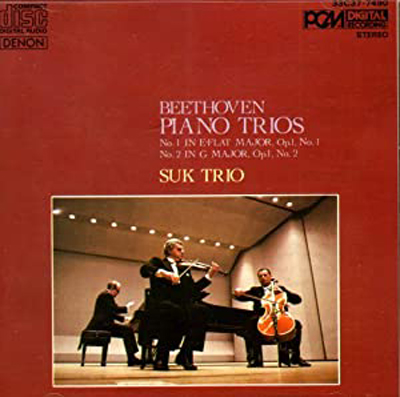
Suk Trio (Josef Suk, violin; Josef Chuchro, cello; Josef Hála, piano). Denon-Supraphon, recorded in Prague, December 1983

by Ken

Sometimes the eerie solitude of this space has its advantages. It is, notably, a not-so-bad place to come to be alone. And after the exhaustive purposelessness of last week's remembrance of bass John Macurdy, I have a couple of quasi-self-therapeutic goals to attempt, starting with this presentation of the opening movements of the first two of the three piano trios that make up Beethoven's Op. 1. I spent what is for me a lot of money to acquire this CD, one of two I was missing from the series of "complete" Beethoven piano trios ("complete" in quotes because of the numerous questions that come into play when we try to define what constitutes "all" of Beethoven's works for piano trios) as recorded by the Suk Trio as constituted above in the early 1980s, the dawn of the digital era, as coproduced by the Japanese and Czechoslovak companies Denon and Supraphon.

For reasons I can't begin to understand, these CDs have been out of print for ages, and the prices of used copies of some of them have risen to weird levels. Over the years I have periodically gone to the shelf to: (a) figure out which CD or CDs exactly I was missing and (b) reconnoitre online to see what it would cost to complete my holdings. Each time I eventually figured out that I was missing the CDs that contain what we traditionally think of as "the first four" Beethoven piano trios: the three trios of Op. 1 and the Op. 11 Trio, written for clarinet rather than violin but playable either way. Some of you may recall that one of the many Sunday Classics threads currently suspended in mid-air is some consideration of this very trio, Op. 11, alongside Mozart's sublime Clarinet Quintet. This may have been the proximate cause of my most recent reinvestigation of the Suk Trio Beethoven lacunae.

THE DECISION I MADE . . .